
Build a Recomposition Plan With a Total Body Scan
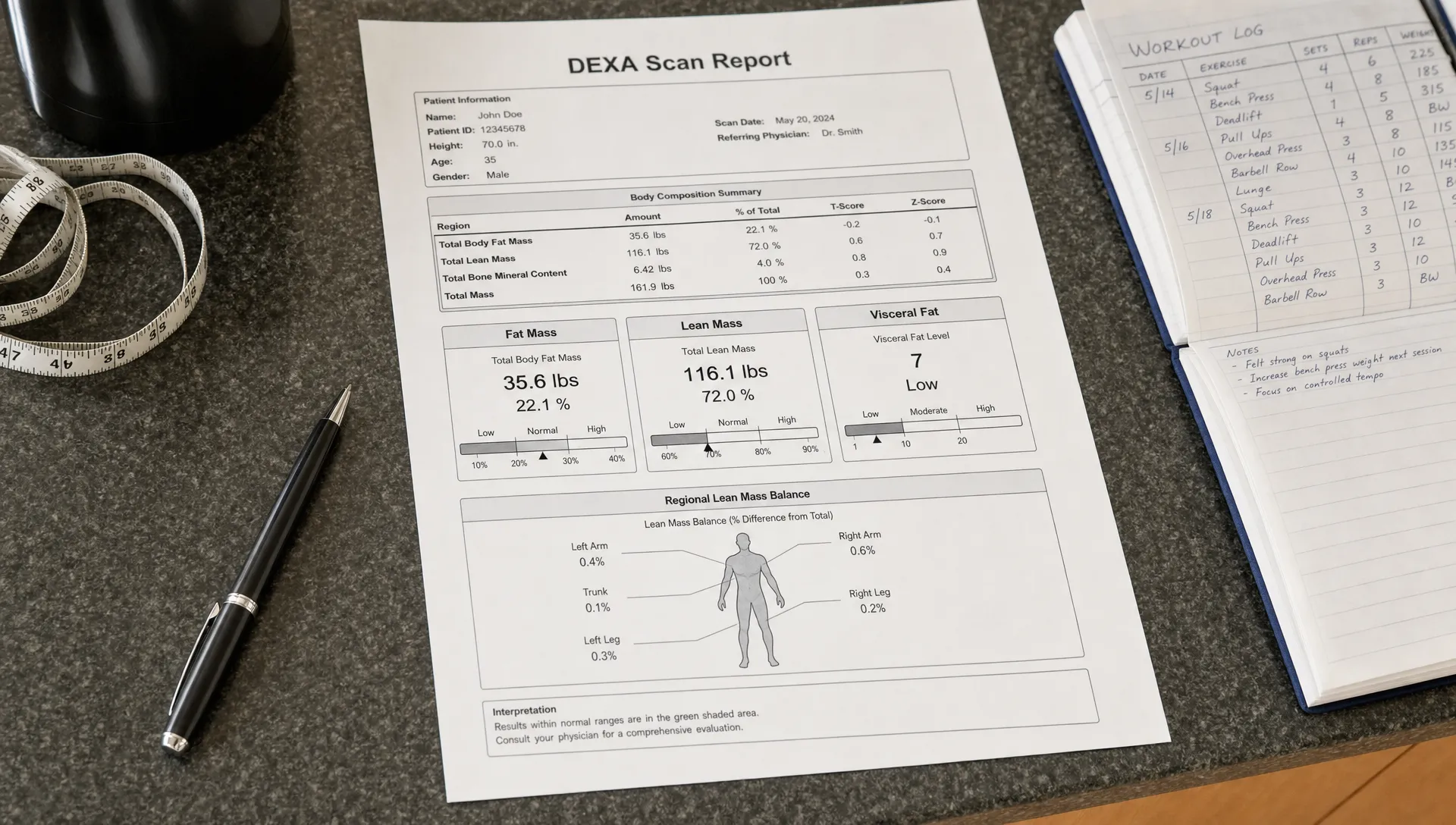
Recomposition is the goal most people actually mean when they say they want to get in shape: lose fat, keep or gain muscle and look or perform better without chasing scale weight alone. A total body composition scan gives you a baseline for that plan by separating fat mass, lean mass, visceral fat, bone density and regional differences, so your next nutrition and training decisions are based on measurement rather than guesswork.
A bathroom scale can tell you whether body weight changed. It cannot tell you whether that change came from fat, muscle, water or normal daily fluctuation. That is why recomposition can feel confusing. You might train hard for eight weeks, weigh nearly the same and assume nothing worked, even though you gained lean mass and lost fat at the same time.
DEXA data makes the plan more specific. Instead of setting a vague goal like “lose 10 pounds,” you can decide whether the priority is reducing fat mass, preserving lean tissue, improving left to right balance, lowering visceral fat or supporting bone health while you train.
Why a total body composition scan changes recomposition planning
A recomposition plan has two jobs that can compete with each other. You need enough energy and training stimulus to build or preserve muscle, but enough control over calories to reduce body fat. The value of a total body composition scan is that it shows the starting point for both sides of that equation.
That matters because two people can weigh the same and need very different plans. One may have relatively high lean mass but excess visceral fat. Another may have lower muscle mass and normal body fat. Both might say they want to “tone up,” but their training volume, calorie target and protein strategy should not be identical.
A DEXA scan also helps remove some of the emotion from progress tracking. If weight stays flat, you can look at lean mass and fat mass separately. If weight drops quickly, you can check whether the loss is coming mostly from fat or whether your plan is too aggressive and costing you muscle.
Start with the scan metrics that affect your plan
A DEXA report can include many numbers, but not every metric deserves equal attention on day one. Use your total body composition scan to identify the few measurements that should drive your first training and nutrition block.
| Scan metric | What it tells you | How it can shape your plan |
|---|---|---|
| Total fat mass | How many pounds of your body weight are fat tissue | Sets a realistic fat loss target without relying only on scale weight |
| Lean mass | Muscle, organs, connective tissue and body water grouped as non-fat mass | Helps you protect or build lean tissue during a calorie deficit |
| Regional lean mass | How lean mass is distributed across arms, legs and trunk | Highlights whether your program should address asymmetries or weak areas |
| Visceral fat | Fat stored around internal organs in the abdominal area | Adds a health-focused target beyond appearance or body weight |
| Bone density | Bone mineral measurement from the scan | Helps frame training and nutrition with long-term bone health in mind |
If visceral fat is a major concern, it may deserve its own plan. DEXA SF has a deeper guide on what a body scan for visceral fat can add to your plan, especially if your main goal is to improve health markers rather than only body shape.
Define the recomposition goal before changing calories
Before choosing macros or workouts, decide what success should look like at the next scan. A strong recomposition goal is measurable, time-bound and realistic enough that it does not push you into extreme dieting.
For many people, the first target is not “gain muscle and lose fat as fast as possible.” It is more useful to choose one main emphasis and one protection goal. For example, you might aim to reduce fat mass while maintaining lean mass, or gain lean mass while keeping fat gain minimal.
A total body composition scan helps you choose that emphasis. If lean mass is already solid and body fat is the main limiter, a modest calorie deficit may make sense. If lean mass is low relative to your goals, a maintenance or slight surplus phase with structured strength training may be the better first block.
A practical first block often lasts 8 to 12 weeks. That is long enough to see meaningful trends, but short enough to adjust before wasted effort piles up. The exact timing depends on your training history, how aggressive the plan is and whether you are changing multiple habits at once.
Build the nutrition side around body composition, not just weight
Calories still matter, but recomposition is not just a math problem. Protein, meal consistency, training fuel and recovery all affect whether the body has what it needs to preserve or build lean tissue while fat mass changes.
For active adults, the International Society of Sports Nutrition position stand notes that protein intakes around 1.4 to 2.0 grams per kilogram of body weight per day can support exercise training adaptations. That range is not a prescription for everyone, but it is a useful conversation starter if your scan shows that lean mass is a priority.
If fat loss is the main goal, avoid cutting calories so hard that performance collapses. A moderate deficit usually pairs better with recomposition because you can still train with enough intensity. If muscle gain is the main goal, maintenance calories or a small surplus may be more appropriate than a large bulk.
For a more nutrition-specific breakdown, DEXA SF covers how to build a better nutrition plan from scan data, including why a scale-only approach can miss what is happening to lean mass and fat mass.
Match training to what the scan shows
Your training plan should answer the main problem revealed by the scan. If fat mass is high but lean mass is adequate, the plan may emphasize strength maintenance, daily movement and conditioning. If lean mass is lower than expected, progressive resistance training should become the foundation.
The CDC recommends that adults get at least 150 minutes of moderate-intensity aerobic activity each week and do muscle-strengthening activity on 2 or more days per week. For recomposition, those guidelines are a baseline. Many people need a more structured strength plan with progressive overload, adequate rest and exercises that match their current ability.
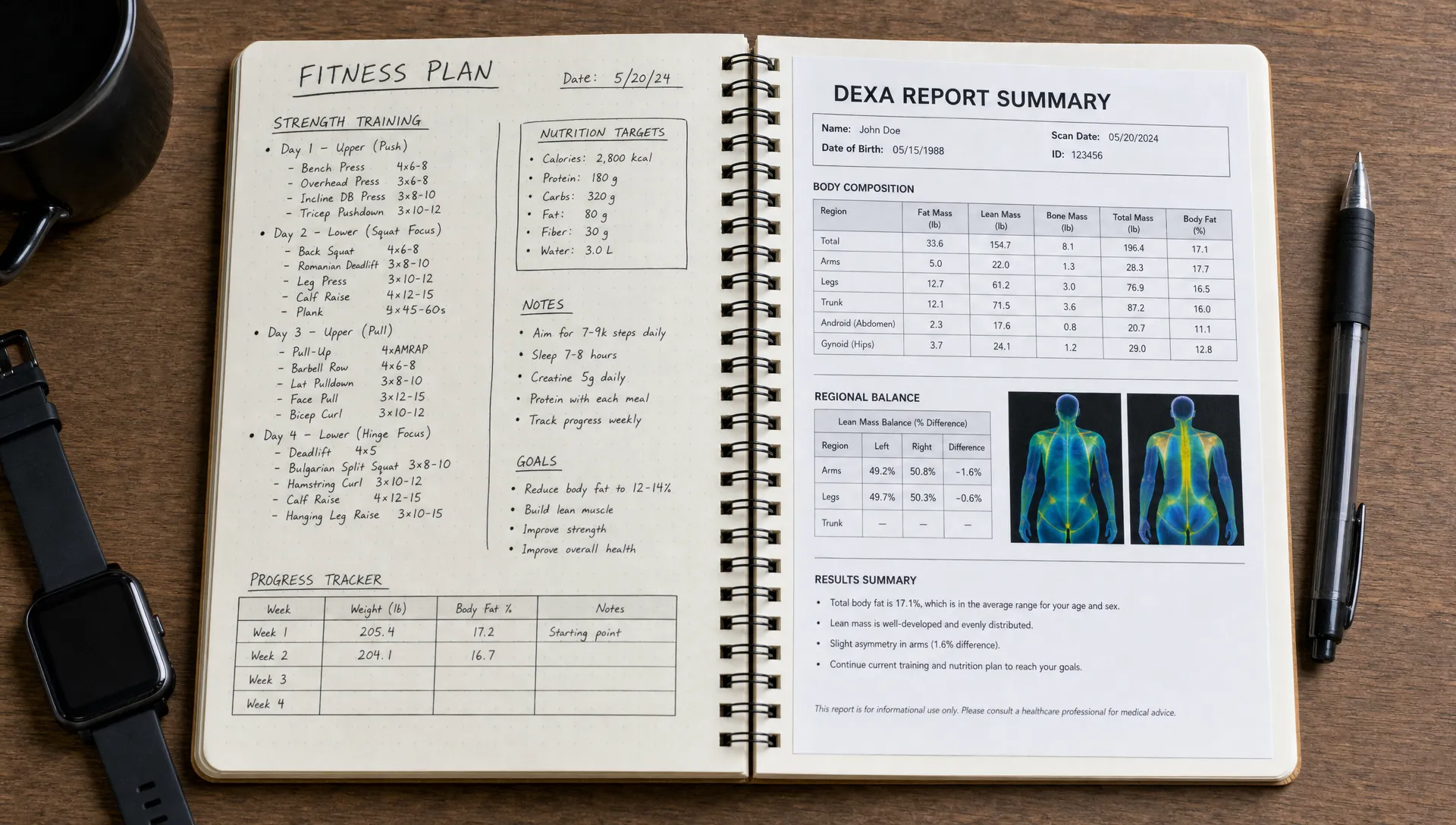
After a total body composition scan, regional lean mass can also help refine exercise selection. A large left to right difference does not diagnose an injury by itself, but it can prompt better programming. You might add unilateral movements, clean up technique or ask a qualified coach to assess whether an asymmetry is affecting performance.
Use recovery as part of the plan, not an afterthought
Recomposition depends on adaptation. Training creates the signal, nutrition supplies the materials and recovery is when your body responds. If sleep is poor, stress is high or soreness never settles, your scan-to-scan progress may look worse than your effort suggests.
Recovery does not need to be complicated. Start with sleep consistency, planned rest days and enough calories to support the training you are asking your body to perform. If performance is dropping every week, the plan may be too aggressive, even if the scale is moving in the direction you want.
A total body composition scan can make this easier to spot over time. If body weight drops but lean mass falls faster than expected, the plan may need more protein, less calorie restriction, lower cardio volume, better sleep or a change in lifting volume.
Track the right numbers between scans
You do not need to measure everything every day. In fact, too much tracking can make recomposition feel noisy. Pick a small dashboard that supports the goal you set from the scan.
Useful between-scan markers include:
- Body weight trend, using weekly averages instead of single weigh-ins
- Training performance on key lifts or movement patterns
- Daily protein consistency
- Waist measurement if fat loss or visceral fat is a priority
- Sleep duration and subjective recovery
These markers do not replace scan data. They help you decide whether the plan is being followed and whether your body is responding in the expected direction before the next measurement.
If you want to connect scan data to training decisions more directly, DEXA SF also explains using DEXA body composition analysis for smarter training, including how fat mass, lean mass and asymmetry can influence program design.
Re-scan and adjust without overreacting
The most useful moment for a total body composition scan is often the second scan. The first gives you a baseline. The second shows whether the plan worked, and more importantly, what kind of weight change actually happened.
If fat mass decreased and lean mass stayed stable, your deficit and training plan are probably well matched. If lean mass increased and fat mass stayed stable, you may be in a strong building phase. If both fat and lean mass dropped, the plan may have been too aggressive or recovery may not have supported the workload.
Avoid judging the plan from one metric. Look at the pattern across fat mass, lean mass, regional changes, visceral fat and training performance. A small increase in scale weight can be a win if lean mass rose and fat mass did not. A large scale drop can be less impressive if a meaningful share came from lean tissue.
When you have two or more reports, use the same testing conditions when possible. Similar hydration, meal timing and training timing help make comparisons cleaner. DEXA SF has a guide on how to compare results between scans so you can focus on real trends instead of measurement noise.
A simple recomposition planning framework
Once you have your baseline, turn the data into decisions. Repeat your total body composition scan after a planned training block, then use the results to choose the next block instead of making random changes each week.
| If your scan shows... | Your first emphasis may be... | What to watch next |
|---|---|---|
| Higher fat mass with solid lean mass | Moderate fat loss while preserving strength | Fat mass trend, training performance and hunger |
| Lower lean mass than expected | Muscle gain or lean mass restoration | Strength progression, protein consistency and recovery |
| Higher visceral fat | Fat loss with aerobic work and nutrition consistency | Waist trend, visceral fat change and adherence |
| Regional asymmetry | Balanced strength work and technique review | Left to right changes and movement quality |
| Low bone density concerns | Bone-supportive training and professional guidance | Resistance training consistency and medical follow-up if needed |
This framework keeps the plan focused. You do not need to fix every metric at once. Most successful recomposition plans improve one or two priorities per block, then reassess.
When to get expert interpretation
DEXA data is powerful, but interpretation matters. A scan can show what changed, but a qualified professional can help connect those changes to your actual training, nutrition, health history and goals.
That is especially useful if you have a history of injury, major weight loss, low energy availability, bone density concerns or a performance goal with a deadline. It is also helpful if you have been dieting and training consistently but your results do not match your effort.
At DEXA SF in San Francisco, clients can use professional DEXA body composition scans to measure body fat, lean mass, bone density, visceral fat, asymmetry and related metabolic insights. The goal is not just to collect numbers, but to turn them into clearer fitness and nutrition decisions.
Frequently Asked Questions
How does a total body composition scan help with recomposition? It separates fat mass from lean mass, which lets you see whether your plan is reducing fat, building muscle, preserving muscle or simply changing scale weight.
How often should I repeat a scan during a recomposition plan? Many people use an 8 to 12 week interval because it allows enough time for measurable change. Shorter intervals may be useful in special cases, but they can also make normal variation look more important than it is.
Can I build muscle and lose fat at the same time? Yes, especially if you are newer to strength training, returning after time off, improving protein intake or moving from inconsistent training to a structured plan. More advanced lifters may need more focused phases.
What if my weight does not change but my scan improves? That can be a successful recomposition result. If fat mass decreases and lean mass increases, scale weight may stay similar even though body composition, performance and appearance are improving.
Do I still need to track food if I have a scan? A scan gives you the baseline and progress measurement, but food habits drive much of the outcome. You do not always need strict tracking, but you do need enough consistency to know what is causing the change.
Turn your scan into a plan
If you are trying to lose fat, gain muscle or understand why the scale is not telling the full story, start with better data. A DEXA scan can give you the baseline you need to set targets, choose the right training emphasis and adjust nutrition with more confidence.
For a professional scan and expert interpretation in San Francisco, schedule with DEXA SF and use your results to build a recomposition plan that is specific to your body, not someone else’s template.