
DEXA Body Composition Analysis for Smarter Training
Most training plans fail for a simple reason: the feedback loop is too vague. The scale says you are up three pounds, but it cannot tell you whether that is muscle, fat, water, or normal fluctuation. Your mirror can show visible change, but only after weeks or months. Performance metrics help, but they do not explain what is happening inside your body.
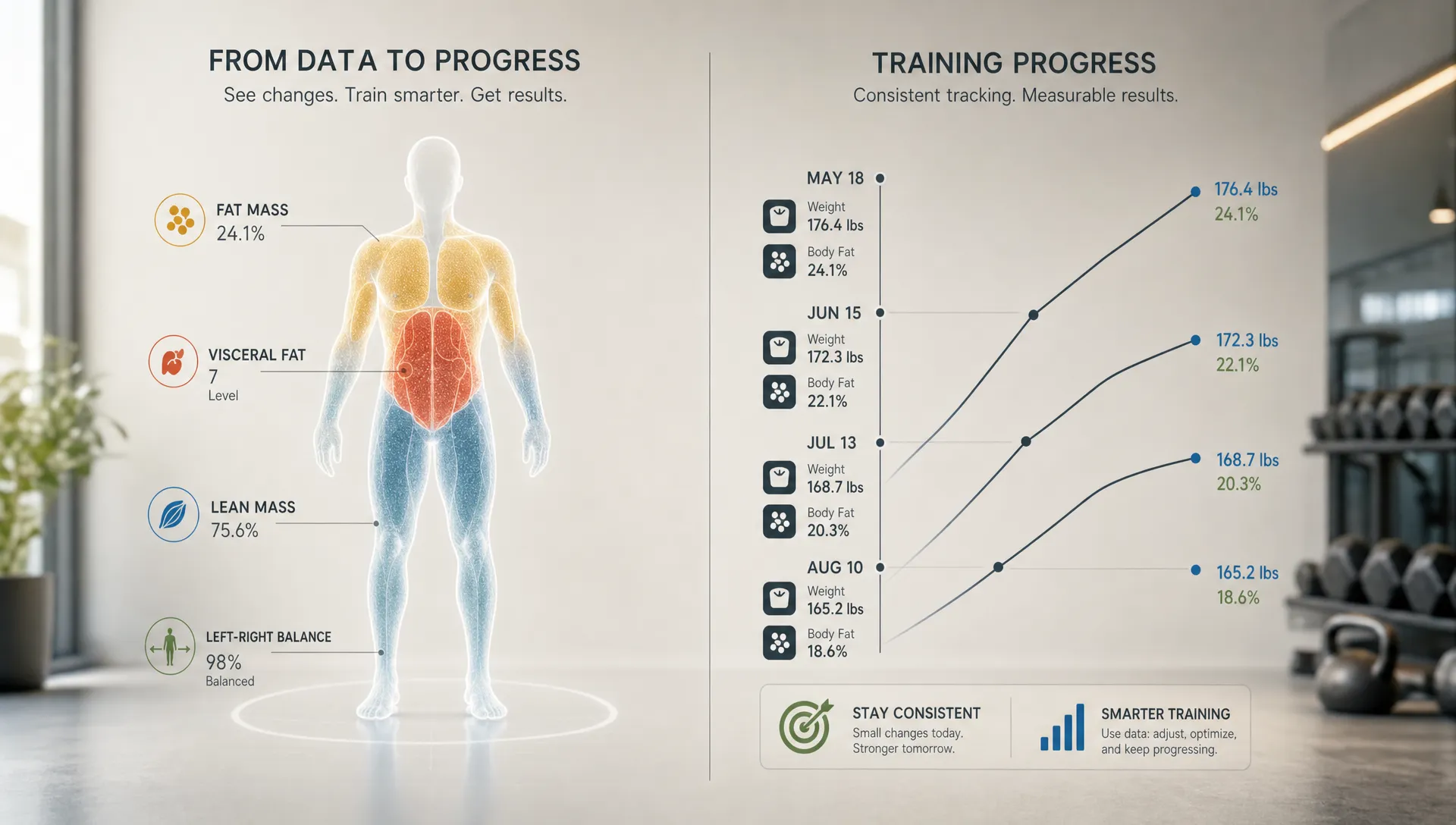
That is where DEXA body composition analysis becomes powerful. Instead of training based on guesses, you can see how your fat mass, lean mass, bone density, visceral fat, and left-to-right balance are changing over time. For anyone lifting, cutting, bulking, running, competing, or simply trying to improve health, DEXA turns training into a more measurable process.
The goal is not to chase perfect numbers. The goal is to make smarter decisions sooner.
Why smarter training starts with better measurement
Body weight is useful, but it is incomplete. The CDC notes that BMI does not measure body fat directly, which is one reason two people with the same height and weight can have very different physiques, health risks, and performance profiles.
The same problem shows up inside your own training. You may weigh the same for eight weeks while losing fat and gaining muscle. You may lose weight quickly while also losing lean mass. You may gain weight during a strength phase and assume it is muscle, when part of it is fat accumulation.
DEXA, short for dual-energy X-ray absorptiometry, helps separate these variables. A scan uses low-dose X-ray technology to estimate bone mineral content, fat mass, and lean tissue. In a fitness setting, that allows you to evaluate whether your program is producing the adaptation you actually want.
For a deeper breakdown of specific outputs, DEXA SF has a helpful guide to the DEXA body composition metrics that matter most. This article focuses on how to turn those metrics into smarter training choices.
What DEXA body composition analysis tells you
A useful DEXA report is not just a body fat percentage. The real value comes from the combination of regional and whole-body data.
| DEXA metric | What it helps answer | Training decision it can inform |
|---|---|---|
| Total body fat percentage | Is your overall fat level trending in the right direction? | Whether to continue, slow, or adjust a fat loss or mass gain phase |
| Fat mass in pounds | How much actual fat tissue do you carry? | Whether weight change is coming from fat loss or another source |
| Lean mass | Are you building or preserving muscle? | Whether training volume, protein, and calories are sufficient |
| Regional lean mass | Are certain limbs or areas underdeveloped? | Exercise selection, unilateral work, and accessory priorities |
| Visceral fat estimate | How much fat is stored around the abdominal organs? | Health-focused nutrition and activity decisions |
| Bone density | Is bone health a consideration in your training plan? | Strength training emphasis, impact exposure, and medical follow-up if needed |
| Left-to-right asymmetry | Are there notable side-to-side differences? | Technique review, rehab referral, and targeted programming |
Each metric becomes more useful when you connect it to a training question. For example, “What is my body fat?” is less actionable than “Did I lose fat without losing lean mass during this 10-week cut?”
How DEXA changes training decisions
A single scan gives you a baseline. Repeated scans, spaced appropriately, show whether your plan is working. That is the difference between data and direction.
If your goal is fat loss
The best fat loss phase is not simply the one where weight drops fastest. It is the one where fat mass decreases while lean mass is preserved as much as possible.
DEXA can help you see whether your calorie deficit is too aggressive. If body weight is down but lean mass has dropped noticeably, your plan may need more resistance training, more recovery, a smaller deficit, or improved protein intake. The International Society of Sports Nutrition has noted that higher protein intakes can support lean mass retention and body composition goals in exercising individuals, especially when paired with resistance training, in its protein and exercise position stand.
In practice, a DEXA-informed fat loss plan often looks less extreme. You are not trying to lose the most weight possible. You are trying to lose the right kind of weight.
If your goal is muscle gain
A muscle-building phase can be deceptive. The scale may rise, gym performance may improve, and you may assume the entire process is going well. But without body composition data, it is hard to know how much of the gain is lean tissue versus fat.
DEXA body composition analysis helps you evaluate whether your surplus is appropriate. If lean mass is increasing with a manageable rise in fat mass, the plan may be on track. If fat mass is climbing quickly while lean mass barely moves, you may be overshooting calories, undertraining key muscle groups, or misjudging recovery.
Regional lean mass is especially useful here. If your right leg has significantly more lean mass than your left, or your upper body is lagging relative to your lower body, you can adjust programming with more precision than simply “train harder.”
If your goal is performance
For athletes and serious recreational trainees, body composition affects power, speed, endurance, durability, and recovery. More muscle is not always better if it does not contribute to sport performance. Less body fat is not always better if the process compromises strength, hormones, mood, or training quality.
DEXA helps frame performance tradeoffs. A cyclist, runner, climber, martial artist, or field sport athlete may care about power-to-weight ratio. A strength athlete may care more about lean mass distribution, bone density, and whether weight-class changes are worth it. A masters athlete may use DEXA to monitor bone and lean tissue while staying active long-term.
If you compete or train at a high level, the question is not “How low can my body fat go?” It is “What body composition supports my best sustainable performance?”
Turning DEXA results into a training plan
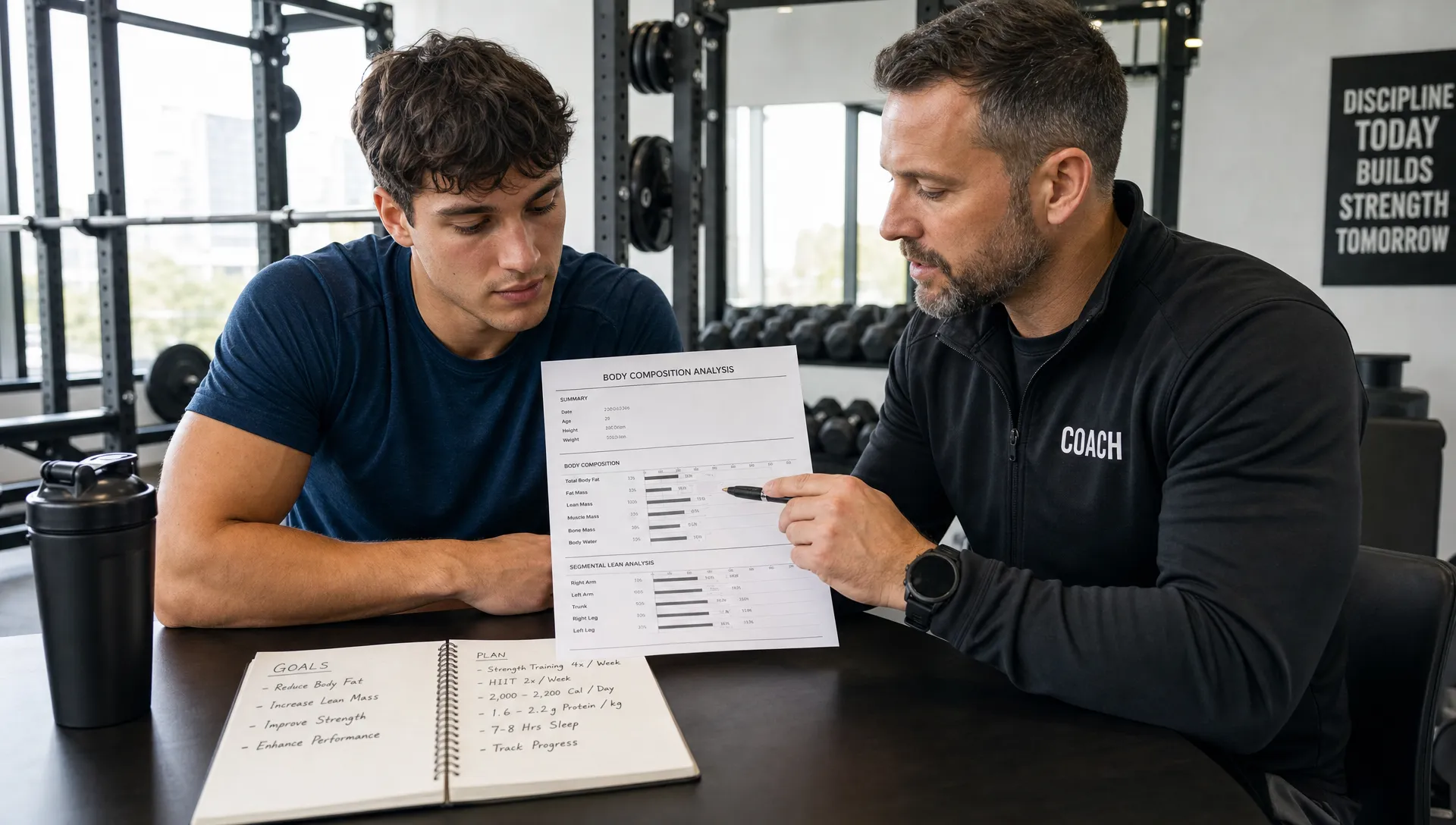
DEXA does not replace coaching, programming, nutrition, or consistency. It improves the quality of the decisions around them. The most productive way to use your results is to connect each finding to one next action.
Here is a simple framework:
| Result pattern | What it may suggest | Smart next step |
|---|---|---|
| Fat mass down, lean mass stable | Fat loss phase is likely working | Continue the current plan and avoid unnecessary changes |
| Fat mass down, lean mass also down | Deficit or recovery may be too aggressive | Review calories, protein, training volume, and sleep |
| Weight up, lean mass up, fat mass stable | Productive muscle gain | Continue and reassess after the next block |
| Weight up, fat mass up, lean mass flat | Surplus may be too high or training stimulus too low | Adjust nutrition and evaluate progressive overload |
| One limb shows lower lean mass | Possible asymmetry or training imbalance | Add unilateral work and assess technique or injury history |
| Visceral fat remains elevated | Health risk may need more attention | Prioritize sustainable fat loss, daily activity, and professional guidance |
This approach prevents overreaction. A DEXA scan should not trigger a complete program overhaul unless the data clearly supports it. Often, the best move is a small adjustment, then another scan after enough time has passed for real adaptation.
How often should you get a DEXA scan for training?
Timing matters. Scanning too often can create noise, while scanning too rarely can delay useful feedback.
For most training goals, every 8 to 16 weeks is a practical range. That usually gives your body enough time to show meaningful changes in fat mass or lean mass. Very short intervals can be misleading because hydration, glycogen, recent exercise, and normal biological variation can influence lean mass estimates.
| Training situation | Suggested scan timing |
|---|---|
| Starting a new program | Baseline scan before or near the start |
| Fat loss phase | Every 8 to 12 weeks |
| Muscle gain phase | Every 12 to 16 weeks |
| Athletic season planning | Before and after major training blocks |
| Long-term health tracking | A few times per year, depending on goals |
Standardization improves the quality of your comparisons. Try to scan under similar conditions each time, such as the same time of day, similar hydration status, and no unusually hard workout immediately beforehand.
If you are planning your first scan, this 2026 guide to DEXA scan benefits, cost, and timing can help you decide when it makes the most sense.
Common mistakes when using DEXA for training
DEXA is precise, but it still needs context. The data is only as useful as the way you interpret it.
One common mistake is treating body fat percentage as the only number that matters. Body fat percentage can change because fat mass changes, lean mass changes, or both. If you lose muscle while losing fat, your percentage may look better while your performance suffers.
Another mistake is comparing your results to someone else’s. Your sport, age, sex, training history, injury history, and goals all influence what is appropriate. A healthy number for one person may be unnecessary or counterproductive for another.
A third mistake is ignoring regional information. If your total lean mass improves but one side of your body remains significantly lower, that could affect performance or injury risk. DEXA does not diagnose movement problems, but it can flag patterns worth discussing with a coach, trainer, physical therapist, or medical professional.
Finally, avoid changing everything at once. If your scan suggests your cut is too aggressive, adjust calories or training volume in a controlled way. If your lean mass is not increasing, review progressive overload, protein, sleep, and consistency before assuming the program is broken.
Why DEXA is especially useful in San Francisco training culture
San Francisco is full of people who train seriously while balancing demanding work, outdoor activities, endurance events, boutique fitness, strength training, and longevity goals. That combination makes efficient feedback valuable.
If you only have a few focused training blocks per year, you do not want to spend months guessing. A DEXA scan can show whether your current plan is actually moving you toward your goal, whether that is reducing visceral fat, building lean mass, improving symmetry, or protecting bone health.
DEXA SF provides professional DEXA body composition scans in San Francisco, with measurements for body fat, lean mass, bone density, metabolic insights, visceral fat, asymmetries, and expert interpretation. The scan process is quick, and results can be used to support more personalized fitness and nutrition decisions.
Frequently Asked Questions
Is DEXA body composition analysis only for athletes? No. Athletes can benefit from the performance detail, but DEXA is also useful for anyone pursuing fat loss, muscle gain, healthy aging, bone health, or more informed nutrition decisions.
How is DEXA different from a smart scale? Smart scales estimate body composition using electrical impedance and can be affected by hydration, food intake, and timing. DEXA directly estimates fat, lean tissue, and bone mineral content by region, which makes it more informative for training decisions.
Can DEXA tell me exactly what workout to do? Not by itself. DEXA shows what is changing in your body. A coach, trainer, dietitian, or qualified expert can help translate those results into programming and nutrition adjustments.
Will one scan be enough? One scan is an excellent baseline, but the biggest training value comes from comparing scans over time. Trends reveal whether your plan is helping you lose fat, gain lean mass, preserve muscle, or correct imbalances.
Should I scan while cutting or bulking? Yes, DEXA can be useful in both phases. During a cut, it helps monitor lean mass retention. During a bulk, it helps show whether weight gain is mostly productive lean mass or excessive fat gain.
Train with better feedback
Smarter training is not about collecting more data for its own sake. It is about knowing which changes are actually happening, then adjusting your plan with confidence.
If you are ready to move beyond the scale, you can schedule a DEXA body composition scan in San Francisco with DEXA SF and get expert interpretation to support your next training phase.