
Absorptiometry Scan Terms You Should Know Before Results
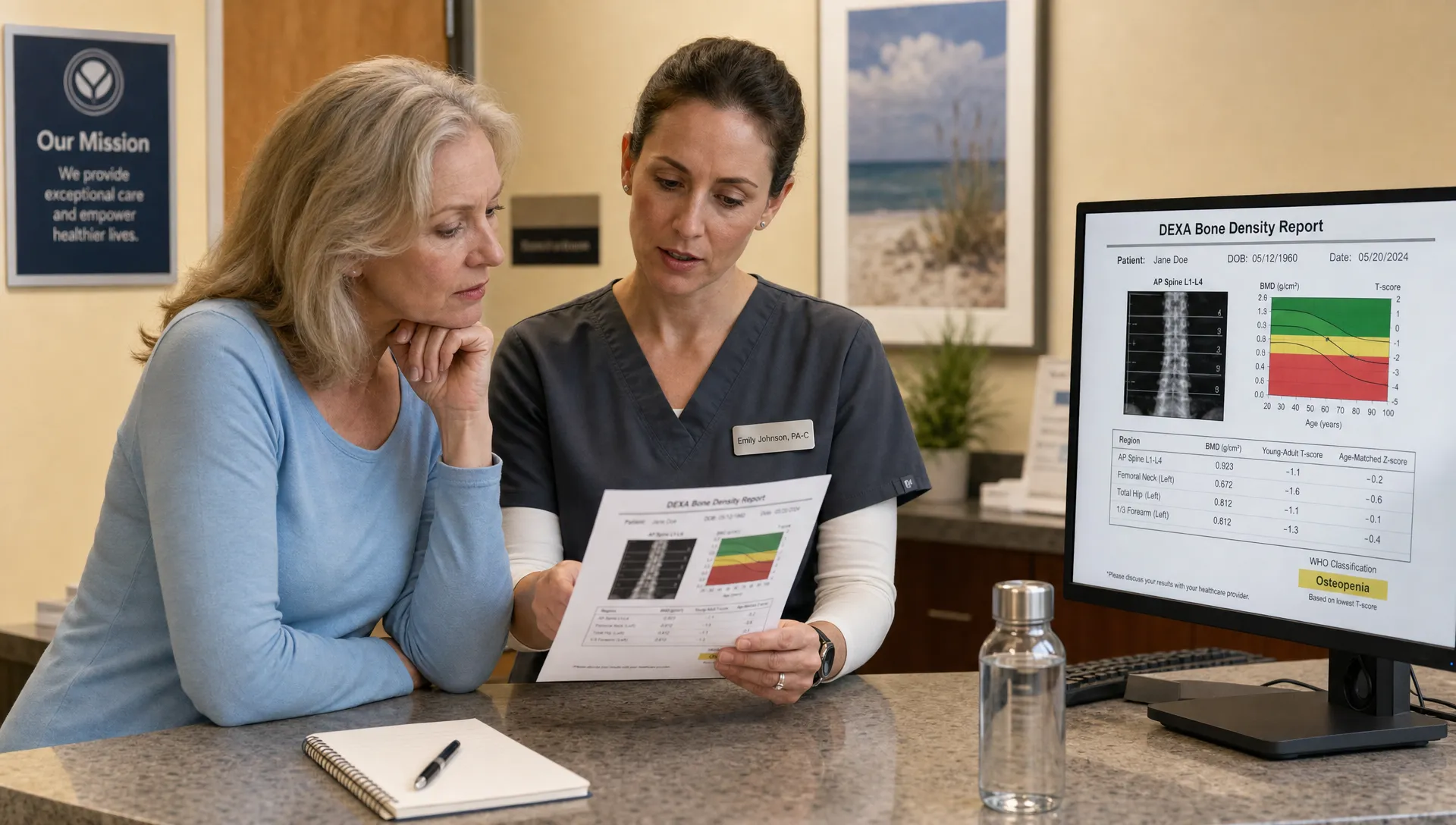
If your absorptiometry scan is coming up, the report can feel much easier to use when the vocabulary already makes sense. DEXA results are packed with short labels, percentages and regional measurements, but each term answers a practical question about body fat, muscle, bone density or metabolic health. Learn the language first and your results become a decision-making tool, not just a page of numbers.
A DEXA report is most useful when you can connect each metric to a goal, such as fat loss, strength training, bone health or long-term tracking. If you are still learning what happens during the appointment itself, DEXA SF's plain-English guide to X-ray absorptiometry is a helpful starting point before you focus on the report language.
Key absorptiometry scan terms at a glance
The fastest way to prepare is to learn the core glossary before your results review. Not every report looks identical, but most DEXA body composition summaries use the same categories.
| Term | What it means | Why it matters |
|---|---|---|
| DXA or DEXA | Dual-energy X-ray absorptiometry, the scanning method | Explains how the system estimates tissue and bone compartments |
| Total mass | The total measured body mass in the scan | Gives context for how fat, lean tissue and bone add up |
| Fat mass | Pounds or kilograms of fat tissue | Helps separate true fat change from scale weight change |
| Lean mass | Non-fat, non-bone tissue such as muscle, organs and body water | Useful for training, nutrition and performance goals |
| BMC | Bone mineral content | Shows the mineral amount measured in bone regions |
| BMD | Bone mineral density | Used to evaluate bone density in specific areas |
| VAT | Visceral adipose tissue | Estimates deeper abdominal fat around internal organs |
| Android and gynoid | Abdominal and hip or thigh regions | Shows where fat is distributed |
| T-score and Z-score | Bone density comparisons against reference groups | Helps frame bone results for clinical discussion |
Reading an absorptiometry scan report is less about memorizing every abbreviation and more about knowing which terms apply to your goal. A runner may care most about leg lean mass and asymmetry, while someone focused on metabolic health may look first at visceral fat and waist-region trends.
Scan type, regions and software labels
DEXA and DXA refer to the same technology, dual-energy X-ray absorptiometry. The scan uses two low-dose X-ray energy levels to estimate how much of your body is fat tissue, lean tissue and bone mineral. RadiologyInfo, a patient resource from the American College of Radiology and the Radiological Society of North America, describes bone densitometry as a quick, noninvasive test commonly used to assess bone density.
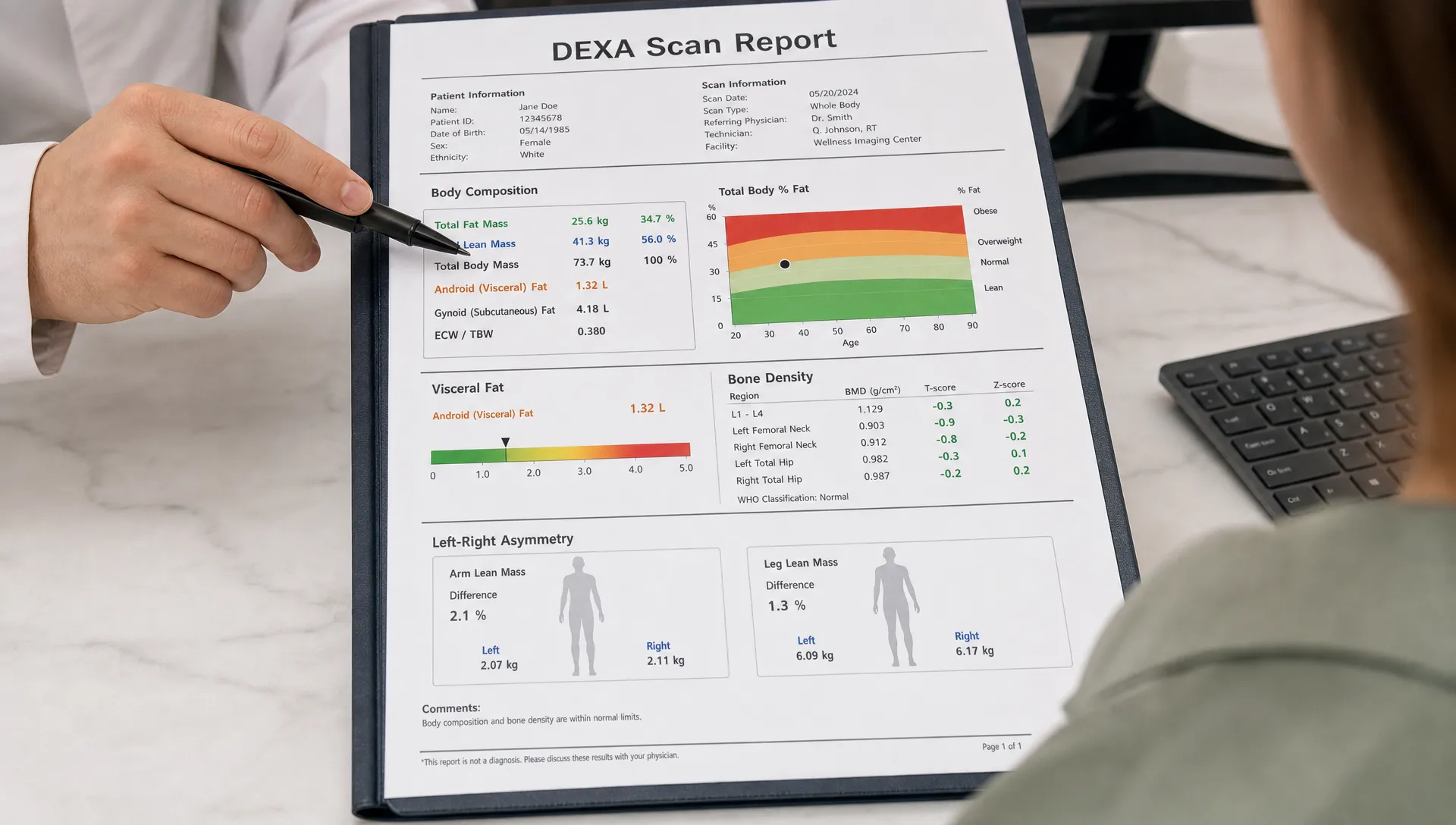
A DEXA absorptiometry scan report usually divides results into regions of interest. You may see labels such as total body, arms, legs, trunk, android region and gynoid region. These regional labels matter because two people can have the same total body fat percentage but very different distribution patterns.
Software labels can also vary by device or clinic. For example, one report may use VAT while another spells out visceral adipose tissue. One may display lean mass by limb, while another groups it under appendicular lean mass. When in doubt, ask your reviewer to point to the exact region on the report rather than guessing from the abbreviation.
Tissue compartments: fat, lean mass and bone mineral
The main body composition terms describe compartments. Fat mass is the estimated amount of fat tissue. Lean mass is everything that is not fat or bone mineral, which means it includes skeletal muscle but is not identical to pure muscle. Bone mineral content is the amount of mineral measured in your bones.
An absorptiometry scan separates these compartments so you can see what changed beneath the scale. If body weight drops by 8 pounds, the report can show whether most of that change came from fat mass, lean mass or a mix. If body weight stays the same, the report may still reveal a meaningful recomposition, such as lower fat mass and higher lean mass.
Body fat percentage is calculated from fat mass relative to total measured mass. It is easy to focus on this percentage because it is familiar, but fat mass in pounds or kilograms can be more concrete when tracking progress. For a deeper walkthrough of these numbers, DEXA SF's guide to reading DEXA scan body fat results explains how the main body composition metrics work together.
Fat distribution: VAT, android and gynoid regions
Visceral adipose tissue, usually shortened to VAT, estimates fat stored deeper in the abdomen around internal organs. This is different from subcutaneous fat, which sits under the skin. VAT often gets special attention because higher visceral fat is associated with greater cardiometabolic risk, though your scan result should be interpreted in context with medical history, labs and clinician advice.
In an absorptiometry scan, android usually refers to the abdominal region and gynoid refers to the hip and thigh region. The android to gynoid ratio compares these areas and can help show whether fat is concentrated more centrally or lower in the body. This is useful because body fat percentage alone does not show where fat is stored.
Regional fat results also help make goals more realistic. You cannot choose exactly where fat loss occurs, but you can track whether a nutrition and training plan is reducing total fat mass, abdominal fat or visceral fat over time.
Muscle and asymmetry terms
Lean mass by region is one of the most useful parts of a DEXA report for training. The scan may show lean mass in the right arm, left arm, right leg, left leg and trunk. If one limb carries noticeably less lean mass than the other, that difference may appear as a left-right asymmetry.
Asymmetry does not automatically mean something is wrong. Most people have some side-to-side difference because of handedness, sport history, previous injury or movement habits. The value of the report is that it gives you a baseline. If the right leg is consistently lower after an old knee injury, for example, that may shape your strength program or your conversation with a physical therapist.
Some reports include appendicular lean mass, which generally refers to lean mass in the arms and legs. This can be useful because limb lean mass is closely tied to strength, mobility and training adaptation. When reviewing the number, remember that hydration, glycogen storage and recent hard workouts can affect lean mass readings, so trends are more useful than one isolated value.
Bone terms: BMC, BMD, T-score and Z-score
Your absorptiometry scan may include bone measurements, especially bone mineral content and bone mineral density. BMC describes how much mineral is measured in a bone region. BMD describes mineral density, often reported for specific sites or as part of a body composition summary.
T-score and Z-score are comparison metrics. A T-score compares bone density with a young adult reference population. A Z-score compares bone density with what is expected for someone closer to your age, sex and body size. The International Society for Clinical Densitometry publishes official positions on adult bone densitometry that clinicians use when interpreting these measures.
For a fitness-focused body composition scan, bone terms can still be valuable, but they should not be treated as a stand-alone diagnosis. If your bone density result raises a concern, bring the report to a qualified healthcare professional who can consider risk factors, medications, fracture history, lab work and whether a diagnostic bone density exam is needed.
Metabolic terms you may see alongside DEXA
Some reports or consultations include metabolic data, such as resting metabolic rate, basal metabolic rate or estimated daily energy needs. Resting metabolic rate usually refers to the energy your body uses at rest. Total daily energy expenditure adds movement, exercise and the thermic effect of food.
An absorptiometry scan does not directly measure every calorie you burn. When metabolic numbers appear with DEXA results, they may be estimated from variables such as lean mass, body size, age and sex, or they may be paired with a separate metabolic assessment. The key question to ask is whether the number is measured, estimated or calculated from your body composition data.
Metabolic context can make the report more actionable. Higher lean mass often supports higher energy needs, while changes in fat mass and training volume can affect how aggressively you should adjust calories. DEXA SF's article on what a metabolic scan can tell you alongside DEXA goes deeper into using these numbers together.
Which terms deserve the most attention in your results?
The most important terms depend on why you booked the scan. A clear goal keeps you from overreacting to every small number on the page.
| Goal | Terms to review first | What to ask during interpretation |
|---|---|---|
| Fat loss | Fat mass, body fat percentage, VAT, android fat | Did fat mass change or only scale weight? |
| Muscle gain | Lean mass, appendicular lean mass, limb regions | Is lean mass increasing in the areas I train most? |
| Athletic performance | Regional lean mass, asymmetry, trunk and leg lean mass | Are side-to-side differences affecting my training plan? |
| Bone health | BMD, BMC, T-score, Z-score | Should I discuss this result with a clinician? |
| Nutrition planning | Lean mass, fat mass, RMR or energy estimates | Do my calories and protein match my current body composition? |
After an absorptiometry scan, the best interpretation often comes from connecting two or three related terms. For example, lower scale weight with stable lean mass and lower fat mass is a different outcome than lower scale weight with falling lean mass. A good review should help you understand the pattern, not just the headline number.
Terms that matter when comparing results over time
A single absorptiometry scan gives you a detailed baseline, but repeat scans show whether your plan is working. When comparing results, pay close attention to precision, trend and testing conditions. Small changes can happen because of hydration, food intake, glycogen, positioning or normal measurement variation.
Least significant change is a term used in bone densitometry to describe the amount of change needed before a difference is likely to be real rather than measurement noise. You may not see that exact term on every body composition report, but the principle still matters. Do not rebuild your training or nutrition plan because of a tiny shift in one metric.
For cleaner comparisons, try to repeat scans under similar conditions. Use the same facility when possible, scan at a similar time of day, avoid unusual training immediately before the appointment and note any major changes in diet, hydration or medication. If you plan to track progress, DEXA SF has a separate guide on comparing DEXA analysis results between scans without misreading small changes.
Frequently Asked Questions
Is DEXA the same as DXA? Yes. DEXA and DXA both refer to dual-energy X-ray absorptiometry. DXA is often used in clinical settings, while DEXA is common in fitness and body composition discussions.
Does lean mass mean muscle mass? Not exactly. Lean mass includes muscle, organs, connective tissue and body water. It is useful for training decisions, but it should not be read as a pure measurement of skeletal muscle.
What is the most important term on the report? There is no single best term for everyone. Fat mass, lean mass, VAT, BMD and asymmetry all matter in different contexts, so the most important metric is the one tied to your goal.
Should I worry if my T-score or Z-score looks low? Do not panic, but do follow up. Bone density scores should be interpreted by a qualified healthcare professional who can consider your age, sex, medical history and fracture risk.
How often should I repeat an absorptiometry scan? The right interval depends on your goal and how quickly your plan is changing. Many people benefit from waiting long enough for real body composition changes to occur rather than scanning after every minor weight fluctuation.
Bring better questions to your results review
Learning the terms before your appointment helps you get more out of the conversation after your scan. Instead of asking only whether a number is good or bad, you can ask what changed, which regions matter most and how the result should influence your training or nutrition plan.
At DEXA SF, body composition scans are designed to give you precise measurements of body fat, lean mass, bone density, visceral fat, asymmetry and related metabolic insights, with expert interpretation to help turn the data into practical next steps. If you want a clearer baseline for your fitness, health or performance goals, schedule a scan and bring these terms with you.