
Why Human Fat Density Varies and Why It Matters
Human fat density sounds like a physics lab detail, but it helps explain a frustrating reality: two people can have the same body weight and look very different. It also explains why your waist, clothes fit and DEXA results can improve even when the scale barely moves.
At the simplest level, density is mass divided by volume. Fat tissue is less dense than muscle and bone, so a pound of stored fat occupies more space than a pound of lean tissue. That general idea is true, but the exact density of human fat is not identical in every person or every part of the body.
This matters because many common fitness and health tools make assumptions about mass, volume or tissue composition. If those assumptions are too simple, your results can look cleaner than reality. A more detailed body composition assessment gives you a better way to understand fat loss, muscle gain, visceral fat and bone health.
What human fat density actually means
When people talk about human fat density, they usually mean the density of adipose tissue. Adipose tissue is the body tissue that stores fat, but it is not pure oil. It includes fat cells, stored triglycerides, water, blood vessels, collagen, nerves and immune cells.
Pure triglyceride is less dense than water, which is why fat tends to float. In body composition science, adipose tissue is often modeled at roughly 0.9 g/cm3, while fat-free mass is commonly modeled closer to 1.1 g/cm3. Those are useful averages, not exact values for every person.
Classic densitometric equations, including the revision by Brozek and colleagues, convert whole-body density into estimated body fat using assumptions about the density of fat mass and fat-free mass. Those formulas helped shape modern body composition testing, but they also show the limitation: the body is being simplified into compartments.
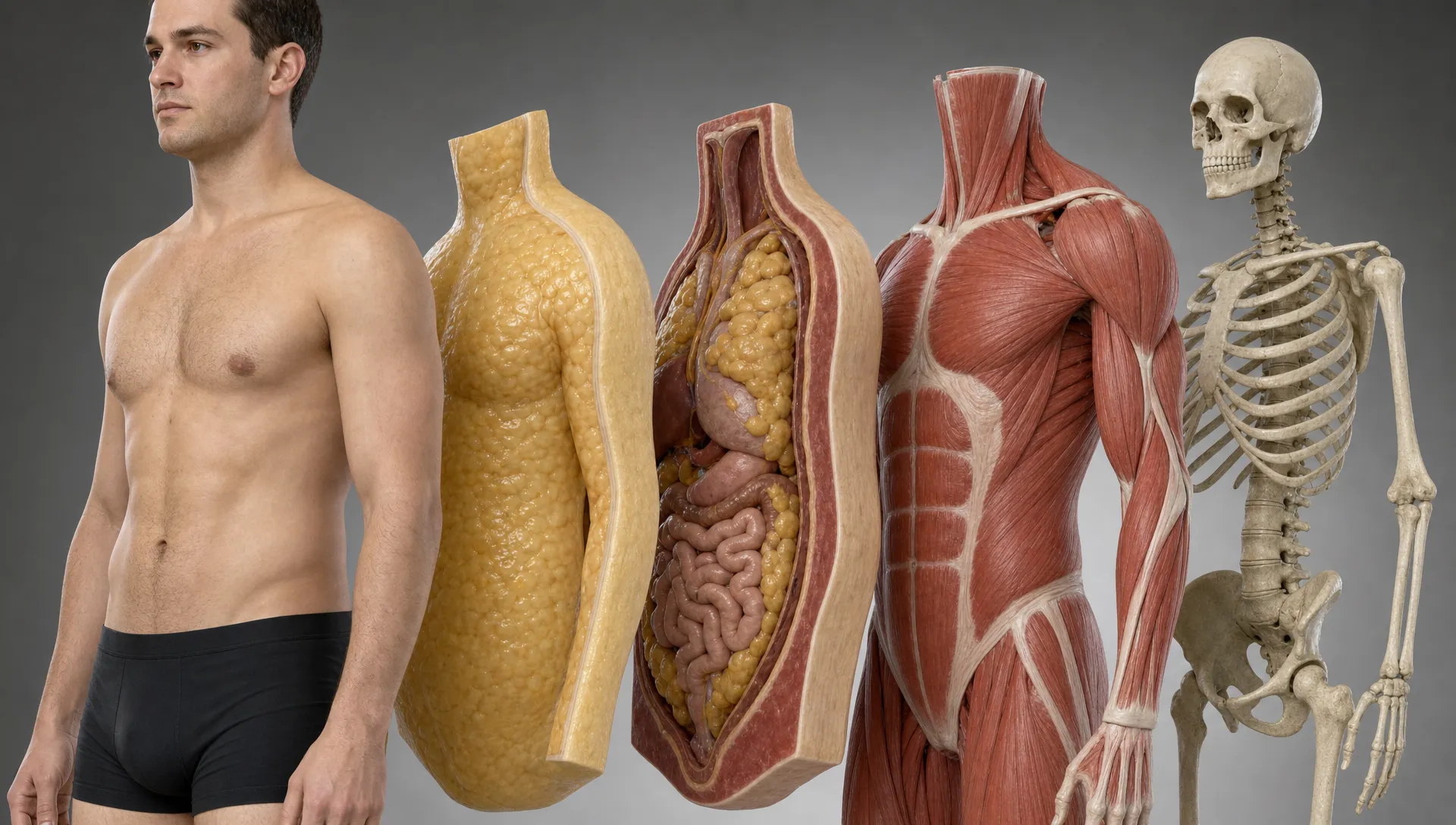
This is where the common saying that muscle weighs more than fat comes from. A pound is a pound, but muscle is denser. For the same weight, fat generally takes up more space. That is why someone can lose inches, improve muscle definition or look leaner without a dramatic drop in total body weight.
Why human fat density varies
Human fat density varies because adipose tissue is living tissue, not a uniform storage tank. The variation is usually modest compared with the much larger density difference between fat, muscle and bone, but it is still meaningful when you are trying to understand body composition.
Fat cells contain different amounts of lipid and water
Adipocytes, or fat cells, expand as they store more triglyceride. A fat cell that is packed with lipid has a different composition than a smaller cell with a higher relative share of water, cell membrane, proteins and supporting structures.
Adipose tissue can also change with inflammation, injury, fluid shifts and connective tissue remodeling. When fat tissue contains more water, immune cells or fibrous tissue, its density can shift. This does not mean a person has good fat or bad fat based on density alone. It means the tissue is biologically active and not identical across all bodies.
Fat location changes the context
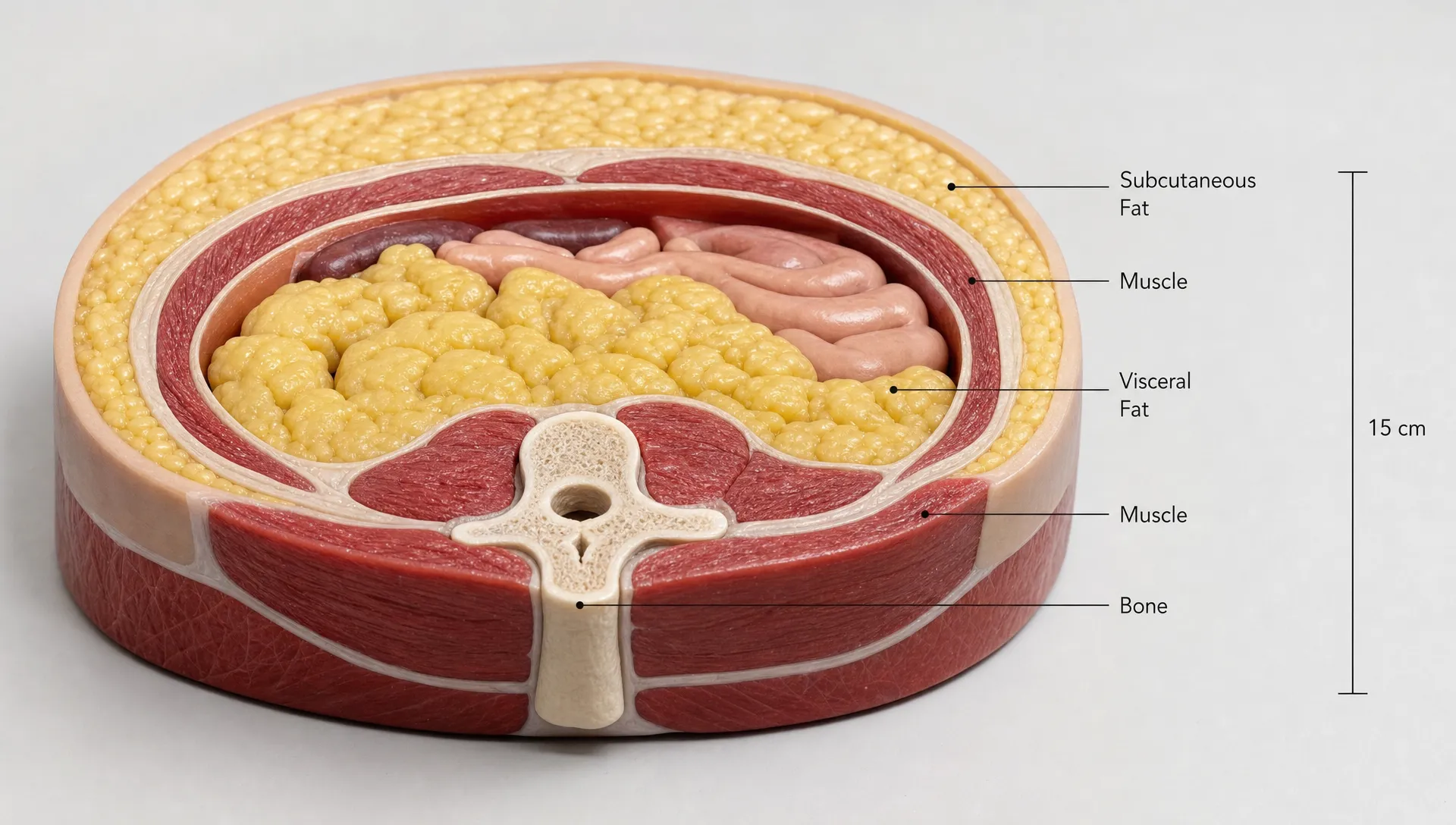
Subcutaneous fat sits under the skin. Visceral fat sits deeper in the abdomen around internal organs. Both are adipose tissue, but they behave differently. Visceral fat is generally more metabolically active and is more strongly linked with cardiometabolic risk than the fat stored just under the skin.
The key point is that density is not the only thing that matters. Where fat is stored can matter more than the exact density of that fat. Two people may have the same body fat percentage but very different amounts of visceral fat, which can change the health interpretation.
White, beige and brown fat are not identical
Most adult body fat is white adipose tissue, which primarily stores energy. Brown adipose tissue contains more mitochondria and blood supply, helping generate heat. Beige fat has properties between white and brown fat and can appear under certain physiological conditions.
For most adults tracking body composition, brown and beige fat are not the main drivers of DEXA results. Still, these tissue types are a reminder that human fat is not one uniform material. Its structure and function vary across the body.
Age, sex, hormones and training influence fat tissue
Hormonal status, age, genetics, training history and nutrition patterns all influence where fat is stored and how adipose tissue behaves. For example, fat distribution often changes across adulthood, and many people store proportionally more abdominal fat with age.
Resistance training, adequate protein intake and fat loss can improve the relationship between fat mass and lean mass, even if the density of fat tissue itself is not something you can directly optimize. In practice, most people benefit more from tracking total fat mass, lean mass, visceral fat and trends over time than from trying to estimate their personal fat density.
Why fat density matters for measurement
The first reason human fat density matters is simple: volume affects appearance. If you lose fat and gain muscle, your body may become smaller or more defined even when weight changes slowly. That is body recomposition, and it is one reason scale weight can be misleading.
The second reason is measurement accuracy. Some methods estimate body fat by making assumptions about density, hydration or tissue composition. If your body differs from those assumptions, the result may be directionally useful but less precise.
The CDC notes that BMI does not measure body fat directly. BMI can be helpful for population-level screening, but it cannot tell whether weight comes from fat, muscle, bone or fluid. It also cannot tell where fat is stored.
| Measurement approach | How density enters the picture | What to remember |
|---|---|---|
| Scale weight | Measures total mass only | A stable weight can hide fat loss or muscle gain |
| BMI | Uses height and weight, not tissue density | It cannot separate fat mass from lean mass |
| Hydrostatic weighing | Estimates body density from water displacement | Assumptions about fat-free mass, lung volume and bone can affect results |
| Smart scales | Infer composition from electrical impedance and water content | Hydration, algorithms and timing can shift the estimate |
| DEXA | Estimates fat, lean tissue and bone mineral using X-ray attenuation | It gives a more regional and actionable body composition picture |
How DEXA reduces the guesswork
A DEXA scan does not measure human fat density the way a lab would measure a tissue sample. Instead, it uses low-dose X-rays at two energy levels to estimate body composition, including fat mass, lean mass and bone mineral content.
That distinction matters. Rather than treating your body as one average-density object, DEXA provides regional information. It can show whether fat is concentrated in the trunk, whether lean mass differs between the left and right side and whether your progress reflects fat loss, muscle gain or both.
This is why DEXA is more useful than tools that rely heavily on indirect estimates. For example, bioelectrical impedance devices and bathroom smart scales can be influenced by hydration, recent meals and proprietary formulas. If you want a deeper comparison, DEXA SF explains why DEXA body fat measurement is different from smart scales.
DEXA also helps separate the fat density conversation from the bigger health question: what kind of mass do you have and where is it located? A person with a normal BMI can still carry excess visceral fat. A strong athlete can have a high BMI because of lean mass. A person losing weight quickly may be losing both fat and muscle, which is not always the goal.
For people concerned about abdominal fat, a DEXA scan for visceral fat can provide a more specific view than weight or waist size alone. Visceral fat is not just a storage issue. Its location near internal organs is part of why it receives so much attention in metabolic health discussions.
What to track instead of chasing a fat density number
Most people do not need to know their exact personal human fat density. They need to know whether their body composition is moving in the right direction for their health, performance or physique goals.
A more practical approach is to track total fat mass, body fat percentage, lean mass, visceral fat, regional distribution and bone density. These numbers give context that scale weight cannot provide. If you are dieting, they help show whether the weight you are losing is mostly fat. If you are strength training, they help show whether muscle is increasing in the areas you expect.
Trends matter more than one isolated result. Scan timing, recent training, hydration and food intake can influence some body composition measurements, so consistency helps. Try to compare scans under similar conditions when possible.
If you want to understand which DEXA results deserve the most attention, DEXA SF has a guide to the DEXA body composition metrics that matter most. The goal is not to collect more numbers for the sake of it. The goal is to use the right numbers to make better decisions about training, nutrition and long-term health.
Frequently Asked Questions
What is the density of human fat? Human adipose tissue is commonly modeled around 0.9 g/cm3, but that is an average. Actual density can vary because fat tissue contains different amounts of lipid, water, connective tissue, blood vessels and cells.
Why does human fat density vary between people? It varies because adipose tissue composition is influenced by fat cell size, hydration, inflammation, fat location, age, sex, hormones, genetics and metabolic health. Most of these factors change tissue behavior more than they change appearance by themselves.
Does fat density affect BMI? BMI does not measure fat density or body composition. It only compares weight with height, so it cannot tell whether weight comes from fat, muscle, bone or fluid.
Can DEXA measure human fat density directly? DEXA does not directly measure the density of a fat tissue sample. It estimates body composition using X-ray attenuation, then reports fat mass, lean mass, bone mineral content and regional distribution.
Is visceral fat denser than subcutaneous fat? The clinically important difference is not simply density. Visceral fat is stored around internal organs and is more metabolically active, which is why measuring its amount and location can be more useful than focusing on density alone.
Get a clearer view of your body composition
Human fat density helps explain why body weight can be misleading, but it is only one part of the picture. If you want to know what is actually changing in your body, a DEXA scan gives you a more complete view of fat, lean mass, bone density, visceral fat and asymmetries.
If you are in San Francisco, schedule a DEXA scan with DEXA SF for precise body composition measurements, expert interpretation and personalized fitness and nutrition guidance.