
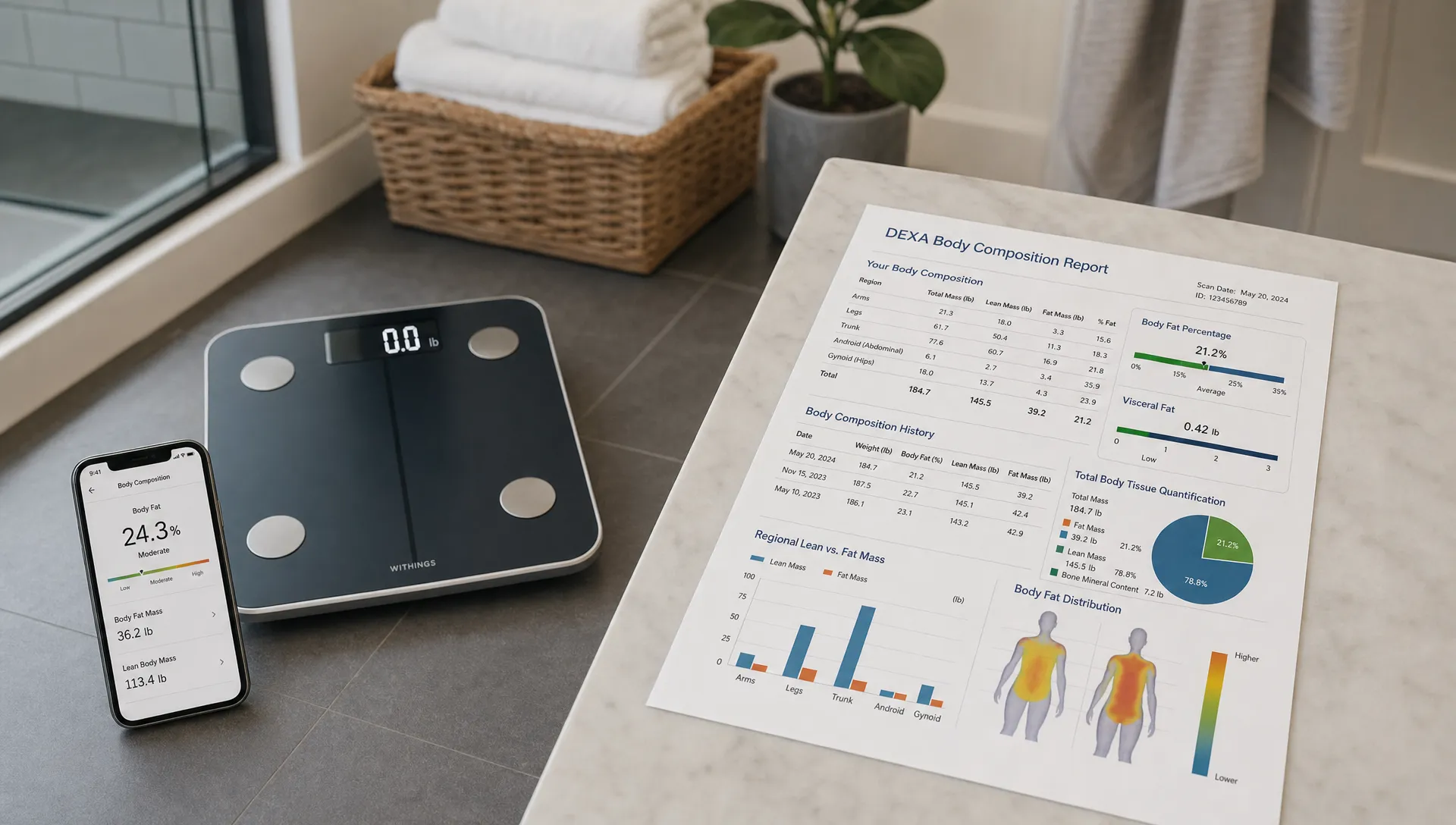
DEXA Body Fat Measurement: Why It Beats Smart Scales
Your smart scale is convenient. It is also easy to believe because it gives you a body fat percentage in seconds, often with decimal places that feel scientific. But when the goal is to make decisions about fat loss, muscle gain, performance, or long-term health, convenience is not the same as confidence.
That is where DEXA body fat measurement stands apart. A DEXA scan does not simply estimate your body composition from your weight and an electrical signal. It uses dual-energy X-ray absorptiometry to separate your body into fat mass, lean soft tissue, and bone mineral content, then shows where those tissues are distributed.
Smart scales can still be useful for daily weight trends. But if you want a reliable baseline, a clearer progress check, or a more complete picture than “weight down” or “weight up,” DEXA gives you data a bathroom device cannot.
Why smart scales feel precise, but often are not
Most smart scales use bioelectrical impedance analysis, commonly called BIA. When you stand on the scale, a very small electrical current passes through your body, usually from foot to foot. Because water-rich lean tissue conducts electricity differently than fat tissue, the scale estimates body composition based on electrical resistance.
The key word is estimates. A smart scale does not directly see fat, muscle, bone, or visceral fat. It uses impedance, your height, weight, age, sex, and the manufacturer’s algorithm to predict those values.
That means the number can shift for reasons that have little to do with actual fat gain or fat loss. Hydration, sodium intake, recent exercise, skin temperature, alcohol, menstrual cycle phase, meal timing, and even how your feet contact the sensors can all affect the reading. A hard workout the night before may temporarily change fluid distribution. A salty dinner may increase water retention. A dehydrated morning may make your estimated body fat percentage look higher or lower than reality, depending on the device and algorithm.
This does not make smart scales useless. They can help you notice weight trends, build consistency, and stay engaged. The problem starts when you treat the body fat percentage on a smart scale as a precise measurement.
What makes DEXA body fat measurement different
DEXA stands for dual-energy X-ray absorptiometry. It is widely used for bone density testing, and the FDA describes DXA as a common method for measuring bone mineral density. In a body composition scan, the same underlying technology helps differentiate bone mineral content, lean soft tissue, and fat mass.
Instead of inferring your body fat percentage from electrical resistance, a DEXA scan measures how two low-dose X-ray beams pass through different tissues. The result is a detailed body composition report that can include total body fat percentage, fat mass, lean mass, bone density, visceral fat, and left-versus-right asymmetries.
The practical difference is simple: DEXA gives you a map, while a smart scale gives you a rough estimate.
| What you want to know | DEXA scan | Smart scale |
|---|---|---|
| Total body fat percentage | Measures fat mass and body composition using imaging-based technology | Estimates body fat using electrical impedance and an algorithm |
| Regional fat distribution | Shows fat by region, such as trunk, arms, and legs | Usually cannot accurately separate regional fat |
| Lean mass tracking | Reports lean soft tissue by region | Estimates lean mass indirectly, often from water-based assumptions |
| Visceral fat insight | Can estimate visceral fat in the abdominal region | Many scales provide a score, but it is algorithm-based |
| Bone density | Measures bone mineral content and density metrics | Not measured |
| Left-right asymmetry | Can show side-to-side differences in lean mass | Not typically measured in a meaningful way |
| Best use | Periodic benchmarks and program decisions | Daily weight trends and general habit feedback |
The biggest reasons DEXA beats smart scales
1. DEXA separates fat loss from weight loss
A lower number on the scale can mean fat loss. It can also mean water loss, muscle loss, less food in your digestive system, or a combination of all of these. If you are dieting aggressively, the scale may move quickly while lean mass drops too. If you are strength training, the scale may barely move while you lose fat and gain lean mass.
DEXA helps clarify what changed. For example, two people can both lose five pounds, but one may lose mostly fat while the other loses a mix of fat and lean tissue. Those are very different outcomes, especially if your goal is to improve body composition rather than simply weigh less.
For a deeper look at precision and what affects the numbers, DEXA SF has a dedicated guide on DEXA scan accuracy for body fat percentage.
2. DEXA shows where fat is stored
Body fat percentage is useful, but location matters too. Fat stored around the abdomen is not the same as fat stored in the hips or limbs. Visceral fat, the fat stored deeper in the abdominal area around internal organs, is especially important because it is associated with metabolic health risks.
A smart scale may show a visceral fat rating, but it is still an estimate generated from a formula. DEXA can provide a more meaningful view of abdominal fat distribution and visceral fat estimates. If this is a priority for you, it is worth understanding what a DEXA scan for visceral fat can reveal beyond your total body fat percentage.
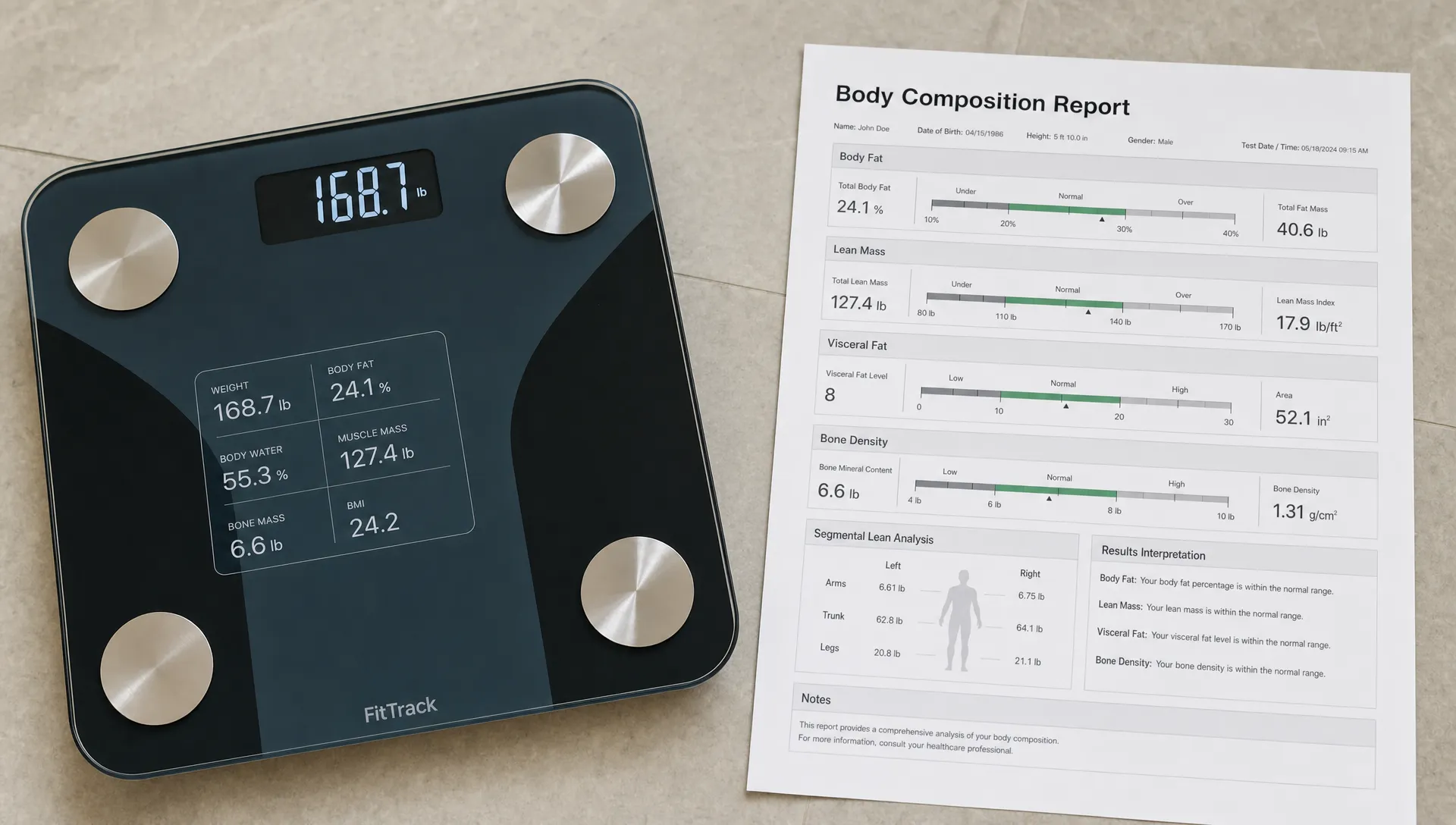
3. DEXA tracks lean mass more clearly
Smart scales often use “muscle mass” language, but most consumer devices are estimating lean mass from electrical impedance and body water. That can be directionally interesting, but it is not the same as measuring regional lean soft tissue.
DEXA is especially valuable if you lift weights, play sports, or are trying to preserve muscle while losing fat. It can show whether lean mass is increasing, decreasing, or staying stable across different regions of the body.
This matters because muscle gain is not always evenly distributed. You may find that one leg carries more lean mass than the other, or that your upper body is lagging behind your lower body. Those insights can help shape smarter training decisions. DEXA SF explains this in more detail in its article on how a DEXA scan tracks muscle mass progress.
4. DEXA includes bone density information
Smart scales cannot measure bone density. Some may display a “bone mass” estimate, but that is not the same as a DEXA-based bone density assessment.
This is one of the most overlooked advantages of DEXA. Even if your main reason for booking a scan is body composition, bone density information can be valuable context, especially for athletes, older adults, people with a history of dieting, or anyone thinking long term about strength and resilience.
A body composition scan is not a substitute for medical care or a physician-directed diagnostic exam. Still, having more information about your body can help you ask better questions and make better-informed decisions.
5. DEXA is better for program decisions
If a smart scale says your body fat went from 22.4% to 21.8%, should you change your calorie target? Add cardio? Increase protein? Adjust training? Maybe, but maybe not. That change may be noise.
DEXA is better suited for meaningful checkpoints. It helps you evaluate whether your current plan is working after enough time has passed for real tissue change to occur. Instead of reacting to daily fluctuations, you can compare scans and look at fat mass, lean mass, visceral fat, and regional changes together.
That makes DEXA useful for questions like:
- Am I losing fat while preserving muscle?
- Is my strength training program increasing lean mass?
- Is my visceral fat moving in the right direction?
- Are there left-right imbalances worth addressing?
- Did my nutrition plan produce the body composition change I expected?
When a smart scale is still useful
The best comparison is not “DEXA or smart scale.” For many people, the strongest approach is to use each tool for what it does best.
A smart scale can be helpful for daily or weekly weight tracking. If you weigh yourself under consistent conditions, such as after waking and before eating, you can use the trend line to understand whether your body weight is generally moving up, down, or staying stable.
The body fat percentage on the smart scale should be treated as a rough signal, not a final answer. If it moves dramatically overnight, that is almost certainly not a true change in fat mass. If the trend changes gradually over months, it may be useful, but it is still worth validating with a more reliable method.
DEXA, on the other hand, is best used as a periodic benchmark. Many people use it at the start of a fitness or nutrition phase, then repeat it after several weeks or months to see what actually changed. The exact timing depends on your goals, your provider’s guidance, and how quickly your program is expected to create measurable change.
How to get the most from a DEXA scan
A DEXA scan is only as useful as the decisions you make from it. The goal is not to collect numbers for their own sake. The goal is to turn better data into better action.
Start by identifying your main objective. A fat-loss client may focus on fat mass, visceral fat, and lean mass preservation. A strength athlete may care more about regional lean mass and asymmetry. Someone focused on healthy aging may pay closer attention to bone density, lean mass, and abdominal fat.
Next, standardize your comparisons as much as possible. Try to scan under similar conditions each time. Follow the preparation instructions from your scan provider, and avoid comparing a scan done after unusual travel, dehydration, or a major routine disruption with one done under normal conditions.
Finally, review your results with someone who can interpret them in context. At DEXA SF, clients receive professional DEXA body composition scans in San Francisco along with expert interpretation, fitness guidance, and nutrition advice. That matters because a report can tell you what changed, but a qualified expert can help you understand what to do next.
Who benefits most from DEXA body fat measurement?
DEXA is valuable for anyone who wants more than a weight trend, but it is especially useful when the stakes are higher than curiosity.
If you are dieting, DEXA can show whether your weight loss is coming primarily from fat. If you are lifting, it can show whether lean mass is increasing. If your weight is stable but your clothes fit differently, DEXA can help confirm whether body recomposition is happening. If you are concerned about abdominal fat, it can provide a clearer view of visceral fat than a home scale.
It is also useful for people who feel stuck. Sometimes the scale says nothing is happening, but a scan shows fat loss and lean mass gain. Other times, the scale is dropping, but the scan shows more lean mass loss than expected. Both insights are useful because they help you adjust with evidence rather than guesswork.
Frequently Asked Questions
Is DEXA body fat measurement more accurate than a smart scale? Yes. A DEXA scan uses imaging-based technology to measure body composition, while a smart scale estimates body fat from bioelectrical impedance and algorithms. Smart scales can be useful for trends, but DEXA provides a more reliable and detailed benchmark.
Can a smart scale track fat loss at all? It can sometimes show a general trend over time, especially if you weigh under consistent conditions. However, hydration, meals, exercise, and device algorithms can cause fluctuations that do not reflect true fat change.
Does DEXA measure muscle mass directly? DEXA reports lean soft tissue, which includes muscle and other non-fat, non-bone tissue. For fitness tracking, regional lean mass is often a useful indicator of muscle changes when scans are compared consistently.
How often should I get a DEXA scan? It depends on your goal. Many people use DEXA before starting a training or nutrition phase, then repeat after enough time has passed to create measurable change. Follow your provider’s guidance, especially if you have medical considerations.
Can DEXA show visceral fat? Yes, DEXA can estimate visceral fat in the abdominal region, depending on the scan and reporting software. This is one reason it provides more actionable health and fitness insight than a basic scale reading.
Get a clearer benchmark than your smart scale can provide
If you are serious about understanding your body composition, a smart scale can only take you so far. DEXA gives you a clearer view of body fat, lean mass, visceral fat, bone density, and asymmetries, all in one scan.
DEXA SF provides professional DEXA scans in San Francisco with expert interpretation and practical fitness and nutrition guidance. If you want better data before making your next training or nutrition decision, you can schedule a DEXA scan with DEXA SF and replace guesswork with a more reliable baseline.