
DEXA Body Composition: The Metrics That Matter Most
Your bathroom scale can tell you whether your weight changed. It cannot tell you what changed. Did you lose fat, gain muscle, retain water, or simply shift where your body stores tissue? That is where a DEXA body composition scan becomes useful.
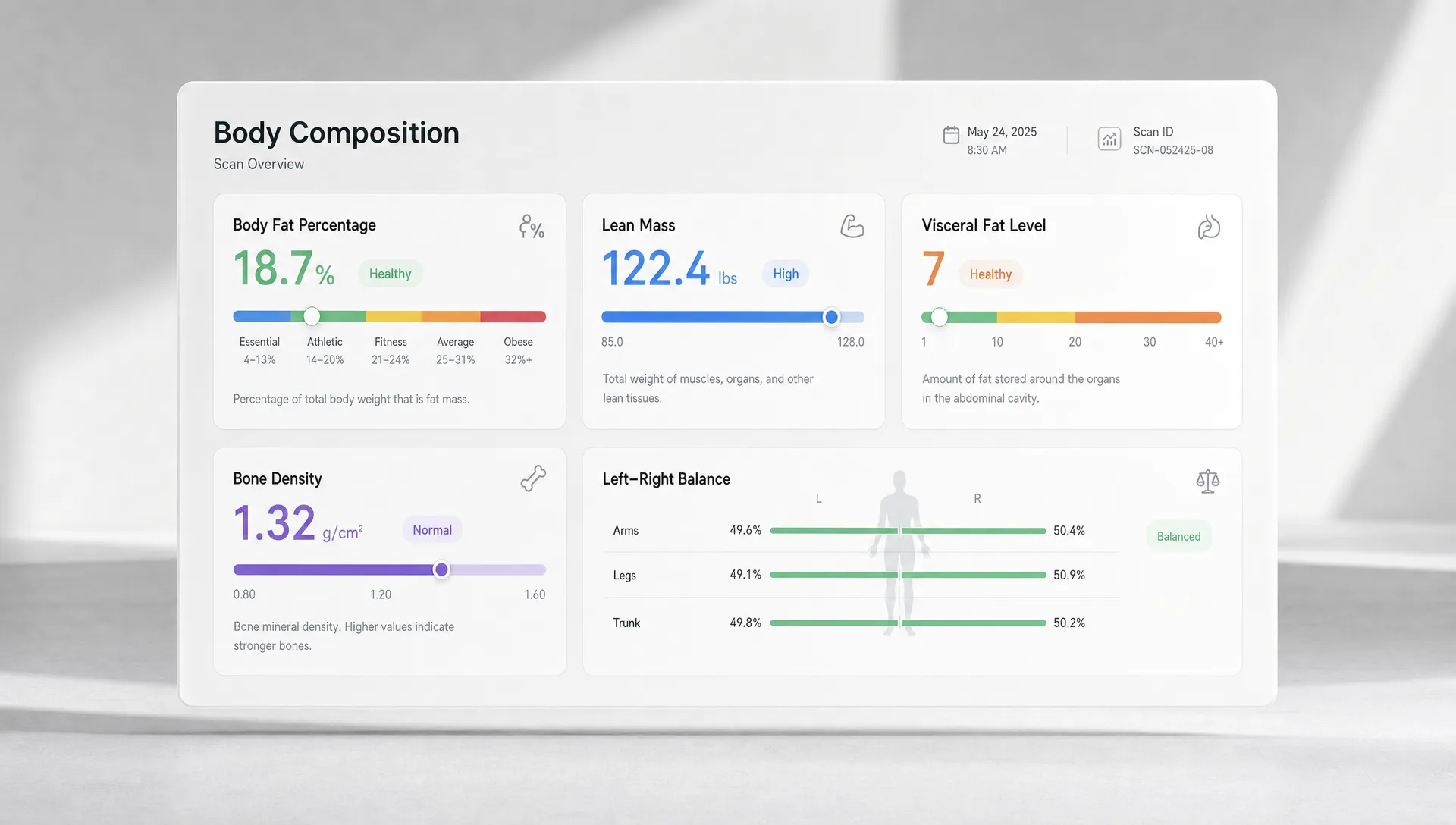
A DEXA report can include body fat percentage, total fat mass, lean mass, visceral fat, regional distribution, left vs. right asymmetries, bone density, and metabolic estimates. That amount of data is powerful, but it can also be overwhelming if you do not know which numbers deserve the most attention.
The goal is not to chase every metric at once. The goal is to identify the measurements that connect most directly to your health, fitness, and performance goals, then track them consistently enough to make better decisions.
Why DEXA body composition data is different
Most common body composition tools use indirect estimates. BMI compares height and weight, but as the CDC notes, BMI does not directly measure body fat. Smart scales use bioelectrical impedance, which can shift with hydration, meal timing, skin temperature, and other daily variables.
DEXA, short for dual-energy X-ray absorptiometry, uses two low-dose X-ray energy levels to estimate bone mineral content, fat tissue, and lean soft tissue. For body composition, that means you get a compartment-level view of your body rather than one general weight number.
If you are still deciding where a scan fits into your plan, this broader DEXA scan guide for benefits, cost, and timing can help you understand the bigger picture. This article focuses on what to do with the numbers once you have them.
The DEXA metrics that matter most
Not every metric has the same value for every person. A strength athlete, a runner, a person focused on fat loss, and someone monitoring bone health may all need different primary measurements. Still, most DEXA reports can be organized into a practical hierarchy.
| Metric | What it tells you | Why it matters |
|---|---|---|
| Body fat percentage | The share of total body mass that is fat | Useful for broad body composition context |
| Total fat mass | The actual pounds or kilograms of fat tissue | Better than percentage alone for tracking fat loss |
| Lean mass | Non-fat, non-bone soft tissue, including muscle and water | Key for strength, metabolism, and healthy aging |
| Regional lean mass | Lean tissue by arms, legs, trunk, and sides | Helps identify imbalances and training effects |
| Visceral fat | Fat stored deep around abdominal organs | Important for cardiometabolic risk awareness |
| Bone mineral density | A measure of bone strength and mineral content | Relevant for long-term bone health |
| Metabolic estimates | Energy needs estimated from body composition | Helps personalize nutrition planning |
Think of the report as a dashboard. Body fat percentage is the familiar headline number, but the deeper value often comes from the supporting metrics.
Body fat percentage: useful, but not the whole story
Body fat percentage is usually the number people look for first. It tells you what proportion of your total body mass is fat. If you weigh 180 pounds and your body fat percentage is 25 percent, roughly one quarter of your body weight is fat mass.
That number is useful because it gives context that scale weight cannot. Two people can weigh the same amount and have very different body compositions. One may carry more lean mass and less fat mass, while the other may have less muscle and more fat.
The limitation is that body fat percentage is a ratio. It can improve because you lost fat, gained lean mass, or both. It can also look worse if you lose lean mass faster than fat. That is why serious progress tracking should always pair body fat percentage with total fat mass and lean mass.
For example, if your body fat percentage drops but your lean mass drops sharply too, your plan may be too aggressive. If your weight stays similar but your fat mass decreases and lean mass increases, the scale may look “stuck” even though your body composition is improving.
Total fat mass: the cleaner fat loss metric
If your goal is fat loss, total fat mass is often more actionable than body fat percentage. It shows how much fat tissue you are carrying in pounds or kilograms. When total fat mass decreases over multiple scans, you have direct evidence that your fat loss strategy is working.
This is especially helpful when strength training is part of your plan. Many people get discouraged when scale weight does not change quickly, but a DEXA scan may show that fat mass is decreasing while lean mass is stable or increasing. That is a very different story than “nothing is happening.”
When reviewing your results, look for direction and consistency rather than obsessing over tiny changes. A single scan is a baseline. Two or more scans, performed under similar conditions, begin to show a trend.
If you already have a report and want help interpreting the layout, this guide on how to read DEXA scan body fat results breaks down common report sections in more detail.
Lean mass: the metric many people underestimate
Lean mass includes muscle, organs, connective tissue, and body water. It is not a perfect one-to-one measurement of skeletal muscle, but it is still one of the most important metrics on a DEXA report.
Why does it matter? Lean tissue is closely tied to strength, training capacity, functional independence, and metabolic health. Preserving lean mass during fat loss is also critical. Losing weight quickly is not automatically a win if a large share of that loss comes from lean tissue.
For athletes and regular lifters, lean mass helps answer questions like whether a training block is actually producing tissue gain. For people focused on healthy aging, it provides a way to monitor whether muscle-supporting habits, such as progressive resistance training and adequate protein intake, are doing their job.
The key is to track lean mass alongside performance. If your DEXA lean mass is increasing and your gym numbers, sprint times, or daily energy are improving, that is a stronger signal than body composition alone.
Regional lean mass and asymmetry: where your tissue is located
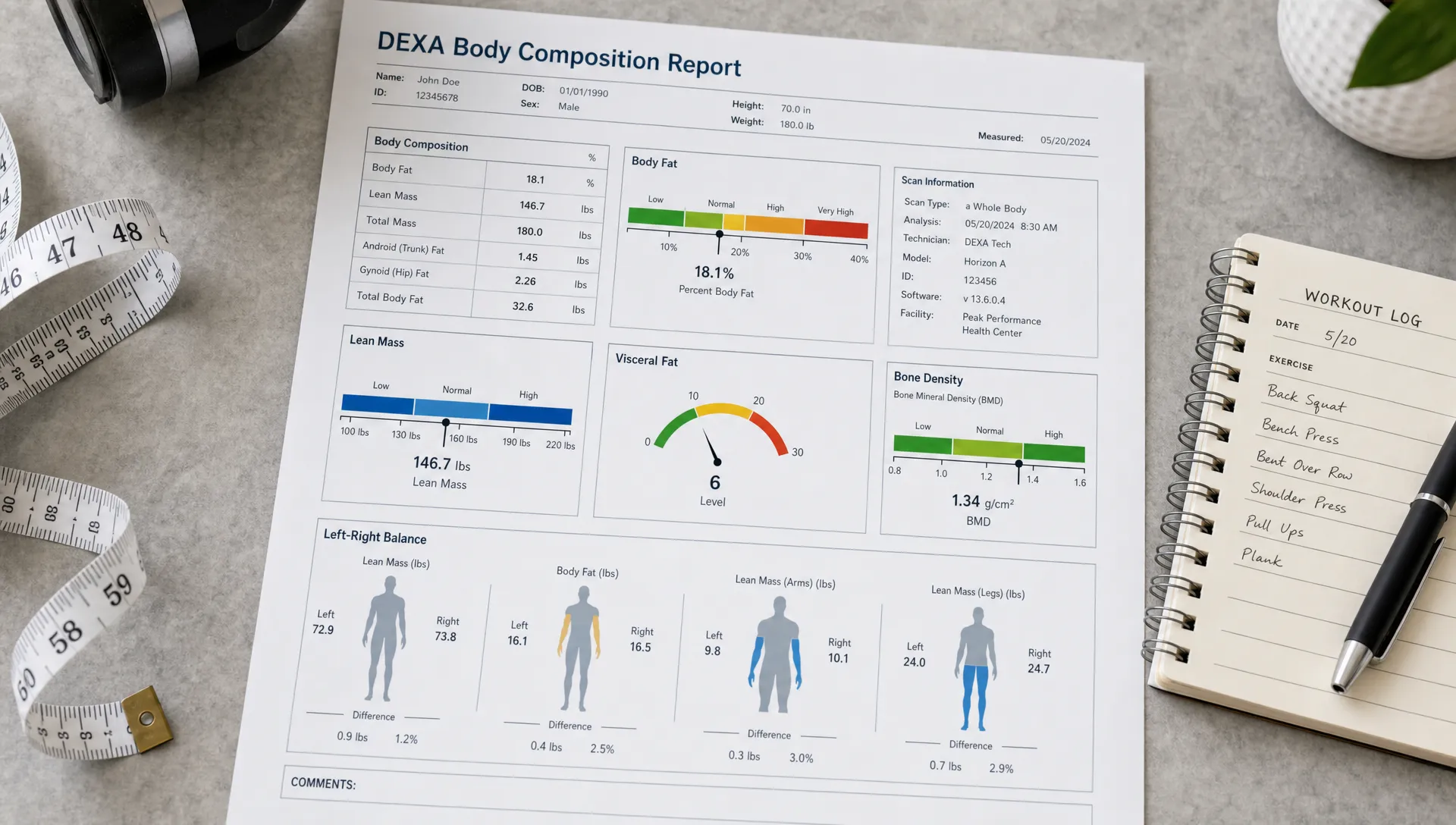
One of the advantages of DEXA body composition testing is that it does not only show totals. It can break tissue down by region, including arms, legs, trunk, and left vs. right sides.
This matters because the location of lean mass can influence performance and injury risk. A cyclist, runner, tennis player, golfer, or strength athlete may develop side-to-side differences because of sport demands, previous injuries, or training habits. Not every asymmetry is a problem, but large or unexpected differences can be worth discussing with a coach, physical therapist, or qualified professional.
Regional data is also useful during recomposition. If your total lean mass rises, you can see where that change is happening. More leg lean mass may reflect lower-body training progress, while changes in trunk composition may connect to shifts in abdominal fat, posture, or training emphasis.
Visceral fat: the health metric to take seriously
Visceral fat is fat stored deep in the abdomen around internal organs. It is different from subcutaneous fat, which sits under the skin. While all fat tissue has biological functions, higher visceral fat is more strongly associated with cardiometabolic concerns than fat stored in some other areas.
This is one reason waist size can matter even when body weight looks “normal.” A person may not appear significantly overweight but still carry more abdominal visceral fat than expected. DEXA can estimate visceral adipose tissue, often reported in the android region of the body.
For many people, visceral fat is one of the most valuable DEXA metrics because it connects body composition to health risk awareness, not just appearance. If visceral fat is elevated, the next step is not panic. It is a more targeted plan that may include nutrition changes, resistance training, aerobic conditioning, sleep improvement, and stress management.
The best use of visceral fat data is trend tracking. If your total weight changes modestly but visceral fat decreases over time, that can represent meaningful progress.
Bone density: the long-term health metric
Bone mineral density is one of the original clinical uses of DEXA technology. In a body composition context, bone density data can add an important long-term health perspective, especially for adults with risk factors for low bone density, athletes in weight-sensitive sports, postmenopausal women, and anyone with a history of fractures or prolonged under-fueling.
Bone density is commonly discussed through T-scores and Z-scores in clinical settings. A T-score compares bone density to that of a healthy young adult reference population, while a Z-score compares it to what is typical for someone of similar age and sex. Formal interpretation should be handled by a qualified medical professional, especially if results are abnormal or if you have medical risk factors.
For fitness planning, bone density reinforces the importance of resistance training, impact loading when appropriate, adequate nutrition, and sufficient vitamin D and calcium intake. Unlike fat mass, bone density usually changes slowly, so it should be viewed as a long-term metric rather than a month-to-month scorecard.
Metabolic data: helpful for planning, not a magic calorie target
Many DEXA reports and expert interpretations include metabolic insights, often based on lean mass and other body composition inputs. This can help estimate resting energy needs and provide a smarter starting point for nutrition planning.
The important word is estimate. Resting metabolic rate is influenced by lean mass, body size, hormones, age, genetics, sleep, dieting history, and activity levels. DEXA-informed metabolic data is more personalized than a generic online calculator, but it should still be tested against real-world outcomes.
For fat loss, metabolic data can help set a calorie deficit that is aggressive enough to work but not so aggressive that lean mass, training quality, or adherence suffers. For muscle gain, it can help avoid the common mistake of eating far beyond what is needed, which often adds unnecessary fat mass.
This is where expert interpretation matters. Numbers are more useful when they are translated into a plan that fits your training, schedule, food preferences, and goals.
Which DEXA metrics should you prioritize for your goal?
The most important metric depends on the decision you are trying to make. A good DEXA interpretation starts with the goal, then selects the metrics that best answer your question.
| Goal | Primary metrics | What to watch |
|---|---|---|
| Fat loss | Total fat mass, body fat percentage, visceral fat | Is fat decreasing while lean mass stays stable? |
| Muscle gain | Lean mass, regional lean mass, body fat percentage | Are you adding lean tissue without excessive fat gain? |
| Athletic performance | Regional lean mass, asymmetries, fat mass | Does body composition support your sport demands? |
| Health risk awareness | Visceral fat, body fat distribution, bone density | Are higher-risk areas improving over time? |
| Healthy aging | Lean mass, appendicular lean mass, bone density | Are you preserving muscle and bone as you age? |
| Nutrition planning | Lean mass, metabolic estimates, fat mass trend | Are calorie and protein targets producing the intended change? |
This goal-first approach prevents data overload. You do not need every number to improve at once. You need the right numbers moving in the right direction for your current objective.
How to track progress without misleading yourself
DEXA is precise, but your testing routine still matters. To make scan-to-scan comparisons more useful, standardize the conditions as much as possible.
- Scan at a similar time of day when possible.
- Keep pre-scan meals, hydration, and exercise timing consistent.
- Avoid comparing a post-vacation scan to a highly controlled pre-event scan without context.
- Track training, nutrition, sleep, and major lifestyle changes between scans.
- Focus on trends over multiple scans, not small changes from one test.
Most people do not need to scan every week. During an active fat loss, muscle gain, or performance phase, a scan every 8 to 16 weeks is often enough time to see meaningful change. For bone density, longer intervals are typically more appropriate because bone adaptation is slower.
The best schedule depends on your goal and how quickly your plan is changing. If you are making a major nutrition or training adjustment, a follow-up scan can help confirm whether that adjustment is working.
Common mistakes when reading DEXA body composition results
The first mistake is treating body fat percentage as the only score. It is important, but it is not the full story. Fat mass, lean mass, and visceral fat often give better guidance for decision-making.
The second mistake is comparing your result to someone else’s. Body composition is influenced by sex, age, height, training history, sport, genetics, and health status. A number that is appropriate for one person may be unrealistic or unnecessary for another.
The third mistake is switching measurement methods and expecting perfect agreement. A smart scale, skinfold test, Bod Pod, InBody, and DEXA scan may all produce different numbers because they use different assumptions. If you use DEXA as your benchmark, stick with it for trend tracking. If you are curious about why home devices can disagree, this comparison of DEXA body fat measurement versus smart scales explains the difference.
The fourth mistake is ignoring the plan behind the data. A scan can show what is happening, but it does not replace consistent training, nutrition, recovery, and follow-through.
Frequently Asked Questions
What is the most important DEXA body composition metric? It depends on your goal. For fat loss, total fat mass and visceral fat are often more actionable than body fat percentage alone. For strength and aging, lean mass and bone density may matter more.
Is body fat percentage from DEXA enough to track progress? No. Body fat percentage is useful, but it is a ratio. Pair it with total fat mass and lean mass to understand whether your changes are coming from fat loss, muscle gain, or lean tissue loss.
How often should I get a DEXA body composition scan? Many people scan every 8 to 16 weeks during an active fitness or nutrition phase. Bone density changes more slowly, so it is usually tracked over a longer timeline with professional guidance.
Can DEXA measure visceral fat? DEXA can estimate visceral fat in the abdominal region. This metric is valuable because visceral fat is more closely connected to cardiometabolic health risk than some other fat storage areas.
Does DEXA tell me exactly how many calories to eat? DEXA can support more personalized calorie and nutrition planning by showing lean mass, fat mass, and metabolic estimates. However, calorie targets still need to be adjusted based on real-world progress, training, hunger, and adherence.
Turn your DEXA metrics into a clearer plan
The best DEXA body composition scan is not just a report full of numbers. It is a decision tool. When you know which metrics matter most, you can stop guessing and start adjusting your training and nutrition with more confidence.
DEXA SF provides professional DEXA scans in San Francisco with measurements for body fat, lean mass, bone density, visceral fat, asymmetries, and metabolic insights. You also receive expert interpretation, fitness guidance, and nutrition advice to help connect your results to your next steps.
If you want a clearer baseline or a more accurate way to track progress, you can schedule a DEXA body composition scan with DEXA SF.