
Why DEXA Uses Two X-Ray Energy Levels
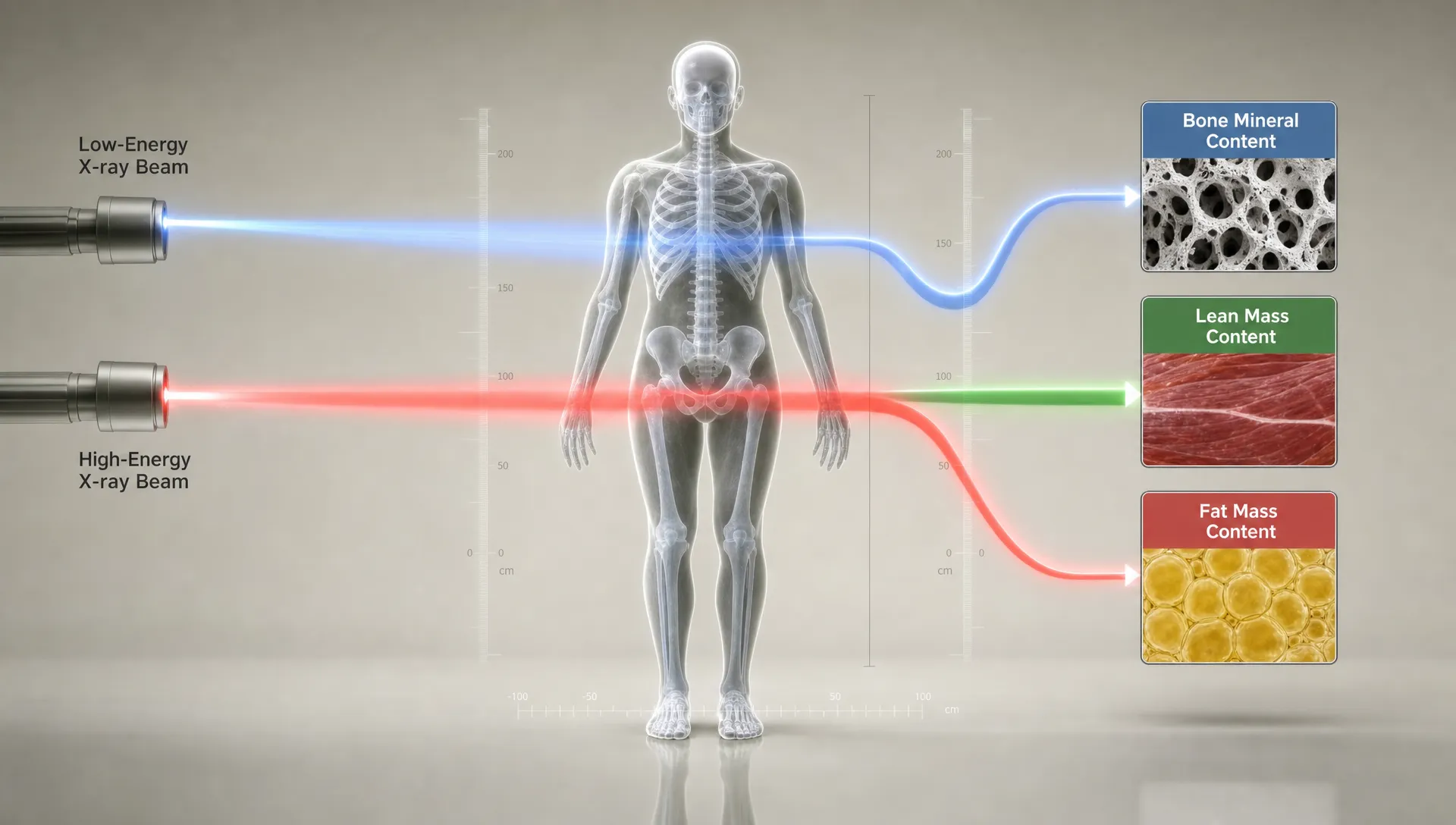
DEXA uses two X-ray energy levels because the scan is not trying to create a simple shadow picture. It is trying to measure what your body is made of.
A regular X-ray mainly shows how much radiation is blocked as it passes through the body. Dense structures, especially bone, block more of the beam and look lighter on the image. That is useful for seeing fractures, but it is not enough to separate body fat, lean tissue, bone mineral and regional differences in a reliable way.
DEXA, also called DXA in medical literature, stands for dual energy X-ray absorptiometry. The key phrase is dual energy. By comparing how two different X-ray energy levels pass through the same area, DEXA can estimate how much of that area is bone mineral, fat mass and lean soft tissue.
That dual measurement is the reason DEXA is widely used for both bone density and body composition. If you want a broader first-time overview before going deeper into the physics, DEXA SF has a helpful guide on how a DEXA X-ray differs from a regular X-ray.
The short answer: different tissues absorb X-rays differently
X-rays lose energy as they pass through the body. This process is called attenuation. The amount of attenuation depends on several factors, including tissue thickness, density and chemical composition.
Bone mineral absorbs X-rays differently from soft tissue because it contains calcium and other minerals. Fat and lean tissue also differ in composition. Lean tissue contains more water and protein, while fat tissue has a different elemental makeup and density. These differences are subtle compared with the difference between bone and air, but they are measurable when the system uses two energy levels instead of one.
A single X-ray energy level can tell you that something reduced the beam. It cannot always tell you whether that reduction came from a thicker body region, more bone mineral, more lean mass or more fat. DEXA solves much of that ambiguity by sending low dose X-rays at two different energy levels and comparing the attenuation pattern.
In simple terms, DEXA asks two questions at once: how much did the lower energy beam get absorbed, and how much did the higher energy beam get absorbed? The relationship between those two answers helps the system classify tissue.
What changes when X-ray energy changes?
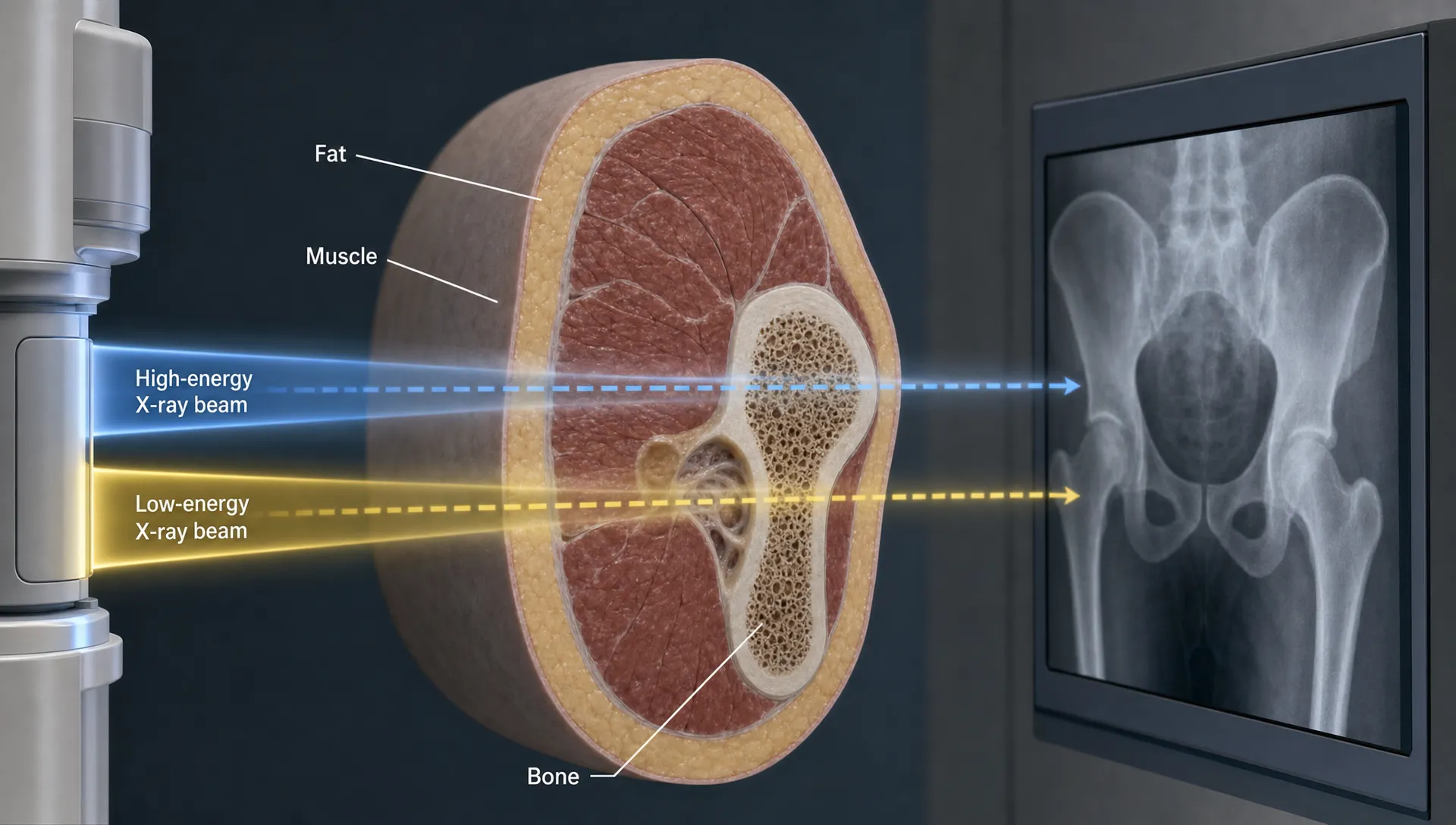
Lower energy X-rays are generally absorbed more strongly than higher energy X-rays. The difference is especially meaningful when the beam passes through mineralized tissue such as bone. Higher energy X-rays pass through more easily, so the two measurements create a contrast pattern that gives DEXA more information than a single beam could provide.
That contrast pattern is sometimes described as an attenuation ratio. The scanner measures how the low energy and high energy beams weaken as they pass through each small region of the body. DEXA software then uses calibrated mathematical models to estimate tissue composition.
| Body component | How it behaves in DEXA measurement | What the dual energy comparison helps estimate |
|---|---|---|
| Bone mineral | Absorbs X-rays strongly, with a distinct response across energy levels | Bone mineral content and bone mineral density |
| Lean soft tissue | Attenuates X-rays differently than fat because of water and protein content | Lean mass estimates by region and whole body |
| Fat tissue | Has a different attenuation profile than lean tissue | Fat mass and body fat percentage estimates |
| Mixed regions | Contain overlapping bone, fat and lean tissue | A modeled separation of tissue compartments |
This is why the word “energy” in dual energy X-ray absorptiometry matters. DEXA is not simply taking two identical pictures. It is gathering two different measurements from the same anatomy so the system can compare tissue behavior.
Why one X-ray energy level is not enough
Imagine two body regions that block the same amount of a single X-ray beam. One region might contain more lean tissue, while the other might contain more fat or simply be thicker. With one energy level, those scenarios can look too similar.
DEXA improves the measurement by looking at how tissue responds when the X-ray energy changes. If two regions reduce the low energy beam and high energy beam in different proportions, the scanner gains a clue about what those regions contain.
This is also why a standard body X-ray is not designed for tracking fat loss, muscle gain, visceral fat or left-to-right asymmetry. A conventional X-ray can be excellent for evaluating bones and certain medical concerns, but it is not a body composition tool. If your goal is fitness or metabolic tracking, DEXA is a better fit than a standard radiograph, a distinction explained in more detail in DEXA SF’s article on whether a body X-ray is useful for body composition goals.
The purpose of a DEXA scan is measurement, not just imaging. The two energy levels allow the scanner to move from “what blocks the beam?” to “what type of tissue is likely causing that absorption pattern?”
How two energy levels become useful DEXA results
A DEXA scan starts with a low dose X-ray source and a detector. As the scanning arm passes over the body, the system records how much of each energy level reaches the detector after passing through tissue.
The machine is calibrated so the software can interpret those signals consistently. Calibration matters because DEXA results are quantitative. You are not only looking at a picture, you are receiving numerical estimates such as total body fat percentage, fat mass, lean mass, bone mineral density and regional body composition.
The software then applies validated models to estimate tissue compartments. In broad terms, DEXA divides the body into bone mineral, fat mass and lean soft tissue. For whole body scans, it can also report regional values such as trunk fat, arm and leg lean mass and left-to-right differences.
Expert interpretation adds another layer. Numbers are more useful when they are placed in context: your training history, goals, nutrition habits, previous scans and health considerations. That is why many people use DEXA not as a one-time curiosity, but as a benchmark for tracking changes over time. If you are deciding which metrics matter most, this guide to DEXA results worth tracking can help you focus on the most actionable data.
Why DEXA can measure bone and body composition in one scan
DEXA’s dual energy approach is especially well suited to bone because bone mineral has a strong and distinct X-ray attenuation pattern. That is why DEXA is widely used for bone density testing.
The same scan technology can also be used for body composition because the system can separate soft tissue into fat and lean estimates. For fitness and nutrition goals, that means DEXA can provide a more complete picture than body weight alone. Two people can weigh the same but have very different fat mass, lean mass, bone density and visceral fat patterns.
At DEXA SF, the value of the scan is not only the machine output. Clients receive precise measurements along with expert interpretation, fitness guidance and nutrition advice based on the results. That combination helps turn technical data into decisions you can act on.
Does dual energy mean double the radiation?
No. “Dual energy” does not mean the scan uses double the radiation of a standard scan or that you are receiving two high dose X-rays. It means the system uses two X-ray energy spectra to collect different information.
DEXA is known for using a very small amount of ionizing radiation. RadiologyInfo.org, a patient education site from the American College of Radiology and the Radiological Society of North America, describes DXA as using a very small dose of radiation to measure bone density. The U.S. Food and Drug Administration also identifies DXA as a bone density scanning method that uses low dose X-rays.
Still, DEXA uses ionizing radiation, so it should be treated as a real imaging procedure. If you are pregnant, may be pregnant or have had recent contrast imaging, you should mention that before your scan. A qualified provider can tell you whether it is appropriate to proceed or reschedule.
Why energy separation matters for fitness and health tracking
The advantage of two X-ray energy levels becomes practical when you are trying to answer questions that a scale cannot answer.
Weight alone cannot tell you whether a change came from fat, muscle, water or normal day-to-day variation. Tape measurements can show size changes, but not internal composition. Bioelectrical impedance scales can be convenient, but their results can shift with hydration, meal timing and other short-term factors.
DEXA gives a more detailed baseline. It can help you see whether a training plan is preserving or increasing lean mass, whether fat loss is coming from the trunk or limbs, whether left and right sides differ meaningfully and whether visceral fat is moving in the right direction. The two energy levels are not a technical footnote. They are the reason the scan can provide those separate estimates.
For athletes, DEXA can help evaluate lean mass distribution and asymmetry. For people pursuing fat loss, it can distinguish scale weight loss from actual fat mass change. For people focused on long-term health, it can provide bone density and body composition information in a single visit.
The limits of dual energy measurement
DEXA is powerful, but it is not magic. The scan estimates body composition using a validated model, and like all measurement tools, it works best when conditions are consistent.
Hydration status, recent meals, recent intense exercise, positioning and differences between machines can influence results. That does not make DEXA unreliable. It means repeat scans should be done under similar conditions whenever possible, especially if you are tracking small changes over time.
DEXA also does not replace every other test. It is not an MRI, CT scan or diagnostic workup for every medical condition. It does not show the same anatomical detail as cross-sectional imaging. Its strength is precise, low dose measurement of bone density and body composition compartments.
A good DEXA interpretation should acknowledge both sides: the technology is one of the best available tools for body composition assessment, and the numbers are most useful when interpreted in context.
What to take away from the two energy levels
DEXA uses two X-ray energy levels because body composition requires more than a shadow image. Different tissues absorb low and high energy X-rays in different ways. By comparing those differences, DEXA can estimate bone mineral, fat mass and lean tissue far more effectively than a single energy X-ray.
That is the core reason DEXA is considered a gold standard for body composition analysis. The dual energy method turns X-ray attenuation into actionable data, from body fat percentage and muscle mass distribution to bone density and visceral fat estimates.
For patients, the takeaway is straightforward: the “dual energy” part of DEXA is not a marketing detail. It is the physics that makes the scan useful.
Frequently Asked Questions
Why does DEXA use two X-ray energy levels? DEXA uses two X-ray energy levels because bone, fat and lean tissue absorb lower and higher energy X-rays differently. Comparing those two absorption patterns helps the scanner estimate body composition and bone density.
Is DEXA the same as a regular X-ray? No. A regular X-ray is primarily designed to create an image, often for evaluating bones or certain medical concerns. DEXA uses dual energy X-ray measurements to quantify bone mineral, fat mass and lean mass.
Does a DEXA scan use a lot of radiation? DEXA uses a low dose of ionizing radiation. The exact exposure depends on the machine and scan type, but DXA is generally recognized as a low dose imaging method. Always tell the provider if you are pregnant or may be pregnant.
Can DEXA tell the difference between fat and muscle? DEXA estimates fat mass and lean soft tissue by comparing how two X-ray energy levels pass through the body. Lean soft tissue includes muscle, organs, water and connective tissue, so DEXA is best understood as a lean mass estimate rather than a direct image of each muscle.
Why is DEXA useful for tracking progress? DEXA can show whether changes in body weight reflect changes in fat mass, lean mass, regional composition or bone density. That makes it useful for fitness, nutrition and long-term health tracking when scans are performed consistently.
Turn dual energy data into a clearer plan
A DEXA scan is most valuable when the results lead to better decisions. At DEXA SF, you can get professional body composition scanning in San Francisco with measurements for body fat, lean mass, bone density, visceral fat, asymmetry and related metabolic insights.
If you want a clearer baseline for your training, nutrition or health goals, schedule a DEXA scan and review your results with qualified experts who can help you understand what the numbers mean.