

DEXA Tests Explained: Which Results Should You Track?
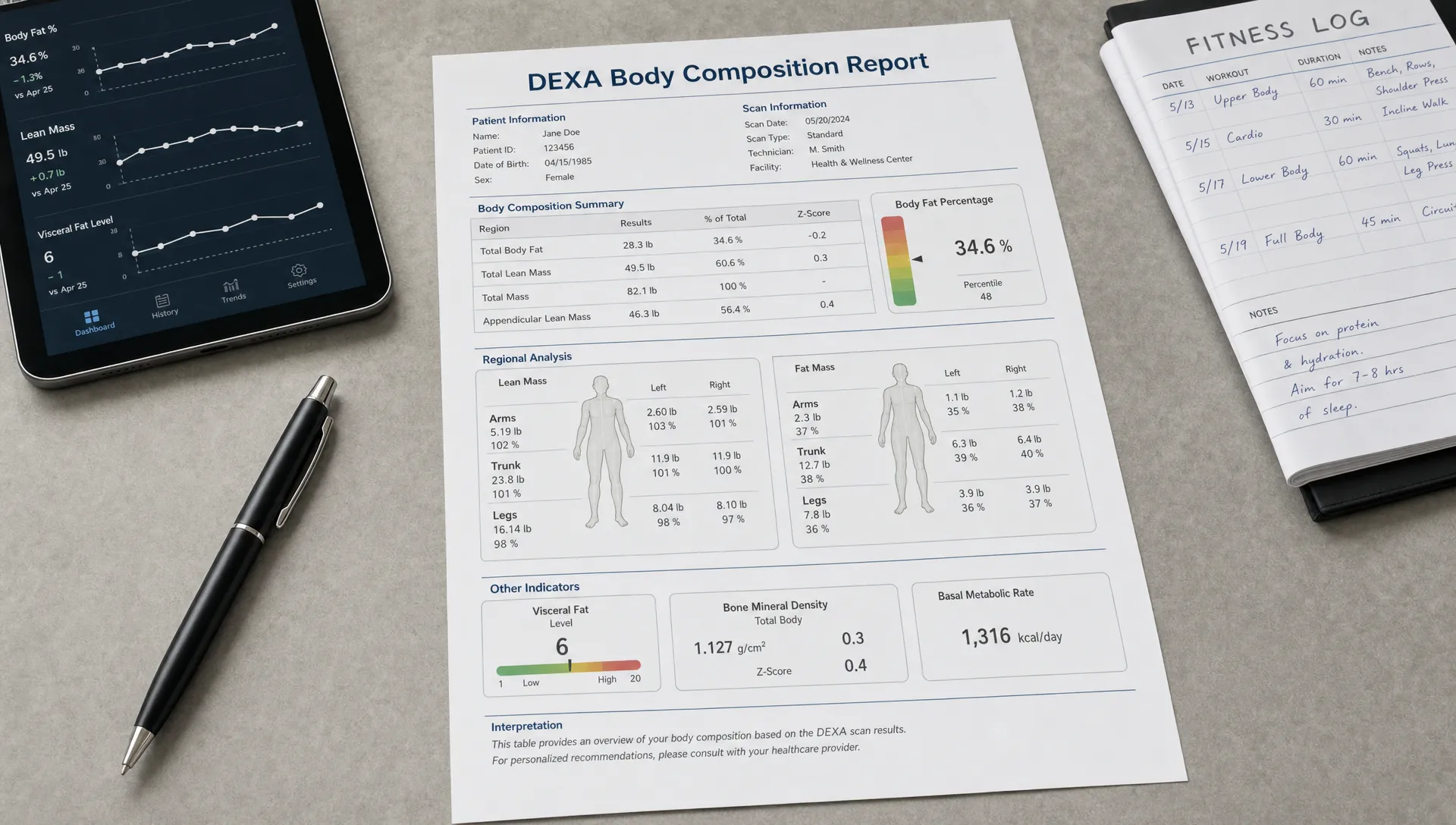
DEXA tests give you more information than a scale, tape measure, or mirror ever can. They can separate fat mass from lean mass, estimate visceral fat, show left-to-right differences, and report bone density data. That is exactly why the results can feel overwhelming at first.
The key is not to track every number with equal intensity. Some results are primary progress markers, some are useful context, and some only change meaningfully over longer timeframes. If you know which results matter for your goal, your DEXA report becomes a decision-making tool instead of a confusing spreadsheet.
Below is a practical guide to the DEXA results worth tracking, how to interpret changes over time, and which numbers deserve the most attention based on your fitness, health, or performance goals.
What DEXA tests actually measure
DEXA stands for dual-energy X-ray absorptiometry. In a body composition setting, the scan uses low-dose X-ray technology to estimate how much of your body is made up of bone mineral, fat tissue, and lean soft tissue. In a bone health setting, DEXA is also widely used to assess bone mineral density.
That distinction matters because people use the term “DEXA test” in different ways. Some are focused on body composition, such as body fat percentage, fat distribution, muscle mass, and asymmetries. Others are focused on bone density and fracture risk. Many DEXA reports include both body composition and bone-related metrics, but the interpretation depends on why you got the scan.
If you are new to the technology and want a plain-English overview of what the scan experience is like, this guide to DEXA X-ray testing for first-time patients explains the process in more detail.
The short answer: track trends, not isolated numbers
A single DEXA scan is a strong baseline. A series of DEXA tests is where the real value appears.
One scan can tell you where you are today. Repeated scans can show whether your training, nutrition, medication plan, or lifestyle changes are moving your body in the intended direction. This is especially useful when body weight is misleading. You might gain three pounds while losing fat and gaining muscle. You might lose weight quickly but discover that too much of the loss came from lean mass.
For best comparisons, try to keep scan conditions consistent. Scan at a similar time of day, follow similar eating and hydration patterns, avoid a hard workout right before the appointment, and use the same testing location when possible. DEXA is precise, but your body’s short-term fluid shifts can still influence lean mass readings.
The core DEXA results worth tracking
Total body fat percentage
Body fat percentage is often the first number people look for. It tells you what proportion of your total body mass is fat tissue. This makes it more useful than body weight alone because two people can weigh the same but have very different body compositions.
Track body fat percentage when your goal is fat loss, recomposition, performance, or general health improvement. A downward trend can be encouraging, especially if lean mass is stable or increasing. However, body fat percentage can also move because your lean mass changed. That is why it should not be interpreted alone.
For example, if your fat mass stays the same but you gain muscle, your body fat percentage may decrease. That is still progress, but it is different from actual fat loss. Always pair body fat percentage with total fat mass and lean mass.
Total fat mass
Fat mass is the estimated amount of fat tissue on your body, usually shown in pounds or kilograms. This is one of the clearest metrics to track if your goal is losing body fat.
If your weight drops by 10 pounds and DEXA shows that eight of those pounds came from fat mass, your plan is likely working well. If your weight drops by 10 pounds and only four came from fat mass, you may need to adjust calories, protein intake, resistance training, recovery, or the pace of weight loss.
Fat mass is often more actionable than body fat percentage because it shows the absolute tissue change. It helps answer the question, “Did I actually lose fat?”
Lean mass
Lean mass includes muscle, organs, water, and other non-fat soft tissue. In fitness conversations, people often use “lean mass” as a proxy for muscle, but it is not exactly the same thing. Hydration, glycogen storage, inflammation, and recent training can affect lean mass readings.
Still, lean mass is one of the most important DEXA results to track. If you are strength training, eating enough protein, and recovering well, you usually want lean mass to be stable or increasing. If you are dieting, preserving lean mass is often one of the most important signs that your plan is sustainable.
Regional lean mass can be even more useful. Seeing lean mass by arms, legs, and trunk can help you identify whether training is producing balanced development. If your goal is muscle gain, this deeper guide on how a DEXA scan tracks muscle mass progress is a useful next step.
Visceral fat
Visceral fat is fat stored deeper in the abdomen around internal organs. It is different from subcutaneous fat, which sits under the skin. Visceral fat matters because higher levels are associated with greater cardiometabolic risk, including insulin resistance and cardiovascular concerns.
DEXA can estimate visceral adipose tissue, often reported as a volume, mass, or area depending on the system. This is one of the most valuable numbers to track if your goal is health improvement rather than appearance alone.
A person can have a moderate body fat percentage but still carry a concerning amount of fat centrally. Another person may not see dramatic changes in scale weight but may reduce visceral fat meaningfully through training, nutrition, sleep improvement, and reduced alcohol intake. That is why visceral fat deserves its own line in your tracking log.
Regional fat distribution
Regional fat data shows where fat is stored across your body, such as trunk, arms, legs, or android and gynoid regions. This can help you understand whether fat loss is happening evenly or whether your body tends to store more fat centrally.
You cannot choose exactly where fat comes off first, but regional data can make progress easier to see. For example, a person may feel discouraged by modest scale changes but discover that trunk fat is decreasing while lean mass is improving. That is meaningful progress.
Left-right asymmetry
DEXA can show differences between the left and right sides of the body. Small differences are normal. Larger or changing asymmetries may be relevant for athletes, lifters, runners, people returning from injury, or anyone who wants more balanced strength and movement.
Asymmetry data is most useful when paired with performance observations. If DEXA shows noticeably lower lean mass in one leg and you also notice strength, balance, or mobility differences on that side, it may be worth discussing with a qualified coach, physical therapist, or clinician.
Bone mineral density
Bone mineral density is a long-term health metric. It is especially important for people at higher risk of low bone density, including many postmenopausal women, older adults, people with a history of fractures, and individuals with certain medical conditions or medication exposures.
The U.S. Preventive Services Task Force recommends osteoporosis screening for women age 65 and older, and for postmenopausal women under 65 who are at increased risk. Individual needs vary, so bone density results should be interpreted with a qualified healthcare professional.
Unlike fat mass or lean mass, bone mineral density usually changes slowly. It is not a short-term fitness score. It is better viewed as a longer-term indicator influenced by age, hormones, resistance training, nutrition, vitamin D status, medications, and medical history.
Metabolic estimates
Some DEXA reports or related consultations include estimated metabolic data, such as resting metabolic rate estimates based on body composition. These can be useful for nutrition planning, but they should be treated as estimates rather than exact daily calorie targets.
Track metabolic estimates as context. If you gain lean mass, your energy needs may rise. If you lose significant body weight, your energy needs may fall. The number can help guide calorie planning, but real-world outcomes still matter. Energy, hunger, training performance, weight trend, and DEXA changes all help refine the plan.
Which results matter most for your goal?
Different goals require different scorecards. A fat-loss client, strength athlete, and bone-health patient should not prioritize the same DEXA metrics in the same order.
| Goal | Primary results to track | Secondary results to watch | Why it matters |
|---|---|---|---|
| Fat loss | Fat mass, body fat percentage, visceral fat | Lean mass, trunk fat | Confirms whether weight loss is mostly fat rather than muscle |
| Muscle gain | Total lean mass, regional lean mass | Body fat percentage, asymmetry | Shows whether training is adding lean tissue and where |
| Body recomposition | Fat mass and lean mass together | Regional fat, waist-related fat storage | Captures progress when scale weight changes very little |
| Health improvement | Visceral fat, body fat percentage, bone density when relevant | Fat distribution, lean mass | Connects body composition to broader risk and resilience markers |
| Athletic performance | Regional lean mass, asymmetry, fat mass | Bone density, total mass | Helps balance power, durability, and sport-specific body composition |
| Healthy aging | Lean mass, bone mineral density, visceral fat | Fat mass, asymmetry | Supports strength, mobility, metabolic health, and fracture prevention |
How often should you repeat DEXA tests?
The right testing cadence depends on what you are trying to change. Testing too often can create noise, while testing too rarely can delay useful feedback.
For body composition goals, many people benefit from repeating DEXA tests every 8 to 16 weeks. That gives enough time for fat loss or lean mass changes to show up more clearly. For muscle gain, a slightly longer window may be better because true muscle growth is gradual.
For bone density, timelines are different. Bone changes usually happen over months to years, not weeks. If you are tracking bone mineral density for medical reasons, follow your clinician’s recommendation.
| Tracking purpose | Practical retest window | Notes |
|---|---|---|
| Active fat-loss phase | About 8 to 12 weeks | Useful for confirming fat loss versus lean mass loss |
| Muscle-building phase | About 12 to 16 weeks | Allows more time for measurable lean mass change |
| Body recomposition | About 10 to 16 weeks | Helps reveal progress that the scale may hide |
| Athletic season planning | Before and after training blocks | Best interpreted alongside performance data |
| Bone density monitoring | Often 1 to 2 years, or clinician-guided | Depends on age, risk factors, and medical context |
How to avoid misreading your DEXA results
Do not judge progress by body fat percentage alone
Body fat percentage is useful, but it is a ratio. If lean mass changes, the percentage changes too. A better approach is to review body fat percentage, fat mass, and lean mass together.
For a deeper explanation of the fat-related numbers, this article on how to read DEXA scan body fat results breaks down common report fields and what they mean.
Do not assume every lean mass change is muscle
Lean mass is influenced by more than muscle tissue. Hydration, carbohydrate intake, sodium intake, soreness, and recent exercise can all affect water stored in lean tissue. That does not make the result useless, but it means you should look for trends across multiple scans.
A one-pound lean mass change may not be meaningful by itself. A repeated upward trend over several months, especially with better strength performance, is more convincing.
Do not compare your report too aggressively to someone else’s
DEXA results are personal. Age, sex, height, training history, genetics, medical background, and sport all influence what is realistic or desirable. A body composition target that makes sense for one person may be inappropriate for another.
The best comparison is usually your current scan versus your prior scan, interpreted in light of your goal.
Do not treat bone density like a short-term challenge
Bone density is not like a weekly weigh-in. If your goal is stronger bones, the plan may include progressive resistance training, impact exercise when appropriate, adequate protein, calcium, vitamin D, and medical guidance when needed. DEXA can help monitor the outcome, but the timeline is longer.
Do not ignore the conversation after the scan
The scan is only the measurement. The interpretation is where decisions improve. A qualified expert can help you understand whether the changes are meaningful, whether your plan matches your goal, and which next steps make sense.
A simple DEXA tracking template
You do not need a complex spreadsheet to make DEXA tests useful. Start with a few core fields and update them every time you scan.
| Result | Baseline | Latest scan | Direction to watch |
|---|---|---|---|
| Body weight | Record value | Record value | Depends on goal |
| Body fat percentage | Record value | Record value | Often down for fat loss, stable or controlled for muscle gain |
| Fat mass | Record value | Record value | Down for fat-loss goals |
| Lean mass | Record value | Record value | Stable or up for most fitness goals |
| Visceral fat | Record value | Record value | Generally down when elevated |
| Trunk fat | Record value | Record value | Down for central fat-loss goals |
| Left-right lean mass difference | Record value | Record value | Smaller or stable, depending on context |
| Bone mineral density | Record value | Record value | Stable or improved over longer periods |
Add a short note next to each scan with what changed in your routine. Include training frequency, major nutrition changes, sleep quality, injury status, medication changes, or major life stress. This context can explain why a scan changed and what to adjust next.
What “good progress” looks like
Good progress depends on the goal, but a strong DEXA trend usually has a few common features.
If you are trying to lose fat, good progress often means fat mass and visceral fat decrease while lean mass is mostly preserved. If you are trying to build muscle, good progress means lean mass increases while fat gain stays within an intentional range. If you are focused on longevity, good progress may mean stable or improved lean mass, lower visceral fat, and bone density that is being monitored appropriately.
The most important question is not, “Is this number perfect?” It is, “Does this result show that my plan is moving me toward my goal?”
That mindset keeps DEXA results useful. You are not collecting numbers for their own sake. You are using objective feedback to make better decisions.
Frequently Asked Questions
Which results from DEXA tests are most important? The most important results depend on your goal, but most people should track fat mass, body fat percentage, lean mass, visceral fat, and any relevant bone density results. Athletes and strength-focused clients may also want to track regional lean mass and asymmetry.
Can DEXA tests show whether I gained muscle? DEXA can track lean mass, including regional lean mass, which is commonly used to evaluate muscle-building progress. However, lean mass is not pure muscle, so it is best interpreted alongside strength performance, training history, and repeat scans.
How often should I repeat a DEXA test? For body composition goals, a practical interval is often 8 to 16 weeks. Muscle gain may require more time to show clearly. Bone density monitoring should follow clinician guidance, often on a much longer timeline.
Is visceral fat more important than body fat percentage? Visceral fat can be especially important for health risk because it reflects deeper abdominal fat around internal organs. Body fat percentage is still useful, but visceral fat adds information that appearance and scale weight can miss.
Can DEXA tests diagnose medical conditions? DEXA bone density testing can help clinicians assess osteoporosis or low bone density, but results should be interpreted in a medical context. Body composition DEXA results are best used for fitness, nutrition, and health tracking rather than self-diagnosis.
Turn your DEXA results into a smarter plan
The best DEXA result is not just a number. It is a clearer next step.
If you are in San Francisco and want precise body composition data with expert interpretation, DEXA SF provides professional DEXA scans that measure body fat, lean mass, bone density, visceral fat, asymmetries, and related metabolic insights. Use your results to set a baseline, track real progress, and make more informed fitness and nutrition decisions.