
Which Health Goals Make a DEXA Scan Most Useful?
A DEXA scan is most useful when it answers a specific question about your health, training or nutrition. If you only want a number to compare with a smart scale, the value is limited. If you want to know whether you are losing fat without sacrificing muscle, whether visceral fat is improving or whether your bone density deserves attention, the scan becomes far more practical.
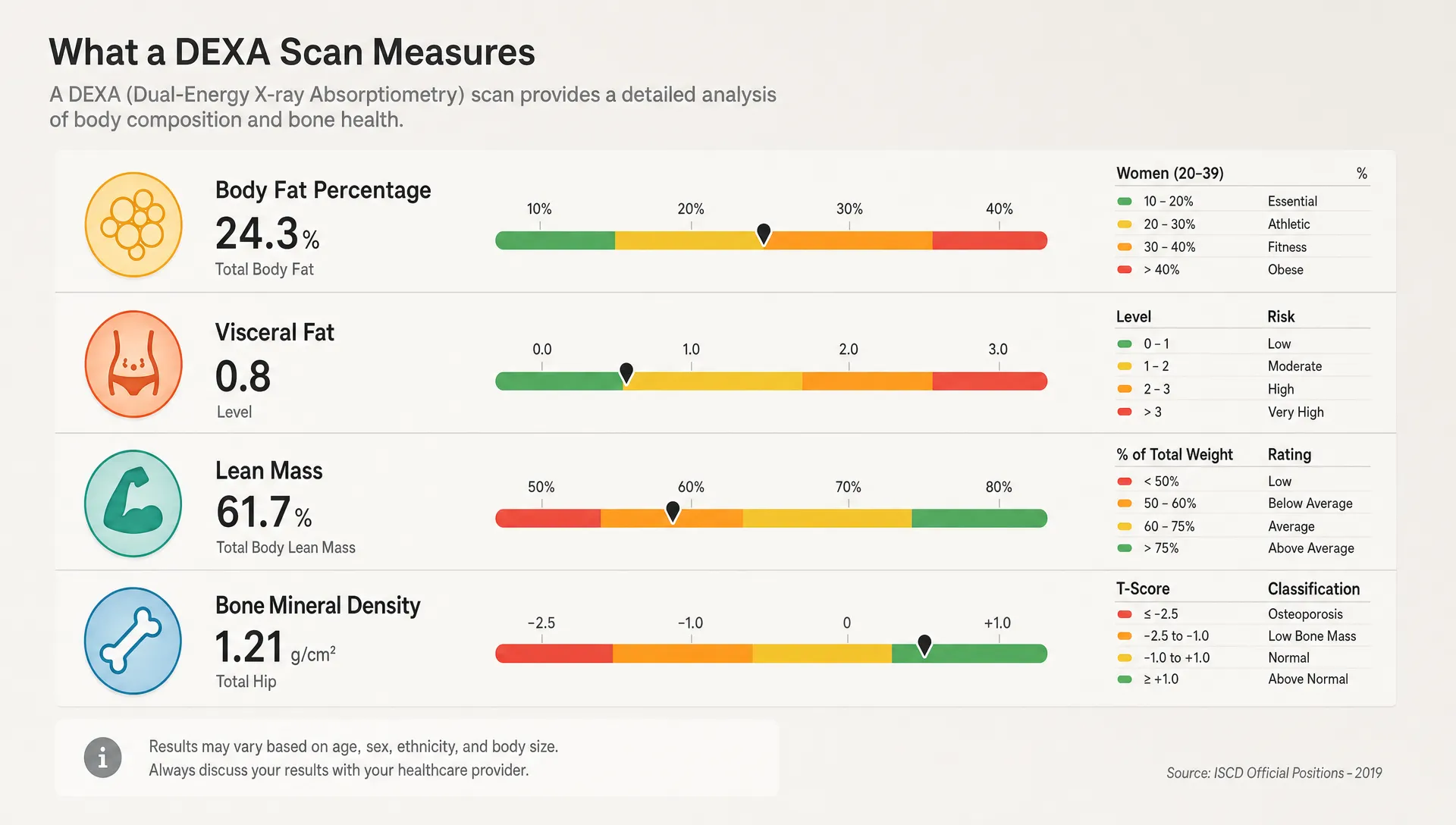
That is the core of the DEXA scan purpose: replacing guesswork with measurable, repeatable data. A DEXA scan can estimate body fat, lean mass, regional muscle distribution, visceral fat and bone density in one appointment. Those numbers are especially helpful when they connect to a clear next step.
Below are the health goals that tend to make a DEXA scan worth it, plus how to use the results without overreacting to a single report.
The DEXA scan purpose in practical terms
DEXA stands for dual-energy X-ray absorptiometry. It uses low-dose X-rays to differentiate bone mineral, fat tissue and lean soft tissue. In medical settings, DEXA is widely known for measuring bone mineral density. In fitness and body composition settings, it is also used to assess fat mass, lean mass, body fat percentage, visceral fat and regional distribution.
A good scan does not just tell you what you weigh. It shows what your weight is made of.
That matters because two people can weigh the same and have very different health profiles. One may carry more lean mass and less visceral fat. Another may have a normal body weight but relatively low muscle, higher body fat or lower bone density than expected. A standard scale cannot tell the difference.
If you are new to the test itself, this overview of what a DEXA scan is and why people get one explains the basics in more detail.
Goal 1: losing fat without losing muscle
Fat loss is one of the strongest reasons to get a DEXA scan. The problem with scale-based dieting is that weight loss can come from fat, muscle, water or glycogen. If the number drops quickly, it can feel like progress even when a meaningful portion of that loss is lean mass.
A DEXA scan helps separate those changes. It can show body fat percentage, total fat mass and lean mass so you can judge whether your plan is working the way you intended.
This is especially useful if you are:
- In a calorie deficit and lifting weights
- Using a higher-protein nutrition plan
- Returning to exercise after time away
- Trying to improve body composition without focusing only on body weight
- Preparing for an event, sport season or personal milestone
The most actionable pattern is not simply “weight down.” It is fat mass trending down while lean mass stays stable or declines only slightly. If lean mass is dropping faster than expected, you may need more resistance training, better recovery, more protein or a less aggressive calorie deficit.
A DEXA scan does not write the nutrition plan for you, but it can make the feedback loop much clearer.
Goal 2: building muscle or improving body recomposition
If your goal is muscle gain, the scale can be just as misleading. A person gaining muscle and losing fat may see little change in body weight. Without body composition data, that can look like stalled progress.
DEXA results can help you see whether lean mass is increasing over time and where those changes are happening. This is valuable for strength training, physique goals, sport performance and healthy aging.
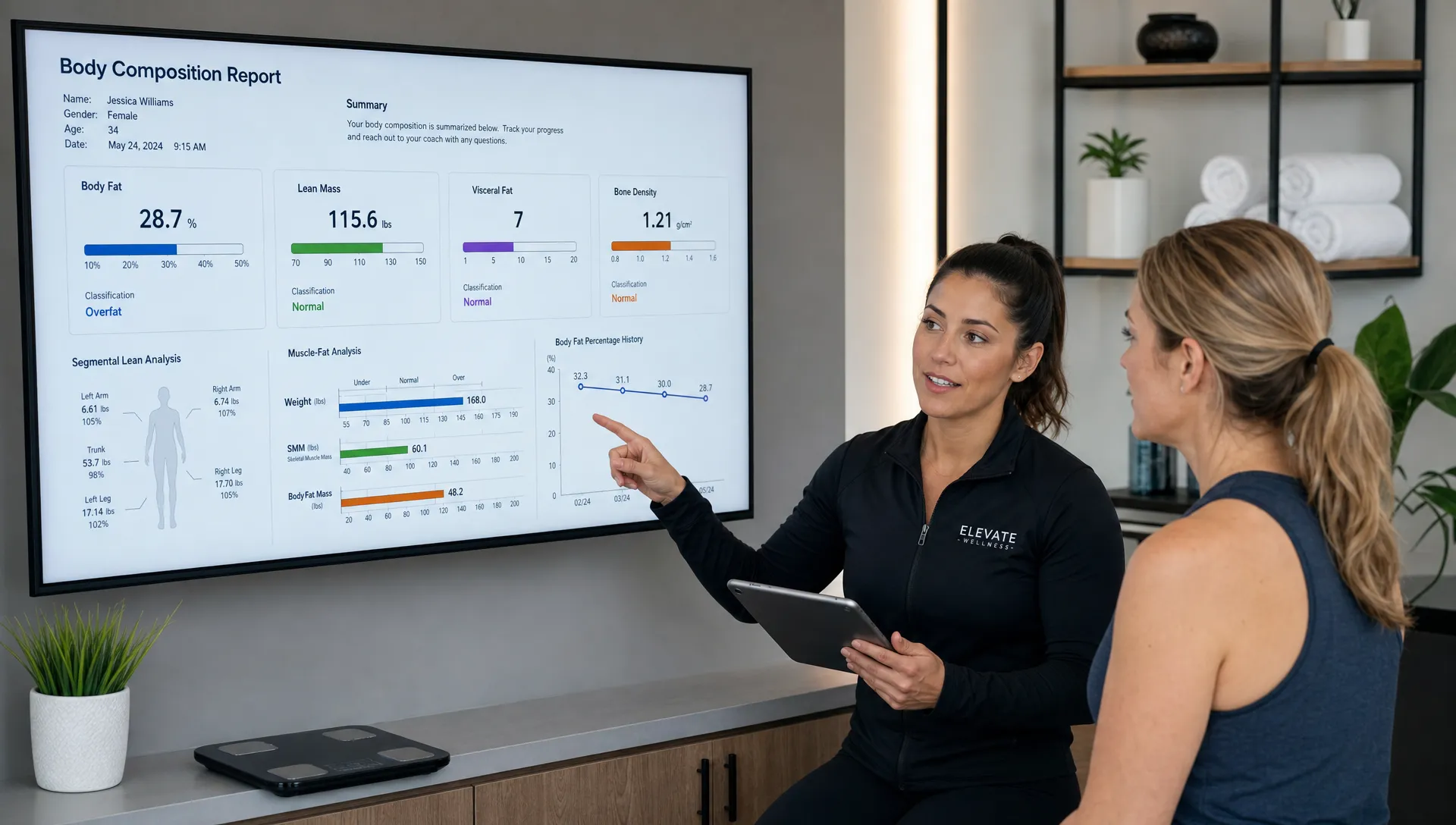
Regional lean mass is often the most interesting part. For example, you may want to know whether your legs are gaining lean tissue from a squat-focused training block or whether one side is lagging after an old injury. DEXA is not a performance test, but it can provide context that a barbell, treadmill or mirror cannot.
For recomposition goals, the ideal result may be modest weight change with improved body fat percentage, higher lean mass or lower visceral fat. That is exactly the kind of change many people miss when they only track pounds.
Goal 3: reducing visceral fat and metabolic risk
Visceral fat is the fat stored deeper in the abdomen around internal organs. It is different from subcutaneous fat, which sits under the skin. Higher visceral fat is associated with cardiometabolic risk factors, which is why it gets more attention than body fat percentage alone.
A DEXA scan can estimate visceral adipose tissue, often reported as visceral fat mass, volume or area depending on the reporting system. This can be useful if your goal is not just to look leaner but to improve long-term health markers.
It is best to interpret visceral fat alongside other health data, such as waist circumference, blood pressure, cholesterol, triglycerides, fasting glucose or A1C. DEXA gives you a body composition view. Lab work and clinical measurements give you a broader metabolic view.
The value of DEXA here is trend tracking. If your visceral fat is decreasing over several months while your fitness, waist measurement and lab markers are moving in the right direction, you have stronger evidence that your plan is working.
Goal 4: understanding bone density and fracture risk context
Bone health is another major reason a DEXA scan can be useful. DEXA is the established test for measuring bone mineral density, and medical DEXA scans are commonly used to evaluate osteoporosis risk.
The U.S. Preventive Services Task Force recommends osteoporosis screening for women age 65 and older and for postmenopausal women under 65 who are at increased risk. People with risk factors such as a prior fragility fracture, long-term glucocorticoid use, low body weight, family history or certain medical conditions should discuss screening with a clinician.
For fitness-focused clients, bone density results can still provide useful context, but medical diagnosis and treatment decisions belong with a qualified healthcare provider. If your main concern is osteoporosis screening, fracture risk or a clinical diagnosis, it is worth understanding the difference between a fitness-focused scan and a medical scan. This guide to DEXA Fit vs. medical DEXA can help you choose the right path.
Bone density also changes more slowly than body composition. You might repeat body composition scans every few months during an active training phase, but bone density trends often require a longer timeline and medical guidance.
Goal 5: finding left vs. right imbalances
DEXA can also show regional differences between the left and right sides of the body. These asymmetries are common, and not every difference is a problem. Most people have a dominant side, prior injuries or movement habits that create small differences over time.
The scan becomes useful when asymmetry connects to a goal. For example, an athlete may want to monitor leg lean mass after rehabbing an injury. A recreational lifter may want to see whether one arm or leg is significantly behind the other. An older adult may want a baseline for muscle distribution before starting a structured strength program.
DEXA does not diagnose movement dysfunction, pain causes or injury risk by itself. It can, however, give a trainer, physical therapist or clinician more objective context when paired with strength testing, mobility assessment and symptoms.
Goal 6: checking whether a plan is actually working
Many people make several changes at once: new workouts, higher protein intake, more sleep, less alcohol, a different medication or a new calorie target. After a few months, it can be hard to know what is changing inside the body.
A DEXA scan works well as a baseline and follow-up tool. Instead of judging progress from daily weight swings, you can compare key metrics over a realistic interval. For body composition goals, many people retest after roughly 8 to 16 weeks, depending on how aggressive and consistent the plan is. For bone density, retesting frequency should be discussed with a clinician.
The best results come from consistency. Try to scan under similar conditions each time, such as the same time of day, similar hydration status and similar food intake beforehand. No measurement method is perfect, but controlling the conditions makes the trend more meaningful.
| Health goal | DEXA results that matter most | What the data can help you decide |
|---|---|---|
| Fat loss | Fat mass, body fat percentage, lean mass, visceral fat | Whether weight loss is mostly fat loss or includes too much lean mass loss |
| Muscle gain | Total lean mass, regional lean mass, left vs. right comparison | Whether training is producing measurable lean tissue changes |
| Metabolic health | Visceral fat, body fat distribution, lean mass | Whether lifestyle changes are reducing abdominal fat in a meaningful way |
| Bone health | Bone mineral density and related bone metrics | Whether to discuss osteoporosis risk or follow-up testing with a clinician |
| Injury recovery or imbalance | Regional lean mass and side-to-side differences | Whether one limb or region may need more targeted training support |
| Nutrition planning | Fat mass, lean mass and metabolic context | Whether calorie, protein and training targets may need adjustment |
When a DEXA scan may be less useful
A DEXA scan is powerful, but it is not necessary for every goal.
If you are just starting a general wellness routine and do not plan to act on the data, simple measures may be enough at first. Body weight trends, waist circumference, strength progress, energy levels and basic lab work can already tell you a lot.
A scan may also be less useful if you expect it to answer questions it is not designed to answer. DEXA does not diagnose every health condition, measure cardiovascular fitness, assess movement quality or tell you exactly what to eat every day. It provides a detailed body composition and bone-related snapshot. The real value comes from interpretation and follow-through.
This is why expert guidance matters. At DEXA SF, the scan is paired with expert interpretation, fitness guidance and nutrition advice, so the numbers can be translated into practical next steps rather than left as a confusing report.
How to turn your scan into an action plan
Before booking, define the question you want the scan to answer. A focused question leads to better decisions after the scan.
A useful question might be: “Am I losing fat while preserving muscle?” Another might be: “Has my visceral fat changed after three months of training and nutrition changes?” Or, “Do I have a meaningful left vs. right lean mass difference after returning from injury?”
Once you have the scan, prioritize a small number of metrics instead of trying to optimize everything at once. For many people, the main metrics are body fat percentage, total fat mass, lean mass, visceral fat and bone density context. If you want a deeper breakdown, DEXA SF has a guide to which DEXA results are worth tracking over time.
Then choose one or two changes based on the result. If lean mass is down, adjust strength training, protein intake or recovery. If visceral fat is high, focus on sustainable fat loss habits and talk with your healthcare provider about relevant lab markers. If bone density is a concern, bring the report to a clinician for medical interpretation.
The scan is a measurement tool. Progress still comes from the habits, training, nutrition and clinical follow-up you build around it.
Frequently Asked Questions
What is the main DEXA scan purpose? The main purpose is to measure body composition and bone-related metrics with more detail than a scale or tape measure. Depending on the scan type, it can show body fat, lean mass, visceral fat, regional distribution and bone density.
Which health goal makes DEXA most useful? Fat loss with muscle preservation is one of the most practical goals for DEXA because the scan can show whether weight loss is coming mostly from fat or whether lean mass is dropping too.
Can a DEXA scan help with nutrition planning? Yes, especially when the results are interpreted by someone who understands body composition. Fat mass, lean mass, visceral fat and metabolic context can help guide calorie targets, protein intake and training priorities.
How often should I get a DEXA scan? For active body composition goals, many people use a follow-up scan after about 8 to 16 weeks. Bone density monitoring usually follows a longer timeline and should be guided by a healthcare professional.
Is DEXA only for athletes? No. Athletes use DEXA for performance and body composition tracking, but it can also help people focused on fat loss, healthy aging, bone health, metabolic risk reduction or returning to fitness after time away.
Make your next health goal measurable
If you have a clear goal, a DEXA scan can help you stop guessing and start tracking the right numbers. DEXA SF provides professional body composition scans in San Francisco, including body fat assessment, muscle mass evaluation, visceral fat measurement, asymmetry detection, bone density analysis and expert interpretation.
Use your scan as a baseline, bring your questions and leave with data you can apply to your fitness and nutrition plan. When the goal is specific, the results become much more useful.