
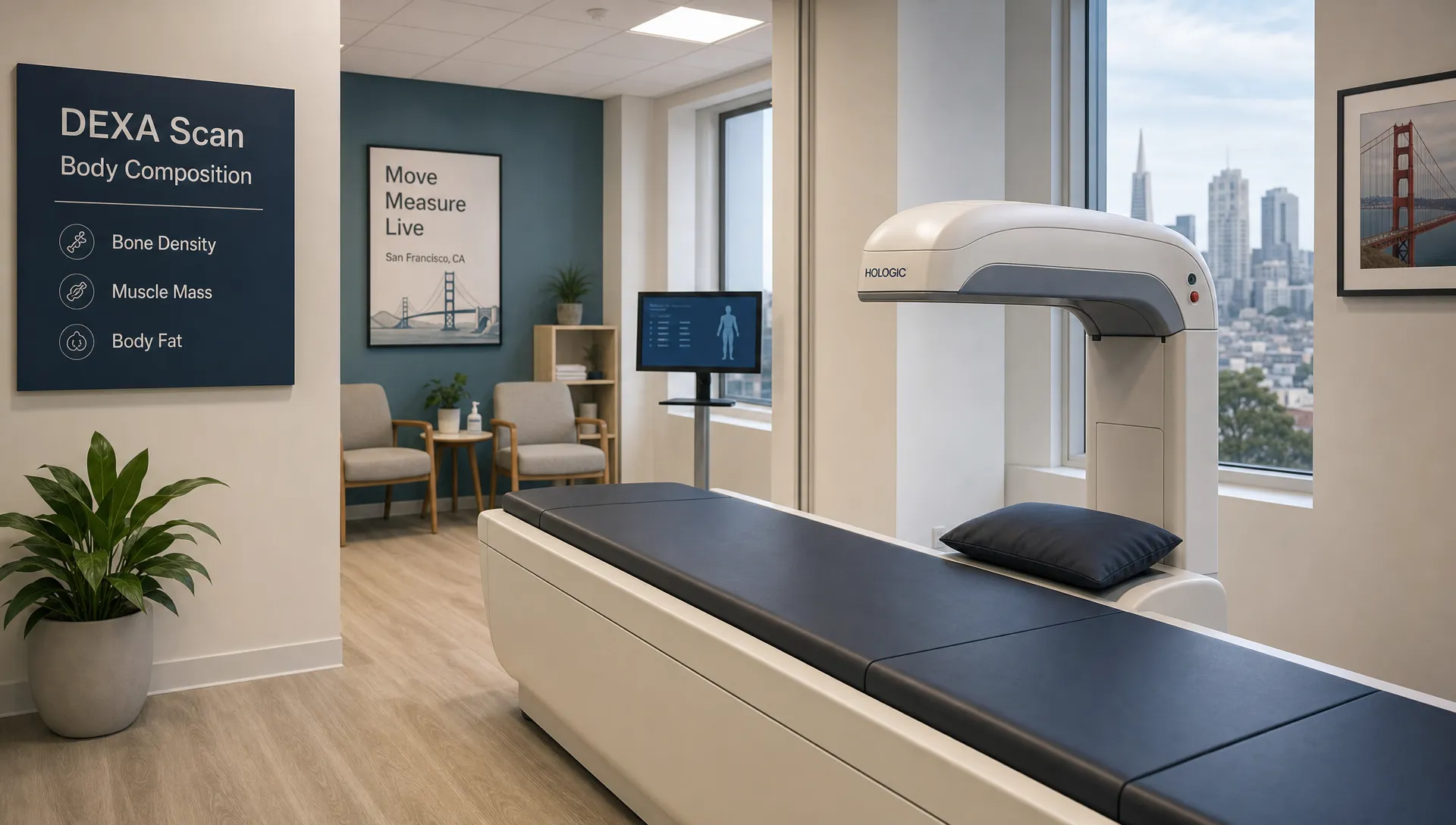
DEXA Scan: What Is It and Why Do People Get One?
If you have ever searched “DEXA scan, what is it?” you are probably looking for a clear answer before deciding whether it belongs in your health, fitness, or medical plan.
A DEXA scan is a quick, noninvasive imaging test that uses low-dose X-rays to measure what your body is made of. Depending on the scan type and report, it can show body fat, lean mass, bone density, visceral fat, and left vs. right differences in muscle or fat distribution.
That makes it very different from a bathroom scale. A scale tells you total weight. A DEXA scan helps explain what that weight actually represents.
What is a DEXA scan?
DEXA stands for dual-energy X-ray absorptiometry. You may also see it written as DXA, which is the same technology. The scan uses two low-dose X-ray beams at different energy levels. Because bone, fat, and lean tissue absorb those beams differently, the scanner can estimate the amount and distribution of each tissue type.
DEXA was originally best known for bone density testing, especially in osteoporosis screening. Today, it is also widely used for body composition analysis because it can measure far more than body weight or BMI.
A DEXA body composition scan can help answer questions like:
- How much of my weight is fat mass vs. lean mass?
- Where do I store fat on my body?
- Do I have more muscle on one side than the other?
- How much visceral fat do I carry around the abdominal organs?
- Are my training and nutrition changes producing the results I think they are?
For many people, the value is not just the scan itself. It is the interpretation. At DEXA SF, clients receive precise body composition data along with expert guidance so the numbers can be translated into practical fitness and nutrition decisions.
What does a DEXA scan measure?
The exact report can vary by provider and scan type, but a full-body DEXA body composition scan commonly includes several key categories.
| Measurement | What it tells you | Why people care |
|---|---|---|
| Body fat percentage | The percentage of your total body weight that is fat | Helps evaluate fat loss more accurately than weight alone |
| Fat mass | The total amount of fat tissue in pounds or kilograms | Useful for tracking changes over time |
| Lean mass | Muscle and other non-fat, non-bone soft tissue | Helps monitor muscle gain, muscle loss, and training results |
| Regional composition | Fat and lean mass by body area | Shows where changes are happening, such as trunk, arms, or legs |
| Visceral fat estimate | Fat stored deep in the abdomen around organs | Often used as a marker for metabolic health risk discussions |
| Bone density or bone mineral data | Bone strength-related measurements | Important for bone health monitoring and osteoporosis risk assessment |
| Left vs. right asymmetry | Differences between sides of the body | Useful for athletes, lifters, injury recovery, and movement planning |
This is why DEXA is often considered a gold standard for body composition assessment. It gives a detailed snapshot of your body’s internal makeup, not just a single number.
Why do people get a DEXA scan?
People get DEXA scans for different reasons. Some are focused on fat loss. Some want to build muscle. Others are concerned about bone health, aging, performance, or metabolic risk. The common thread is that they want objective data.
To see beyond scale weight
Weight can be misleading. You can lose fat and gain muscle while the scale barely moves. You can lose weight rapidly but lose a concerning amount of lean mass. You can also have a “normal” BMI while still carrying excess body fat or visceral fat.
The CDC notes that BMI is a screening tool, not a direct measurement of body fat or health. That does not mean BMI is useless, but it is limited. DEXA provides a deeper look by separating weight into fat, lean tissue, and bone-related measurements.
For someone working hard in the gym or changing their nutrition, this can be a major mindset shift. Instead of asking, “Did my weight go down?” the better question becomes, “Did my body composition improve?”
To track fat loss accurately
Many people book a DEXA scan because they want a reliable baseline before starting a fat loss phase. The scan can show total fat mass, body fat percentage, regional fat distribution, and visceral fat estimates.
That baseline makes future scans more meaningful. If you repeat the scan under similar conditions, you can see whether your plan is reducing fat while preserving lean mass. This is especially helpful if your weight changes slowly or fluctuates because of water, sodium, glycogen, menstrual cycle changes, or training stress.
To measure muscle gain and body recomposition
Body recomposition means gaining muscle while losing fat, or improving the ratio of lean mass to fat mass. This is one of the most common reasons fitness-focused clients get scanned.
A DEXA scan can help identify whether strength training and protein intake are supporting lean mass. It can also show regional lean mass differences. For example, someone may want to know whether leg training is producing measurable changes, or whether one side of the body is lagging after an old injury.
For athletes and recreational lifters, the scan can be a reality check. Progress photos and gym performance matter, but DEXA adds another layer of evidence.
To monitor muscle preservation during weight loss
When people lose weight, the goal is usually to lose fat, not muscle. But without measurement, it can be difficult to know what is happening.
This has become even more relevant as rapid weight loss strategies, intensive diet changes, and medical weight loss approaches have become more common. A DEXA scan can help people and their care teams pay attention to lean mass trends, not just pounds lost.
If lean mass is dropping faster than expected, that may be a cue to revisit resistance training, protein intake, total calorie intake, recovery, or medical guidance.
To assess bone health
DEXA is also the standard imaging method used to evaluate bone mineral density. This is especially important for people at risk of osteopenia or osteoporosis.
The U.S. Preventive Services Task Force recommends osteoporosis screening for women age 65 and older, and for postmenopausal women under 65 who are at increased risk. Men and younger adults may also need bone density evaluation depending on medical history, medication use, fracture history, or clinician recommendation.
A body composition DEXA scan and a diagnostic bone density scan are related, but the purpose and reporting may differ. If your main concern is osteoporosis diagnosis or fracture risk, consult your healthcare provider about the right test and follow-up.
To understand visceral fat
Visceral fat is stored deep in the abdomen around internal organs. It is different from subcutaneous fat, which sits under the skin.
Higher levels of visceral fat are associated with cardiometabolic risk factors, which is why many people want to track it. A DEXA scan can estimate visceral fat, making it useful for people who want a more complete picture than waist circumference or body weight alone.
This does not replace lab work or medical evaluation. But it can be a helpful data point when combined with blood pressure, lipids, glucose markers, lifestyle habits, and clinical guidance.
What happens during a DEXA scan?
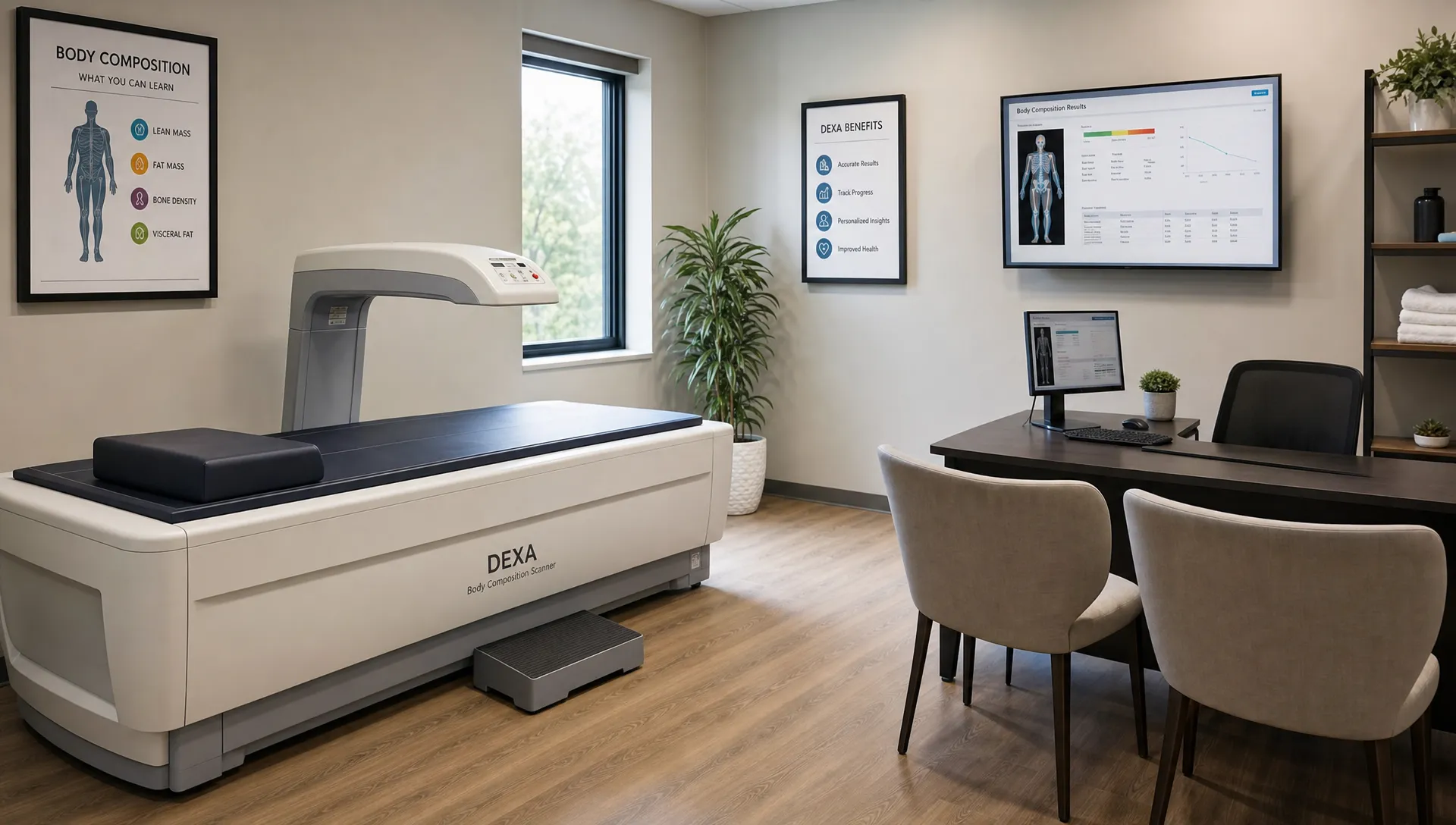
A DEXA scan is usually simple and quick. You lie still on a scanning table while the scanner passes over your body. The scan is painless, and there is no enclosed tunnel like an MRI.
You are typically asked to remove metal items such as jewelry, belts, watches, and items in pockets. Depending on the provider, you may be scanned in light clothing without metal. The scan itself usually takes only a short amount of time, though the full appointment may include setup, review, and interpretation.
If the word X-ray makes you nervous, this first-time patient guide to a DEXA X-ray explains what the experience is like in more detail.
How should you prepare for a DEXA scan?
Preparation is usually straightforward, but consistency matters if you plan to compare scans over time. Hydration, food intake, recent exercise, and clothing can all affect comfort and, in some cases, measurement consistency.
Common preparation tips include:
- Wear comfortable clothing without metal when possible.
- Remove jewelry, watches, belts, and items from pockets before the scan.
- Try to repeat future scans under similar conditions, such as a similar time of day.
- Avoid making one scan immediately after an unusually hard workout if your goal is long-term comparison.
- Tell the provider if you are pregnant, may be pregnant, or have had recent contrast imaging.
Your scan provider may give specific instructions, so follow those over any general advice.
How to interpret DEXA scan results
DEXA results are most useful when you connect them to a goal. A single report is a baseline. Multiple reports over time show a trend.
For body composition, the most important question is not always whether one number is “good” or “bad.” It is whether the numbers align with your goals, health context, and plan.
| If your result shows... | It may mean... | Useful next question |
|---|---|---|
| Weight is stable but fat mass is down | You may be gaining lean mass while losing fat | Is my training plan supporting recomposition? |
| Weight is down but lean mass is also down | Some weight loss may be muscle or lean tissue | Do I need more resistance training, protein, or recovery? |
| Visceral fat is elevated | Abdominal fat may deserve more attention | What lifestyle or medical markers should I review too? |
| One leg or arm has less lean mass | There may be an asymmetry | Is this related to training, injury history, or movement patterns? |
| Bone density is low | Bone health may need follow-up | Should I speak with a clinician about diagnosis and treatment? |
This is where expert interpretation matters. Numbers alone can be confusing, especially if you are comparing body fat percentage, fat mass, lean mass, and regional data all at once. A qualified professional can help you understand what changed, what matters most, and what to do next.
DEXA vs. other body composition methods
There are many ways to estimate body composition. DEXA is not the only option, but it offers a level of detail that most common methods cannot match.
| Method | Strength | Limitation |
|---|---|---|
| Scale weight | Easy and frequent | Does not distinguish fat, muscle, bone, or water |
| BMI | Simple population-level screening tool | Does not directly measure body composition |
| Skinfold calipers | Low cost and accessible | Accuracy depends heavily on technician skill and equations |
| Bioelectrical impedance scales | Convenient for home use | Can fluctuate with hydration, food, and device quality |
| DEXA scan | Detailed fat, lean mass, bone, and regional data | Requires an appointment and uses low-dose X-ray technology |
For people who only need a rough trend, a smart scale may be enough. For people making decisions about training, nutrition, fat loss, muscle gain, or bone health, DEXA provides a more complete picture.
How often should you get a DEXA scan?
The right frequency depends on why you are getting scanned.
For body composition goals, many people scan every 8 to 12 weeks. That usually gives enough time for meaningful changes in fat mass or lean mass to appear. Scanning too often can create noise, because short-term changes in water and glycogen may distract from the longer-term trend.
For bone density monitoring, timing is different and should be guided by a healthcare professional. Bone changes usually occur more slowly, and medical recommendations depend on risk factors, age, medications, and prior results.
If you are comparing options locally, this DEXA scan guide covering benefits, cost, and timing can help you think through when a scan makes sense.
Is a DEXA scan safe?
DEXA uses low-dose X-ray technology. According to RadiologyInfo.org, a bone density DEXA exam uses a very small amount of ionizing radiation, and the test is widely used in clinical settings.
Still, it is not radiation-free. If you are pregnant, may be pregnant, or have specific medical concerns, speak with your healthcare provider before getting scanned. You should also tell the scan provider about recent imaging with contrast material, since that may affect scheduling or results.
For most healthy adults using DEXA for body composition tracking, the scan is quick, painless, and low exposure. The key is to use it purposefully rather than casually.
Who is a good candidate for a DEXA scan?
A DEXA scan may be useful if you want more objective insight into body composition, training progress, fat distribution, or bone health. It is especially relevant for people who are actively changing their exercise, nutrition, or weight management plan.
You might consider one if you are:
- Starting a fat loss, muscle gain, or body recomposition program.
- Training seriously and want to measure lean mass changes.
- Concerned about visceral fat or abdominal fat distribution.
- Losing weight and want to preserve muscle.
- Curious about left vs. right muscle asymmetries.
- Discussing bone density or osteoporosis risk with a healthcare provider.
A DEXA scan is not necessary for everyone. But if you are tired of guessing, it can give you a clearer baseline and a better way to measure progress.
Frequently Asked Questions
What is a DEXA scan in simple terms? A DEXA scan is a quick imaging test that uses low-dose X-rays to measure body composition and bone-related data. It can show body fat, lean mass, bone density, visceral fat, and regional differences.
Is DEXA the same as a bone density scan? DEXA is the technology used for bone density scans, but it can also be used for full-body composition analysis. The purpose of the scan and the report may differ depending on whether you are focused on bone health or body composition.
Does a DEXA scan hurt? No. You lie still on a table while the scanner passes over your body. The scan is noninvasive and does not involve needles, exercise, or enclosed spaces.
Can a DEXA scan tell me my exact body fat percentage? DEXA provides a highly detailed estimate of body fat percentage and regional fat distribution. Like all measurement tools, it has some margin of variation, which is why consistent testing conditions and trend tracking are important.
Do I need a doctor’s referral for a DEXA scan? It depends on the reason for the scan and the provider. Body composition scans are often booked directly, while diagnostic bone density testing may involve a healthcare provider, insurance rules, or medical referral.
What should I do with my DEXA results? Use them to guide decisions. If your goal is fat loss, look at fat mass and visceral fat trends. If your goal is performance, look at lean mass and asymmetry. If bone density is a concern, discuss results with a qualified healthcare professional.
Get objective body composition data in San Francisco
If you want more than scale weight or rough estimates, a DEXA scan can give you a detailed baseline for body fat, lean mass, visceral fat, bone density, and asymmetry.
DEXA SF provides professional DEXA body composition scans in San Francisco, with expert interpretation and practical fitness and nutrition guidance to help you understand what your results mean and how to act on them.