

When to Schedule a DEXA Scan for Reliable Progress Data
A DEXA scan can give you a clearer picture of what is changing in your body than scale weight alone. But for progress tracking, the scan date matters almost as much as the scan itself. If you scan too soon, normal shifts in hydration, glycogen and food volume can make small changes look more meaningful than they are. If you wait too long, you may miss the chance to adjust your training or nutrition while it still matters.
A reliable DEXA scan schedule is less about testing as often as possible and more about measuring at moments when the data can guide a decision. The right timing depends on your goal, whether that is fat loss, muscle gain, body recomposition, maintenance or bone health monitoring.
What reliable progress data actually means
DEXA, short for dual energy X-ray absorptiometry, is widely used to assess bone density and body composition. For body composition, it can estimate total body fat, lean mass, regional distribution, visceral fat and left vs. right differences. That makes it useful for seeing whether your plan is changing the tissue you care about, not just your total weight.
Progress data becomes reliable when you treat each scan as part of a repeatable measurement system. One scan gives you a baseline. Two or more scans reveal a trend. If you want a deeper breakdown of how to read changes over time, DEXA SF has a helpful guide on comparing DEXA analysis results between scans.
The key is to remember that lean mass on a DEXA report is not the same thing as pure muscle tissue. It includes muscle, organs, connective tissue and body water. A hard training session, unusual carb intake, dehydration or recent illness can influence short-term lean mass readings. That does not make the scan unreliable, but it does mean your scan conditions should be consistent.
Reliable progress data usually has four qualities:
- A clear baseline taken before or early in a training or nutrition phase.
- Enough time between scans for real body composition change to occur.
- Similar testing conditions such as time of day, hydration and recent exercise.
- A practical interpretation that focuses on meaningful trends rather than tiny fluctuations.
When to schedule your first DEXA scan
The best time to schedule your first scan is right before a meaningful change begins. That might be the start of a fat loss phase, a strength training block, a lean gaining phase, a new nutrition plan or a return to exercise after time away.
For the cleanest baseline, choose a week that looks normal for you. Avoid scheduling immediately after a vacation, illness, long flight, extreme training event or major change in eating habits. If your body is temporarily inflamed, depleted or holding unusual amounts of water, your baseline may still be useful, but it may not represent your usual starting point.
If you are already several weeks into a plan, do not wait for a perfect reset. A scan now can still become your baseline for the next phase. The bigger mistake is relying only on scale weight for months, then trying to guess whether lost weight came from fat, muscle or water.
If you are unsure whether your goal is a strong fit for DEXA tracking, start with DEXA SF’s article on which health goals make a DEXA scan most useful. It can help you decide whether you need a single baseline, a short-term follow-up or a longer tracking plan.
How often to schedule scans based on your goal
Your follow-up interval should match the speed at which your body can realistically change. Scanning weekly or even every few weeks usually creates more noise than insight for most people. In contrast, waiting six months during an aggressive fat loss or muscle gain plan may leave too much time between feedback points.
| Goal | Good baseline timing | Common follow-up window | Main metrics to watch |
|---|---|---|---|
| Fat loss | Before starting a calorie deficit | 8 to 12 weeks | Fat mass, body fat percentage, visceral fat, lean mass retention |
| Muscle gain | Before a hypertrophy or strength block | 12 to 16 weeks | Total lean mass, regional lean mass, fat gain rate |
| Body recomposition | Start of a combined training and nutrition plan | 12 to 16 weeks | Fat mass change, lean mass change, waist-region trends |
| Maintenance | After reaching a goal weight or body composition target | 4 to 6 months | Stability of fat mass, lean mass and visceral fat |
| Bone health monitoring | Based on medical history and clinician guidance | Often longer intervals | Bone mineral density and related clinical risk factors |
For bone density, timing should be more individualized. The International Society for Clinical Densitometry states that follow-up bone mineral density testing should be done when the results are likely to influence patient management. In practical terms, body composition tracking may justify shorter intervals than bone density monitoring, because fat and lean mass can change faster than bone mineral density.
For fitness goals, an 8 to 16 week follow-up window is often enough time to see whether a plan is working without overreacting to short-term variation. Fat loss phases can sometimes be evaluated around 8 to 12 weeks, especially if the deficit is consistent. Muscle gain usually needs more patience, since lean tissue accrues gradually and water shifts can obscure small changes.
Build your scan timing around decisions, not curiosity
Your DEXA scan schedule should map to moments when you are willing to change something. A scan is most valuable when it helps answer a practical question, such as whether your calorie deficit is too aggressive, whether your strength plan is preserving lean mass or whether a gaining phase is adding more fat than intended.
For example, a fat loss client might scan before starting, then again after 10 weeks. If fat mass dropped but lean mass also fell sharply, the next decision might be to increase protein, adjust training volume, reduce the calorie deficit or add a maintenance phase. If fat mass dropped and lean mass stayed relatively stable, the plan may be working.
A muscle gain client might scan before a 16 week training block, then again at the end. If lean mass increased with only modest fat gain, the training and nutrition approach may be well matched. If scale weight increased but most of the change came from fat mass, the surplus may be too high or training quality may need attention. DEXA SF covers this use case in more detail in its guide to tracking muscle mass progress with DEXA.
How to standardize conditions before each scan
Consistency does not require a complicated protocol, but it does require avoiding obvious sources of variation. Follow the preparation instructions from your scan provider, then try to make each appointment resemble the last one as closely as possible.
| Variable | Why it matters | Better approach |
|---|---|---|
| Time of day | Food, fluid and activity accumulate throughout the day | Book future scans at a similar time when possible |
| Recent training | Hard workouts can affect inflammation, fluid shifts and glycogen | Avoid scheduling right after unusually intense exercise |
| Hydration | Dehydration can influence lean mass estimates | Arrive normally hydrated rather than intentionally depleted |
| Food intake | A large meal can affect body mass and comfort during the scan | Keep meal timing similar across appointments |
| Creatine changes | Starting or stopping creatine can shift body water | Keep supplement routines consistent when comparing scans |
| Menstrual cycle phase | Fluid retention can vary across the cycle | Consider scheduling in a similar cycle phase when practical |
| Scan location | Different machines and protocols can vary | Use the same provider when tracking long-term progress |
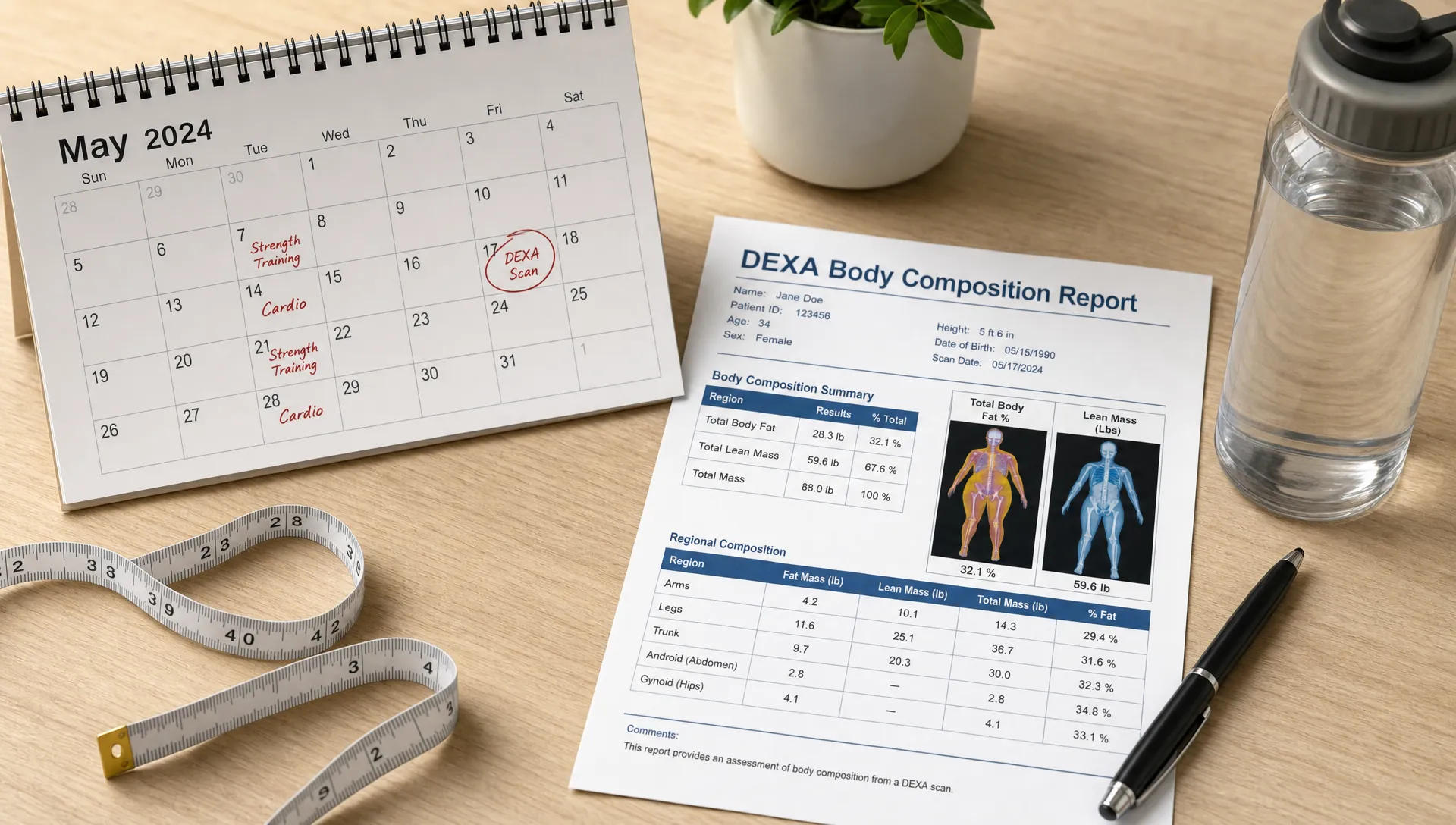
The goal is not to manipulate the scan. The goal is to reduce avoidable noise so that changes in fat mass, lean mass and visceral fat are easier to interpret.
Sample DEXA scan schedule for common scenarios
Use the sample DEXA scan schedule below as a planning framework, not a medical rule. Your ideal timing may differ depending on your training history, health status, body size, rate of change and whether you are working with a clinician, dietitian or coach.
| Scenario | Scan 1 | Scan 2 | Optional Scan 3 |
|---|---|---|---|
| 12 week fat loss phase | Week 0 | Week 10 to 12 | After 4 to 8 weeks of maintenance |
| 16 week muscle gain phase | Week 0 | Week 16 | After a mini-cut or next training block |
| 6 month recomposition plan | Week 0 | Week 12 to 16 | Week 24 |
| Post-goal maintenance | At goal achievement | 4 to 6 months later | Every 6 to 12 months if useful |
| General wellness baseline | When current habits are stable | 6 to 12 months later | Based on goals and results |
This type of timing keeps the data connected to behavior. You are not scanning just to collect numbers. You are scanning before a plan, after enough time has passed and at a point where the results can shape your next move.
Times when you may want to delay a scan
There are moments when a scan can still be performed, but the results may be harder to compare against prior data. If your goal is reliable progress tracking, consider rescheduling when your body is temporarily far from its normal state.
It may be worth waiting if you are recovering from an acute illness, have just completed an endurance event, recently changed creatine use, had an unusually high sodium or carb intake the day before or are coming off major travel. The issue is not that the scan becomes useless. The issue is that the result may reflect temporary fluid and glycogen shifts as much as true tissue change.
Pregnancy is a separate situation. If you are pregnant or think you may be pregnant, tell the scan provider before scheduling so they can advise you appropriately.
How to use the results after your appointment
After a scan, avoid judging progress by body fat percentage alone. Percentage can move because fat mass changed, lean mass changed or both changed at the same time. For decision-making, look at the actual tissue changes.
A productive review usually asks three questions. Did fat mass move in the intended direction? Did lean mass stay stable, increase or decrease? Did visceral fat, regional distribution or left vs. right differences reveal anything that should affect training or nutrition?
This is where expert interpretation matters. DEXA SF provides professional DEXA body composition scans in San Francisco, with measurements that can include body fat, lean mass, bone density, metabolic metrics, visceral fat and asymmetry insights. Clients also receive personalized fitness and nutrition guidance from qualified experts, which helps turn scan data into a practical next step.
Frequently Asked Questions
What is the best DEXA scan schedule for fat loss? For many fat loss phases, a baseline scan followed by a second scan 8 to 12 weeks later provides a useful balance between timely feedback and meaningful change. Very short intervals can be noisy unless there is a specific reason to measure sooner.
Can I schedule a DEXA scan every month? You can, but monthly scans are often more frequent than needed for reliable body composition trends. Most people get better insight from scanning at the start and end of defined training or nutrition blocks.
Should I schedule my scan before or after a workout? For consistency, avoid scheduling immediately after a hard workout, especially if prior scans were done under rested conditions. Recent training can affect fluid balance and inflammation, which may influence lean mass estimates.
Does time of day matter for DEXA progress tracking? Yes, it can. Morning and afternoon scans may differ because of meals, hydration and daily activity. If you are comparing results over time, try to book future scans at a similar time of day.
How often should bone density be checked with DEXA? Bone density follow-up depends on age, risk factors, prior results, medications and clinician guidance. Unlike body composition, bone density usually changes more slowly, so the interval is often longer and should be individualized.
Ready to time your next scan with confidence?
If you are using training or nutrition to change your body composition, do not leave your measurement timing to chance. A well timed scan can show whether your plan is reducing fat, preserving or building lean mass and improving the metrics that matter to your goal.
If you are in San Francisco, you can schedule a DEXA scan with DEXA SF and get precise body composition data with expert interpretation to support your next training or nutrition decision.