
How a DEXA Scan Tracks Muscle Mass Progress
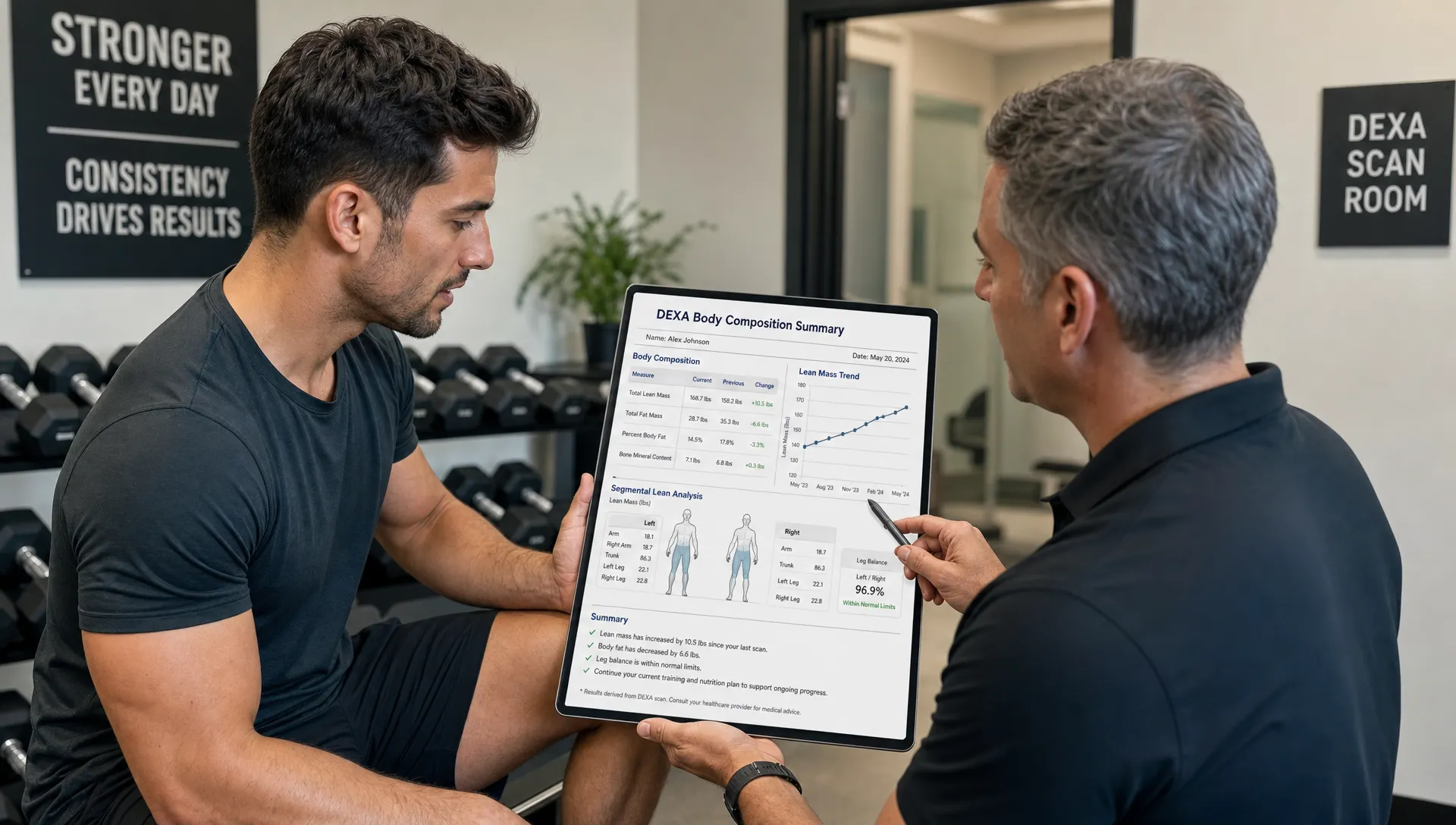
If you are lifting consistently, eating with intention, and trying to improve your physique or performance, the bathroom scale can become frustratingly vague. A five-pound change might mean you gained muscle, lost fat, retained water, replenished glycogen, or some combination of all four. That is why many athletes, strength trainees, and health-focused adults use DEXA to track muscle mass progress with more clarity.
A DEXA scan for muscle mass does not “see” muscle the way an MRI can. Instead, it estimates lean soft tissue across your whole body and by region, which makes it one of the most practical ways to monitor whether your training is moving you in the right direction. When repeated under consistent conditions, it can show if your lean mass is increasing, whether one side is lagging behind the other, and how muscle changes relate to fat loss or fat gain.
What DEXA measures when tracking muscle mass
DEXA stands for dual-energy X-ray absorptiometry. The scan uses two low-dose X-ray beams to estimate how much of your body is bone mineral content, fat mass, and lean soft tissue. In a body composition scan, lean soft tissue is the key number people usually associate with muscle mass.
That distinction matters. DEXA does not isolate skeletal muscle alone. Lean soft tissue includes muscle, water, organs, connective tissue, and stored carbohydrate in the form of glycogen. However, because muscle is a major part of lean soft tissue, especially in the arms and legs, DEXA is highly useful for tracking muscle-related progress over time.
The most valuable muscle-related outputs usually include:
- Total lean mass, which gives a whole-body view of your non-fat, non-bone tissue.
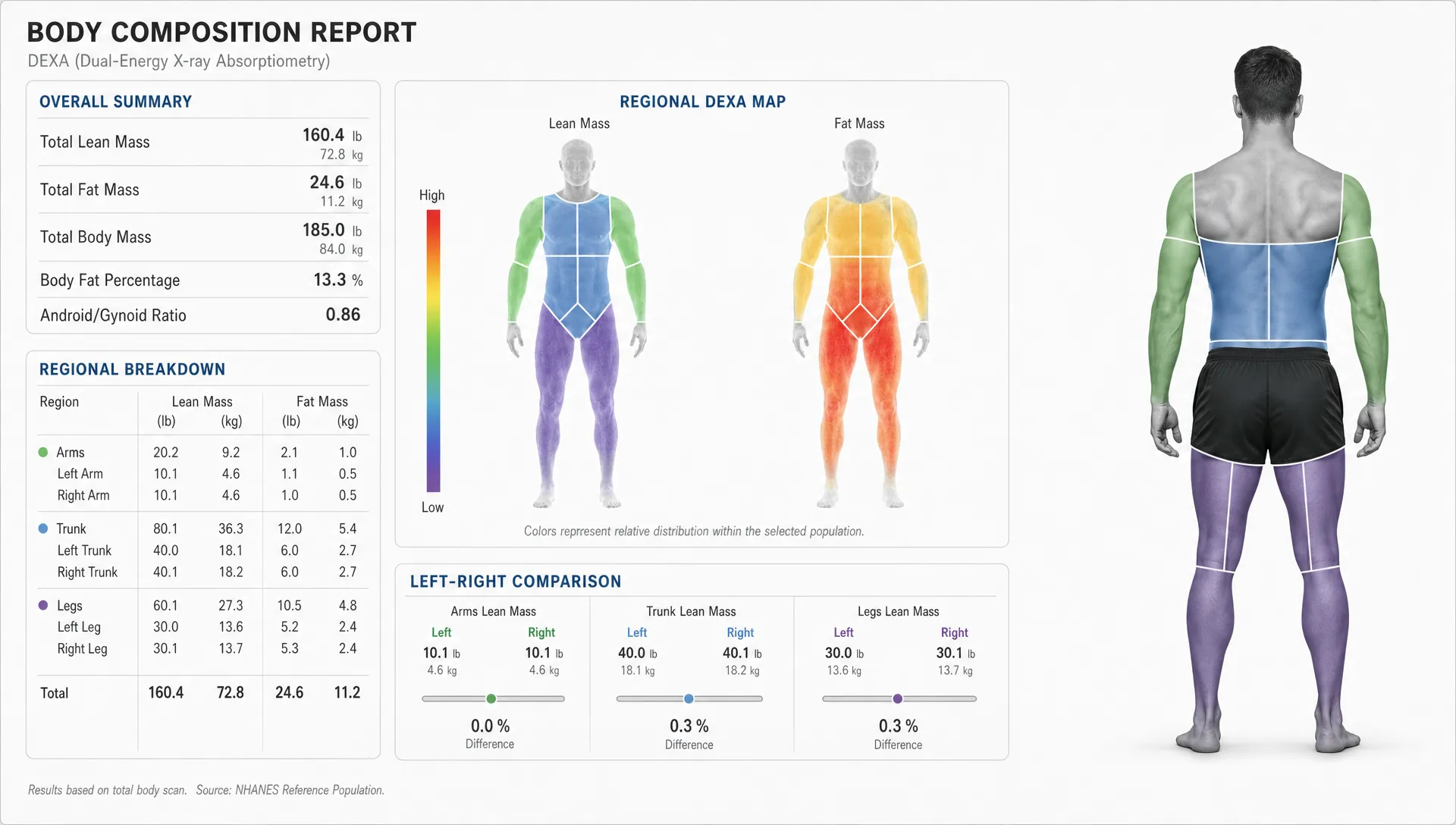
- Regional lean mass, which shows lean tissue in the arms, legs, and trunk.
- Appendicular lean mass, which combines lean mass in the arms and legs and is often used as a practical proxy for skeletal muscle.
- Left vs. right comparisons, which can reveal asymmetries between limbs.
- Fat mass and body fat percentage, which help you understand whether weight change is coming from muscle, fat, or both.
This is why DEXA is especially helpful for body recomposition. If you gain three pounds on the scale, a DEXA scan can help show whether that change is mostly lean mass, fat mass, or fluid-influenced noise. If you lose weight, it can help show whether you preserved muscle while reducing fat.
Why DEXA is more useful than scale weight alone
Scale weight is easy to measure, but it is a blunt tool. It cannot tell you whether your training program is building muscle or whether a calorie deficit is causing unwanted lean mass loss. Tape measurements and progress photos add context, but they can still be influenced by posture, bloating, lighting, and where your body stores fat.
Bioelectrical impedance scales, the kind built into many smart scales and gym devices, are convenient but highly sensitive to hydration, food intake, exercise timing, and device quality. They can be useful for broad trends, but they often struggle to separate true tissue change from short-term water shifts.
DEXA provides a more detailed body composition profile. It can help you answer questions like: Did my legs gain lean mass during this hypertrophy block? Did I lose fat without sacrificing muscle? Is my right side carrying more lean mass than my left? If you are also watching fat loss metrics, this guide on DEXA scan accuracy for body fat percentage explains why the method is often preferred over common consumer tools.
| Tracking method | What it can show | Main limitation |
|---|---|---|
| Scale weight | Total body weight change | Cannot distinguish muscle, fat, water, or bone |
| Tape measurements | Circumference changes at specific sites | Technique and fat distribution affect results |
| Progress photos | Visual changes in shape and definition | Lighting, posing, and timing can distort comparisons |
| Smart scale or BIA | Estimated body composition trends | Hydration and recent activity can strongly affect readings |
| DEXA scan | Fat mass, lean mass, bone density, regional data, asymmetry | Requires an appointment and consistent scan conditions |
The DEXA metrics that matter most for muscle progress
The best way to use DEXA is not to obsess over a single number. Muscle progress is best interpreted through a cluster of metrics, especially when you compare scan to scan over several months.
Total lean mass
Total lean mass is the broadest measure. If your goal is to gain muscle, you generally want this number to rise over time. If your goal is fat loss, you usually want total lean mass to remain stable while fat mass decreases.
Still, total lean mass needs context. A higher reading after a high-carbohydrate weekend, intense training session, or unusually high sodium intake may partially reflect water and glycogen. That does not make the scan useless, but it does mean consistency matters when comparing results.
Regional lean mass
Regional lean mass is where DEXA becomes especially actionable. Instead of only seeing a whole-body total, you can see lean mass by body region. This is useful because muscle gain is rarely perfectly even.
For example, someone following a squat- and deadlift-heavy program might see more progress in the legs than the arms. A climber or rower might see strong upper-body regional lean mass. A runner returning from injury might want to compare the injured and non-injured leg.
Regional data helps you connect your training plan to actual tissue change. If your program emphasizes glutes, quads, or upper body hypertrophy, your scan can help confirm whether your body is adapting in the expected areas.
Left vs. right asymmetry
Most people have some asymmetry. A dominant arm, a previous injury, a sport-specific movement pattern, or years of favoring one side can create measurable differences in lean mass.
DEXA can show whether one arm or leg carries more lean mass than the other. This does not automatically mean there is a problem. Small differences are common. But larger or worsening asymmetries can guide smarter programming, such as adding unilateral exercises, adjusting volume, or working with a coach or physical therapist when appropriate.
For Bay Area athletes, these details can be especially valuable during performance training or return-to-play planning. DEXA SF has covered how fast DEXA scans for Bay Area athletes can support decisions around lean mass, fat mass, bone density, and imbalances.
Fat mass alongside lean mass
Muscle progress should not be interpreted separately from fat mass. Someone in a gaining phase may increase lean mass, but if fat mass rises much faster than expected, their calorie surplus may be too aggressive. Someone in a cutting phase may lose fat, but if lean mass drops quickly too, their deficit, protein intake, recovery, or training plan may need attention.
DEXA is powerful because it shows both sides of the equation. It helps you see whether you are truly recomping, gaining lean mass while reducing fat, or whether your scale trend is hiding the tradeoffs.
How often should you get a DEXA scan to track muscle?
The right scan frequency depends on your goal and how quickly your body is likely to change. Muscle gain is a slower process than day-to-day weight fluctuation, so scanning too often can lead to overinterpreting small changes.
For most people, a practical cadence is every 8 to 12 weeks during a focused training or nutrition phase. This gives your program enough time to produce measurable change while still allowing you to adjust before spending six months on a plan that is not working.
A more specific approach might look like this:
| Goal | Suggested scan timing | What to look for |
|---|---|---|
| Muscle gain phase | Baseline, then every 8 to 12 weeks | Lean mass increase, regional progress, controlled fat gain |
| Fat loss phase | Baseline, then every 8 to 12 weeks | Fat mass decrease with lean mass preservation |
| Athletic performance block | Before and after a training cycle | Regional changes, symmetry, body composition shifts |
| Injury return or imbalance monitoring | Baseline, then after a defined rehab or training block | Left-right lean mass changes and regional recovery |
| Long-term health tracking | Every 6 to 12 months | Lean mass trends, bone density, visceral fat, body composition |
The key is to scan at meaningful checkpoints. A baseline scan gives you a starting point. A follow-up scan tells you whether the plan worked. A third scan can confirm whether the trend is repeatable.
How to make scan-to-scan comparisons more reliable
Because lean mass includes water, consistency is essential. You want each scan to reflect true body composition change as much as possible, not differences caused by hydration, a hard workout, or a large meal.
Try to keep these variables consistent before each scan:
- Scan at the same location and, when possible, on the same machine.
- Choose a similar time of day for each scan.
- Keep food, fluid, caffeine, and sodium intake similar before each appointment.
- Avoid intense exercise immediately before the scan.
- Wear similar light clothing and remove metal items as instructed.
- Compare trends over time rather than reacting to one small change.
This is one reason expert interpretation matters. A qualified reviewer can help you separate meaningful progress from normal fluctuation and connect your results to your actual training and nutrition habits.
What DEXA results can reveal in common training scenarios
You are bulking but unsure if the weight gain is worth it
A gaining phase is supposed to add muscle, but the scale cannot tell you how much of the gain is lean mass. DEXA helps you evaluate the quality of the bulk.
If lean mass is increasing and fat mass is rising slowly, your plan may be well matched to your goal. If fat mass is rising quickly with little lean mass change, you may be overshooting calories, undertraining, recovering poorly, or lacking enough protein.
The International Society of Sports Nutrition position stand on protein and exercise states that many exercising individuals benefit from protein intakes above the general recommended dietary allowance, often in the range of 1.4 to 2.0 grams per kilogram of body weight per day depending on training and goals. DEXA will not tell you exactly how much protein to eat, but it can show whether your current strategy is supporting lean mass gains.
You are cutting and want to preserve muscle
During fat loss, the goal is not simply to weigh less. The goal is usually to lose fat while preserving as much lean mass as possible. DEXA can help you spot when a cut is becoming too aggressive.
If fat mass is decreasing and lean mass is stable, that is usually a strong sign. If both fat mass and lean mass are dropping quickly, it may be time to review your calorie deficit, resistance training intensity, protein intake, sleep, and recovery.
You are training for performance, not just appearance
Athletes often care less about total weight and more about power-to-weight ratio, durability, and sport-specific composition. DEXA can show whether a performance block is adding useful lean mass or unnecessary fat mass.
For example, a cyclist or runner may want enough lean mass for power and injury resilience without adding excessive non-functional weight. A strength athlete may want to see whether lean mass gains align with improvements in lifts. A field sport athlete may care about symmetry and lower-body development.
You are rebuilding after an injury
After an injury, one limb can lose lean mass faster than expected. DEXA can provide objective left-right data, which may help you track whether rehabilitation and strength work are restoring balance.
This is not a replacement for medical care or physical therapy. But it can be a useful measurement tool when interpreted alongside strength tests, movement quality, pain, and function.
What a DEXA scan cannot tell you about muscle
DEXA is valuable, but it is not magic. Understanding its limits helps you use the data wisely.
First, DEXA estimates lean soft tissue rather than directly measuring contractile muscle protein. Changes in hydration, glycogen, inflammation, and recent training can affect lean mass readings. This is why standardized conditions matter.
Second, DEXA does not measure strength, power, endurance, or skill. A scan might show that your legs gained lean mass, but it cannot tell you whether your squat technique improved or whether your sprint mechanics are better.
Third, DEXA should be interpreted as part of a broader performance and health picture. Training logs, strength numbers, sleep quality, nutrition consistency, waist measurements, bloodwork when appropriate, and how you feel all matter.
Finally, DEXA uses low-dose ionizing radiation. For most adults, the exposure is considered low, but you should follow the scan provider’s screening guidance. If you are pregnant or may be pregnant, ask a qualified medical professional before scheduling.
How to turn DEXA muscle data into better decisions
The real value of a DEXA scan is not the report itself. It is what you do next.
If your lean mass is not increasing during a muscle-building phase, review your training volume, progressive overload, exercise selection, calorie intake, protein intake, and recovery. Many people train hard but do not train progressively. Others eat “healthy” but not enough to support growth.
If lean mass is increasing but fat mass is rising faster than you want, your surplus may be too large. A modest adjustment can often keep progress moving while reducing unnecessary fat gain.
If you are losing lean mass during a cut, consider whether the deficit is too steep, cardio volume is too high, resistance training is too light, or protein is too low. Sometimes the solution is not to work harder, but to recover better.
If one side is lagging, regional DEXA data can guide more targeted programming. Unilateral exercises, adjusted set volume, and technique work may help, especially when paired with coaching or rehab support.
For a broader view of how DEXA connects body fat, muscle, and visceral fat, DEXA SF’s guide to a DEXA scan in San Francisco for body fat, muscle, and visceral fat explains how these measurements fit together in a complete body composition profile.
A simple way to use DEXA across a training cycle
Think of DEXA as a checkpoint system.
Start with a baseline scan before you change your training or nutrition. Record your body weight, training program, average weekly workouts, approximate calorie and protein targets if you track them, sleep, and any major lifestyle factors.
Run the plan consistently for 8 to 12 weeks. Do not change everything at once unless necessary. If you adjust training, food, supplements, and sleep all at the same time, it becomes harder to know what drove the result.
Then repeat the scan under similar conditions. Compare total lean mass, regional lean mass, fat mass, visceral fat if included, and left-right differences. Ask what improved, what stayed flat, and what changed in the wrong direction.
From there, make one or two targeted adjustments. That might mean adding lower-body volume, tightening a calorie surplus, increasing protein, improving recovery, or changing the timing of your next training phase. The next scan then tells you whether those adjustments worked.
Frequently Asked Questions
Can a DEXA scan measure muscle mass directly? DEXA estimates lean soft tissue, which includes muscle but also water, organs, connective tissue, and glycogen. It is not a direct muscle biopsy or MRI measurement, but it is highly useful for tracking lean mass trends over time.
Is DEXA better than a smart scale for muscle tracking? For detailed body composition tracking, DEXA is generally more informative because it provides regional lean mass, fat mass, bone density, and asymmetry data. Smart scales can be convenient, but their estimates are often affected by hydration and recent activity.
How soon can I see muscle gain on a DEXA scan? It depends on your training age, nutrition, genetics, and consistency. Many people use 8 to 12 weeks between scans so there is enough time for meaningful change to show beyond normal fluid fluctuations.
Why did my lean mass change if my workouts did not? Lean mass can shift because of hydration, glycogen storage, sodium intake, inflammation, recent exercise, and meal timing. That is why consistent scan conditions and trend-based interpretation are important.
Can DEXA show muscle imbalances? Yes. DEXA can compare lean mass between the left and right arms and legs, which may help identify asymmetries. Those findings should be interpreted alongside strength, mobility, injury history, and performance data.
Ready to track your muscle progress with better data?
If you are training hard, guessing is not the best strategy. DEXA SF provides professional DEXA body composition scans in San Francisco, including body fat assessment, muscle mass evaluation, bone density analysis, visceral fat measurement, asymmetry detection, metabolic data insights, expert interpretation, and practical fitness and nutrition guidance.
Use your scan as a baseline, repeat it after a focused training block, and make decisions based on what is actually changing. To get started, schedule your scan with DEXA SF.