
When a Muscle Scan Can Reveal Training Imbalances
A plateau can look simple from the outside. Your squat has stalled, one shoulder feels more taxed than the other or your running stride breaks down late in a workout. The usual explanations are familiar: not enough strength, too much fatigue, poor mobility or inconsistent recovery.
Sometimes those are the right explanations. Other times, the missing piece is distribution. You may be gaining lean mass overall while one leg lags behind. You may be cutting body fat successfully while losing more lean mass in your arms than expected. You may feel balanced in the gym but carry measurable left-right differences that only show up when your training volume gets high.
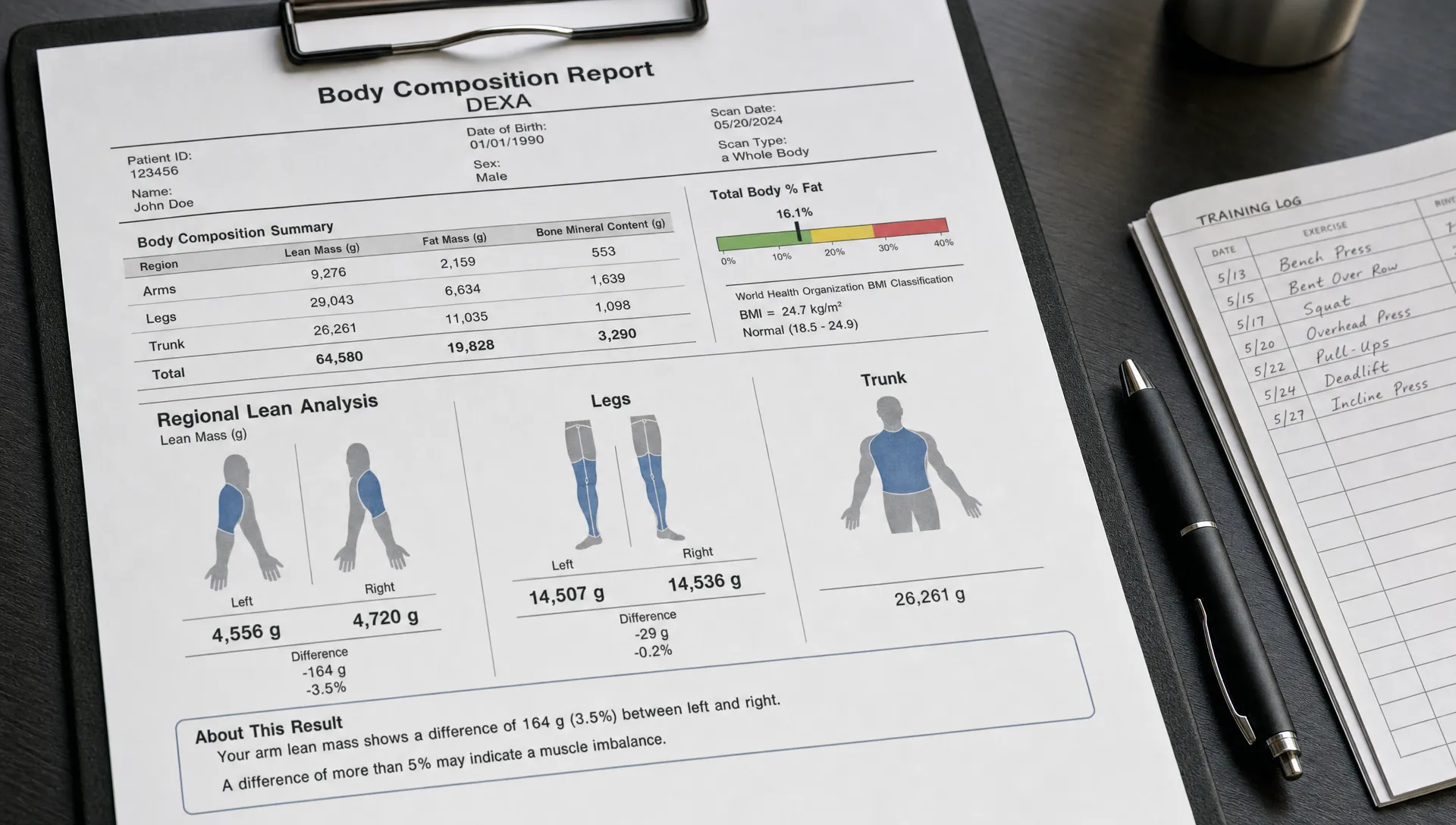
That is where a muscle scan can be useful. In a training context, the term usually refers to a body composition scan that shows how lean mass is distributed across regions of the body. A DEXA scan is especially useful because it can break results down by arms, legs, trunk, left side and right side, giving you a clearer view than scale weight, progress photos or gym numbers alone.
The goal is not to turn every small difference into a problem. Most people are not perfectly symmetrical and sport-specific adaptation is normal. The value of a scan is that it can help you separate normal variation from patterns that deserve a closer look.
What a Muscle Scan Actually Measures
A DEXA scan does not look inside a muscle fiber and measure contractile tissue directly. It estimates body composition using low-dose X-ray technology and separates the body into bone mineral content, fat mass and lean soft tissue. In practical training language, that lean soft tissue measurement is often used as a proxy for muscle mass, especially when you compare regional results over time.
That distinction matters. Lean mass includes muscle, water, connective tissue, organs and other non-fat tissue. Hydration, glycogen storage and recent training can influence readings. Even so, regional lean mass from a DEXA scan can give athletes and active adults a useful map of where tissue is distributed.
The American College of Radiology and RSNA's RadiologyInfo resource describes DEXA as a low-dose imaging test commonly used for bone density, with whole-body applications for body composition. For training decisions, the key is not a single number. It is the pattern across regions and how that pattern changes from scan to scan.
If you want a broader look at the numbers athletes can use, DEXA SF has a deeper guide to DEXA scan measurements that can improve your training.
When Training Imbalances Are Easy to Miss
Training imbalances are not always obvious. Many people assume an imbalance would show up as a visible size difference, but the body is good at compensating. A stronger side can hide a weaker side during barbell lifts. A dominant leg can absorb more force while running. A stiff hip can push extra work to the opposite side without producing immediate pain.
A muscle scan becomes most useful when you already have clues that something is uneven but cannot see the full picture.
| Training signal | What it might suggest | How a muscle scan helps |
|---|---|---|
| One side fatigues faster | Uneven strength, mobility or workload | Shows whether lean mass differs between limbs |
| Progress stalls despite consistent training | Program stress may not be distributed well | Helps reveal whether gains are regional or whole-body |
| Repeated soreness on one side | Technique, recovery or movement strategy issue | Adds body composition context for a coach or clinician |
| Return from injury feels uneven | Protective movement patterns may remain | Provides a baseline for comparing affected and unaffected sides |
| Scale weight changes but performance drops | Fat loss may be paired with lean mass loss | Shows whether lean mass is being maintained by region |
None of these signals prove that you have a muscle imbalance. They are reasons to gather better information. A scan can help you decide whether the issue is likely structural, program-related or unrelated to lean mass distribution.
What Regional Lean Mass Can Reveal
The most useful part of a DEXA-based muscle scan is not just total lean mass. It is the regional breakdown.
Left-right differences
A DEXA scan can compare lean mass on the left and right sides of the body, including arms and legs. This is useful for athletes who play one-sided sports, people who have returned from an injury or lifters who suspect one side dominates major movements.
For example, a recreational tennis player may expect some difference between their dominant and non-dominant arms. That may be a normal adaptation to years of sport. A runner with a meaningful difference between legs, however, may want to review stride mechanics, prior injury history, single-leg strength and mobility.
The scan does not tell you why the difference exists. It gives you a quantified starting point so the next step is less speculative.
Upper-body and lower-body distribution
Some programs create predictable patterns. A lifter who presses often but neglects pulling volume may not see a DEXA result that says, "your back is undertrained," but they may notice that upper-body lean mass is not changing in the way their program goals suggest. A cyclist may have strong lower-body development and comparatively lower upper-body lean mass, which may be expected for the sport but still relevant for health, posture and injury resilience.
Regional lean mass helps you check whether your training matches your goals. If your goal is balanced strength, the scan may show that your program is overdelivering in one area and underdelivering in another.
Lean mass changes during fat loss
Many people use a muscle scan during a cut because the scale can be misleading. Losing weight is not the same as losing fat. If body weight drops but lean mass drops too, the strategy may need adjustment.
This becomes even more useful when the change is regional. A diet phase that preserves leg lean mass but coincides with upper-body lean mass loss may lead to different training and nutrition decisions than a uniform change across the body. For more detail on this tracking process, DEXA SF explains how a DEXA scan tracks muscle mass progress across multiple measurements.
Who Benefits Most From a Muscle Scan?
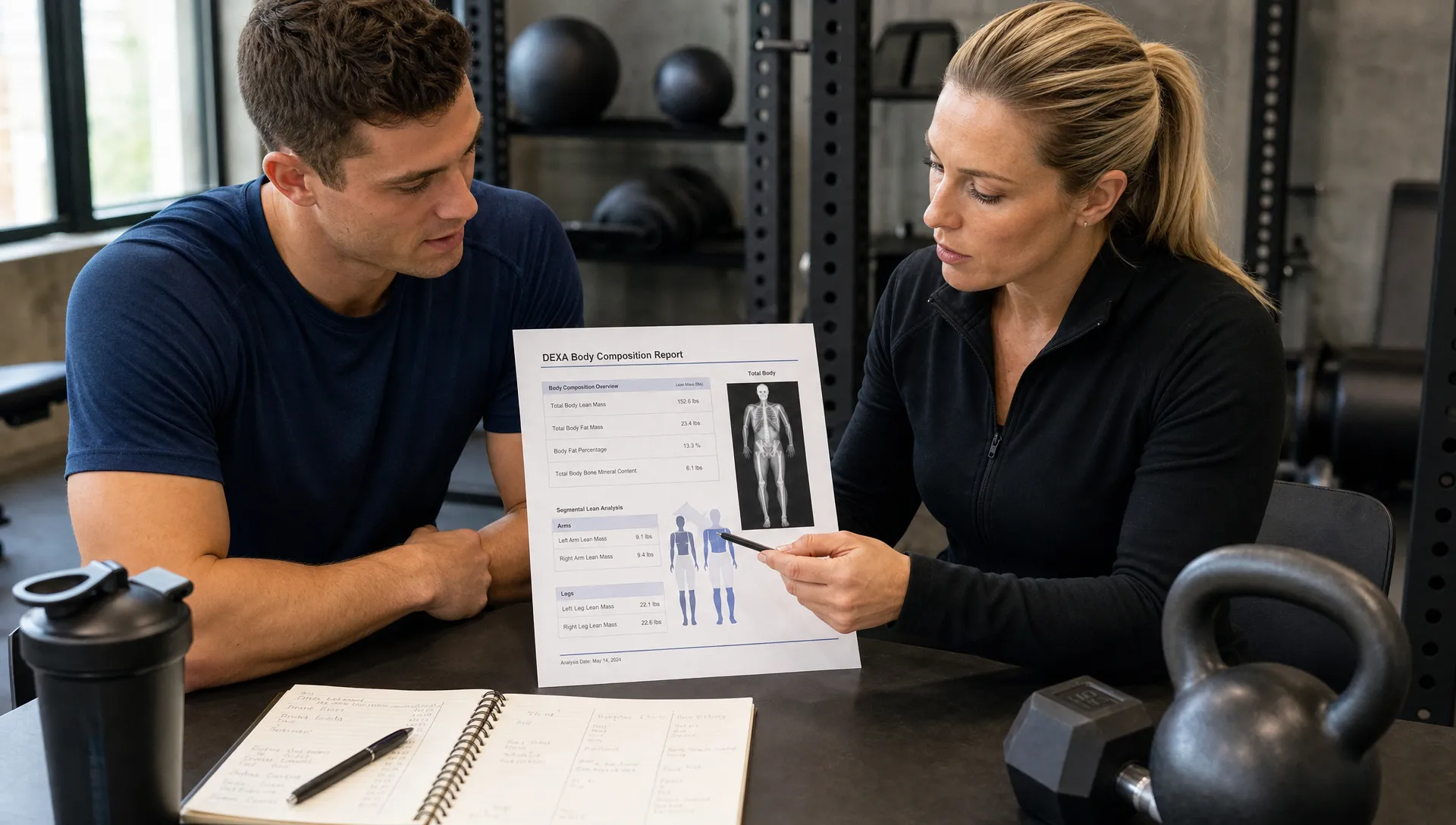
A muscle scan is not only for elite athletes. It can be useful whenever training decisions depend on knowing whether muscle and lean mass are changing in the right places.
Strength athletes and serious lifters often use scan data to confirm that a hypertrophy block is producing measurable lean mass, not just better pumps or temporary water retention. If one limb is lagging, unilateral accessories and technique work can be programmed with more intention.
Endurance athletes can benefit too. Runners, cyclists and triathletes often care about power-to-weight ratio, but losing weight at the expense of lean mass can backfire. Regional data helps identify whether weight changes support performance or simply make the scale look better.
Physique competitors and people pursuing body recomposition may use a scan to distinguish fat loss from lean mass gain. Photos and circumference measurements are useful, but DEXA adds a more objective layer, especially when visual changes are subtle.
People returning from injury may find the asymmetry data especially helpful. After a knee, hip, shoulder or ankle issue, the body often protects the affected side long after pain decreases. A scan can show whether the previously injured side is still carrying less lean mass, which can guide a more focused conversation with a coach, physical therapist or medical professional.
How to Turn Scan Results Into Training Decisions
The scan is only valuable if you use it to make better decisions. A DEXA report should not replace coaching, clinical evaluation or your own training log. It should sharpen the questions you ask.
- Start with a baseline: A first scan tells you where you are now. It is most useful before a new training block, nutrition phase or return-to-training plan.
- Compare regions, not just totals: Total lean mass can improve while one limb or region lags. Look at arms, legs, trunk and left-right differences.
- Match the data to your sport or goal: A baseball pitcher, powerlifter, marathon runner and general fitness client should not interpret symmetry in exactly the same way.
- Adjust one or two variables at a time: If you see an imbalance, avoid changing the entire program at once. Consider targeted unilateral work, volume changes, movement quality and recovery first.
- Retest after enough time has passed: Muscle and lean mass changes take time. Many people get more useful data by scanning after a full training block rather than after a few workouts.
A common mistake is treating a scan as a grade. It is better used as a feedback tool. If the report shows that your left leg has less lean mass than your right, the next step is not panic. The next step is to ask whether that difference is expected, whether it lines up with symptoms or performance and whether your current training plan is addressing it.
What a Muscle Scan Cannot Tell You
A scan can reveal patterns, but it cannot explain every cause behind those patterns. That boundary is important for smart interpretation.
| A muscle scan can help show | A muscle scan cannot replace |
|---|---|
| Regional lean mass distribution | A medical diagnosis for pain or injury |
| Left-right lean mass differences | A movement assessment by a qualified professional |
| Whether lean mass changed during a program | Direct strength testing or performance testing |
| Fat mass and lean mass changes together | Nutrition assessment based on diet history and labs |
| Bone density and body composition context | Clinical evaluation for bone, joint or nerve symptoms |
Strength is not the same as muscle size. A smaller limb can sometimes produce more force due to better neural coordination, skill, tendon stiffness or technique. A larger limb can still be weaker if movement quality is poor. That is why scan results should be interpreted alongside performance tests, training history and how you feel.
A scan also cannot tell you which exercise caused an imbalance. It may show that one arm has more lean mass than the other, but it will not identify whether the cause is sport history, lifting technique, daily habits, prior injury or genetics. The data is powerful because it narrows the investigation, not because it answers every question by itself.
How to Make Muscle Scan Results More Reliable
The more consistent your scanning conditions are, the more useful your comparisons become. Body composition readings can shift based on hydration, food intake, glycogen, recent hard training and even the time of day.
For best comparisons, try to keep the setup similar each time. Scan at a similar time of day, follow the same pre-scan eating and hydration routine, avoid unusually hard workouts right before the scan and use the same scanning provider when possible. Consistency does not remove all variability, but it makes trends easier to trust.
The biggest insight usually comes from repeat scans. One scan provides a snapshot. Two or more scans show direction. If your training block was designed to build lower-body muscle, maintain upper-body lean mass and reduce fat, your follow-up scan can show whether that actually happened.
If you are planning multiple scans, this guide on how to compare DEXA analysis results between scans can help you avoid overreacting to small changes and focus on meaningful trends.
Frequently Asked Questions
What is the best muscle scan for training imbalances? A DEXA scan is one of the most useful options for training imbalances because it can estimate lean mass by body region and compare left versus right sides. It also provides body fat, visceral fat and bone density context, which can matter when evaluating a training plan.
Is lean mass the same as muscle mass? Not exactly. Lean mass includes muscle, water, organs, connective tissue and other non-fat tissue. For arms and legs, regional lean mass is often used as a practical proxy for muscle-related changes, especially when compared over time under similar scan conditions.
How much left-right asymmetry is normal? Some asymmetry is normal, especially if you play a one-sided sport, have a dominant side or have a history of injury. The significance depends on the size of the difference, your sport, your symptoms and whether the gap is increasing or decreasing over time.
Can a muscle scan diagnose an injury? No. A DEXA scan can show body composition patterns and asymmetries, but it does not diagnose muscle tears, joint problems, nerve issues or movement dysfunction. Pain, weakness or persistent symptoms should be evaluated by a qualified healthcare professional.
How often should athletes get a muscle scan? Many athletes find scanning most useful at the start and end of a training block, nutrition phase or return-to-training period. The right timing depends on your goals, training age and how quickly you expect measurable changes.
Use Better Data for Your Next Training Block
If your training feels uneven or your results do not match the work you are putting in, a muscle scan can help you see what the mirror and scale miss. Regional lean mass, left-right asymmetry, body fat, visceral fat, bone density and metabolic insights can all add context to your next decision.
DEXA SF provides professional DEXA body composition scans in San Francisco with expert interpretation, fitness guidance and nutrition advice. If you want a clearer baseline before your next training block, you can schedule a DEXA scan with DEXA SF and use your results to train with more precision.