
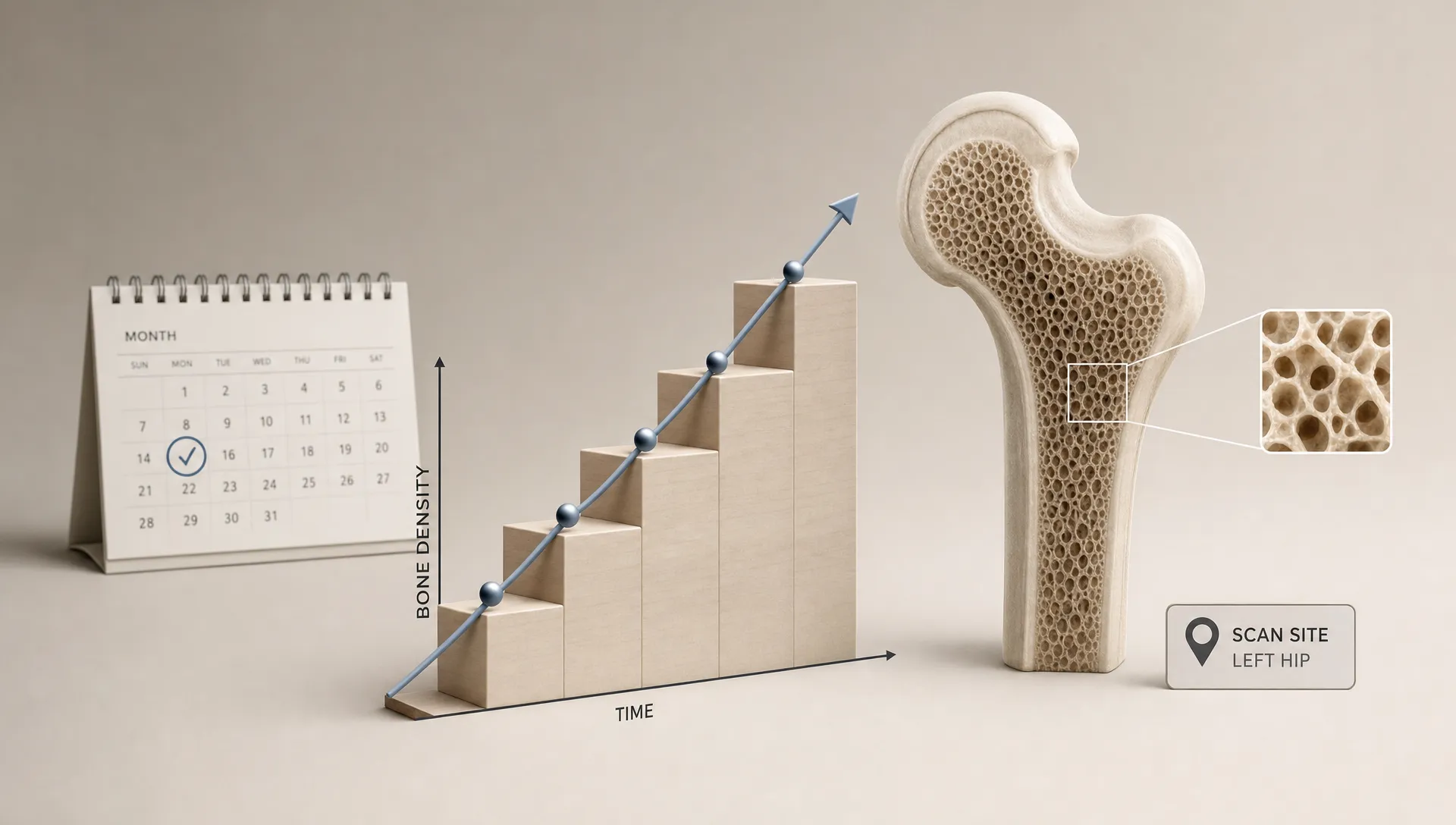
Questions to Ask After Your Bone Density Analysis
Getting a bone density analysis can answer one big question: how strong are my bones right now? The real value comes from what you do with that answer. A DEXA report may include bone mineral density, T-scores, Z-scores, scan sites and sometimes body composition data. Without context, those numbers can feel either more alarming or less meaningful than they really are.
After your scan, your goal is not to memorize every metric. It is to understand your personal risk, what you can change and when to track again. Use the questions below to turn a bone density analysis into a practical conversation with your physician, trainer, dietitian or DEXA specialist.
This guide is educational and should not replace medical care. If your result suggests low bone mass, osteoporosis or elevated fracture risk, discuss it with a qualified clinician who can review your full medical history.
Start with the numbers, then ask what they mean for you
A bone density report is built around comparison. Your measured bone mineral density is compared with reference groups to produce scores that help estimate whether your bones are denser or less dense than expected.
If you need a refresher before your follow-up conversation, DEXA SF has a plain-English guide to bone mineral density scan results that breaks down the main terms. The table below gives you the quick version.
| Report item | What it tells you | Question to ask |
|---|---|---|
| BMD | The amount of mineral measured in a specific bone area | Which scan site should I focus on most? |
| T-score | How your result compares with a healthy young adult reference group | Does my T-score fall in a normal, low bone mass or osteoporosis range? |
| Z-score | How your result compares with people closer to your age and sex | Is my bone density lower than expected for someone like me? |
| Scan site | The area measured, often hip, spine or forearm | Are any sites weaker than others? |
| Prior comparison | Change compared with an earlier scan | Is the change large enough to be meaningful? |
The International Society for Clinical Densitometry emphasizes that DEXA results should be interpreted by site, patient context and technical quality. That is why the best first question is simple: which number matters most in my case?
Ask which scan site is driving the interpretation
Bone density is not always the same across the body. Your lumbar spine may look different from your hip. Your femoral neck may differ from your total hip. In some cases, a forearm measurement is used when the hip or spine cannot be interpreted well.
Ask: Which site had my lowest relevant score? A low score at one site may guide follow-up more than a stronger score elsewhere. Also ask whether any site looked unusual or inconsistent with the rest of the report.
This matters because each site has different implications. Hip bone density is closely tied to hip fracture risk. Spine bone density can be important too, but in some older adults degenerative changes such as arthritis can make spine values look higher than the true underlying bone strength. Your scan interpreter can tell you whether the pattern is straightforward or needs additional clinical review.
Good follow-up questions include:
- Which areas were scanned and why were those areas chosen?
- Is one site clearly weaker than the others?
- Could arthritis, prior surgery, positioning or hardware have affected any measurement?
- If I repeat the scan, should it be done on the same machine or at the same facility?
Ask whether the result changes your fracture risk
Bone density is important, but fracture risk is not based on bone density alone. Age, prior fractures, family history, smoking, alcohol intake, medications, hormone status, balance, fall risk and certain medical conditions can all change the interpretation.
A person with mildly low bone density and multiple clinical risk factors may need closer attention than someone with the same score and no additional risks. A person with a prior low-trauma fracture may be treated differently than someone who has never fractured a bone.
Ask your clinician whether your result should be interpreted with a fracture risk tool. The FRAX calculator is commonly used to estimate 10-year fracture probability in adults, especially when hip bone density is available. It does not replace medical judgment, but it can help frame the conversation.
Useful questions include: Does my scan result change my fracture risk category? Do I have risk factors that matter more than the score itself? Should I be evaluated for secondary causes of low bone density, such as vitamin D deficiency, thyroid disease, malabsorption or medication effects?
Ask what category your score falls into
For post-menopausal women and men age 50 and older, T-scores are commonly grouped into three categories. A T-score of -1.0 or higher is generally considered normal. A T-score between -1.0 and -2.5 is commonly called low bone mass or osteopenia. A T-score of -2.5 or lower is in the osteoporosis range.
Those categories are helpful, but they are not the whole story. If you are a younger adult, pre-menopausal or have a complex medical history, the Z-score may be more relevant than the T-score. A Z-score that is much lower than expected for age can prompt a clinician to look for underlying causes.
Ask: Are these categories appropriate for me? If not, what should we use instead? This is especially important for athletes, younger adults, people with eating disorder history, people with long-term steroid use and anyone with unexplained fractures.
Ask whether the scan quality or comparison is reliable
Small changes in bone density can happen because of positioning, different machines or normal measurement variation. This is why a single comparison line on a report should not be overinterpreted without context.
Ask whether the scan had good positioning and whether the facility uses a least significant change threshold. Least significant change is a technical concept that helps determine whether a difference between two scans is likely to be real rather than measurement noise.
If you have prior reports, bring them. The most useful comparison is usually done with the same machine, same facility and same scan sites. If that is not possible, ask whether the reports can still be compared or whether the new scan should serve as your new baseline.
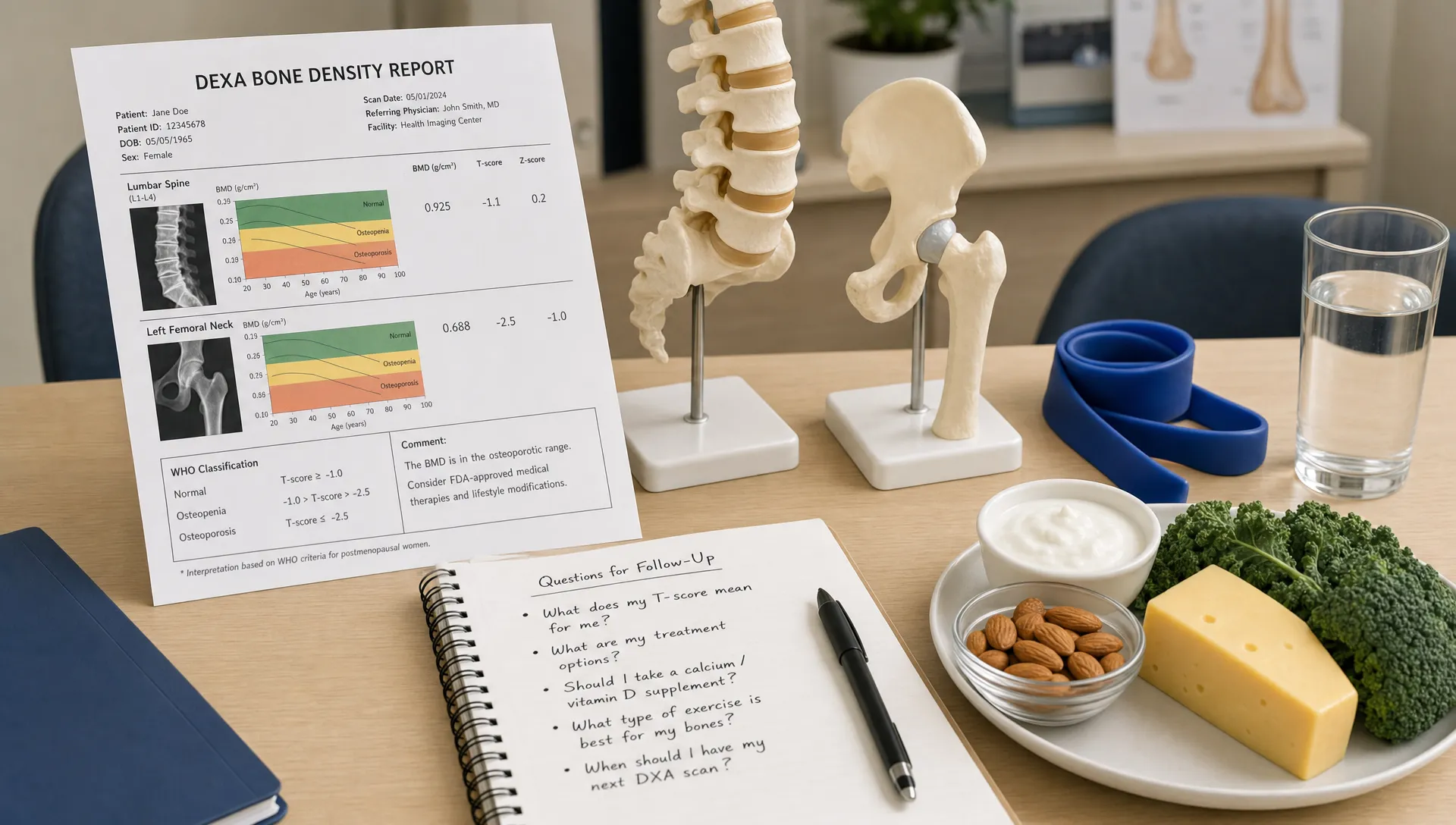
Ask what to change in your training plan
Exercise is one of the most practical areas to discuss after a bone density analysis. Bones respond to load, but the right load depends on your age, fitness level, injury history and current bone status.
Ask whether your current routine supports bone health. Walking is valuable for general health, but some people need progressive resistance training, impact work or balance training to better support bones and reduce fall risk. Others may need to avoid certain high-impact movements until they have medical clearance, especially if fracture risk is high.
If you are active, do not assume strong performance means strong bones. Cyclists, swimmers and endurance athletes can have excellent cardiovascular fitness while still needing a closer look at bone health, nutrition and energy availability. DEXA SF has a bone health assessment checklist for active adults that can help you prepare better questions if you train regularly.
Ask these training-specific questions: Which exercises should I prioritize? Are there movements I should modify for now? Should I add strength work, balance training or impact exposure? Would working with a physical therapist or qualified strength coach make sense given my result?
Ask what to change in your nutrition
Nutrition can support bone remodeling, muscle maintenance and recovery. The right plan depends on your diet, labs, medical history and goals, so avoid making major supplement changes based only on a scan result.
Start with the basics: Am I getting enough calcium, vitamin D and protein? Should I check vitamin D levels or other labs? Does my current calorie intake support bone health, especially if I am training hard or trying to lose weight?
The Bone Health and Osteoporosis Foundation offers patient guidance on calcium and vitamin D, including why food sources and individualized medical advice matter. More is not automatically better, particularly with supplements. Your clinician can help decide whether testing or supplementation is appropriate.
If your DEXA scan also includes body composition, ask how lean mass, regional muscle balance and visceral fat fit into your plan. Muscle supports movement quality and fall prevention, so bone health should not be viewed in isolation from strength, nutrition and recovery.
Ask whether you need medical follow-up or treatment
A DEXA specialist can help explain the report, but treatment decisions should be made with a medical clinician who can review your history, medications and fracture risk. If your result is in the osteoporosis range, if you have had a fragility fracture or if your density is lower than expected for your age, ask who should manage follow-up.
Helpful questions include: Should I see my primary care physician, endocrinologist, rheumatologist or another specialist? Do I need blood work? Are any medications I take affecting my bones? Should we discuss osteoporosis medication, or is lifestyle follow-up enough for now?
You do not need to solve everything in one appointment. The key is to leave with a clear next step, whether that is clinical evaluation, a training adjustment, nutrition changes or a scheduled repeat scan.
Ask when to repeat your bone density analysis
Bone density changes gradually, so repeat timing should match your risk level and the reason you are scanning. Someone monitoring treatment may need a different timeline than someone creating a healthy baseline. Someone with new medication exposure or a recent fracture may also need closer follow-up.
Ask: When should I repeat the scan, and what change would count as meaningful? If you are unsure whether your timing is appropriate, this guide on when to get a Bone DEXA scan and what it shows explains common reasons people consider testing.
Before you leave, clarify what you should track between scans. The goal is not to chase tiny changes. It is to build a consistent picture of bone health over time.
| Area to track | Question to ask | Why it matters |
|---|---|---|
| Bone density | Which sites should we compare next time? | Consistent tracking reduces confusion |
| Fractures or injuries | Should any fracture prompt earlier follow-up? | Fracture history can change risk assessment |
| Strength training | What routine should I document? | Training changes can affect future interpretation |
| Nutrition | Should I track calcium, vitamin D, protein or energy intake? | Diet context helps explain progress or decline |
| Medications | Do any current or new medications affect bone? | Steroids and some other drugs can influence bone loss |
| Body composition | Should I monitor lean mass with bone density? | Muscle and bone health often need to be managed together |
Frequently Asked Questions
What is the most important question to ask after a bone density analysis? Ask what the result means for your personal fracture risk. A T-score or Z-score is useful, but age, prior fractures, medications, hormones, fall risk and medical history all affect what you should do next.
Is a low T-score the same as having a fracture? No. A low T-score means bone density is below the reference range used for interpretation. It can indicate higher fracture risk, but it is not the same thing as an actual fracture. A clinician should interpret the result with your history.
Can I improve bone density after a low result? Many people can improve or stabilize bone health with the right combination of resistance training, nutrition, medical evaluation and treatment when indicated. The best plan depends on why bone density is low and how high your fracture risk is.
How often should I repeat a DEXA scan? Timing depends on your baseline result, risk factors, age, medications and whether you are monitoring treatment. Ask your clinician or scan provider what interval makes sense and whether future scans should be done on the same machine for better comparison.
Should active adults ask different questions? Yes. Active adults should ask whether their sport, training load, energy intake and injury history support bone health. Endurance athletes, cyclists and swimmers may need to pay special attention to strength training and nutrition.
Turn your DEXA results into a clearer plan
A bone density analysis is most useful when it leads to better decisions. After your scan, ask which number matters most, how it affects fracture risk, whether the scan is comparable with prior results and what changes you should make before your next measurement.
If you are in San Francisco and want precise DEXA data with expert interpretation, DEXA SF provides professional scans that measure body fat, lean mass, bone density, visceral fat, asymmetry and metabolic metrics. Bring your questions, prior reports if you have them and your current training or nutrition goals so your results can become a practical next step rather than just a set of numbers.