
How Is a DEXA Scan Done From Check-In to Results?
If you have been searching for “DEXA scan how is it done,” the short answer is reassuring: a DEXA scan is quick, noninvasive, and usually much simpler than people expect. You check in, confirm a few health and preparation details, lie still on a padded table while a scanner arm passes over your body, then review precise measurements such as body fat, lean mass, bone density, visceral fat, and left-right balance.
At DEXA SF, the value is not just the scan itself. It is the full experience, from accurate measurement to expert interpretation and practical fitness and nutrition guidance. Here is what typically happens from the moment you arrive to the moment you understand your results.
Before You Arrive: How to Prepare for a Smooth Scan
Preparation is straightforward, but a few details can make your appointment more comfortable and your data easier to compare over time.
Wear comfortable clothing without metal. Zippers, large buttons, underwire, belts, jewelry, and metal accessories may need to be removed because metal can interfere with imaging. Athletic wear is often a good choice if it does not contain metal.
Try to keep your routine consistent if you plan to use DEXA for body composition tracking. Hydration, recent meals, intense exercise, and timing can all influence how your body composition reads from one test to another. The goal is not to “game” the scan, it is to create repeatable conditions so future comparisons are meaningful.
If you are pregnant, think you might be pregnant, or have had recent imaging with contrast material, tell the staff before the scan. DEXA uses a very low dose of X-ray, but pregnancy and recent contrast studies are important screening details. For bone density exams, RadiologyInfo notes that patients may be asked to avoid calcium supplements for 24 hours beforehand, so follow the instructions from your scan provider.
Step 1: Check-In and Intake
When you arrive, check-in usually begins with basic intake information. Staff may confirm your appointment, explain the scan process, and ask about relevant health or imaging history. If your goal is body composition, you may also discuss what you are trying to learn, such as fat loss progress, muscle gain, visceral fat, asymmetries, or a baseline before starting a new training plan.
This is also the time to ask practical questions. For example, you can ask what clothing should be removed, whether you should use the restroom before the scan, how still you need to be, and when results will be reviewed.
For first-time patients who want a deeper explanation of the technology itself, DEXA SF’s guide to DEXA X-ray for first-time patients explains how dual-energy X-ray absorptiometry differs from a standard X-ray and why it can measure more than bone.
Step 2: Removing Metal and Getting Positioned
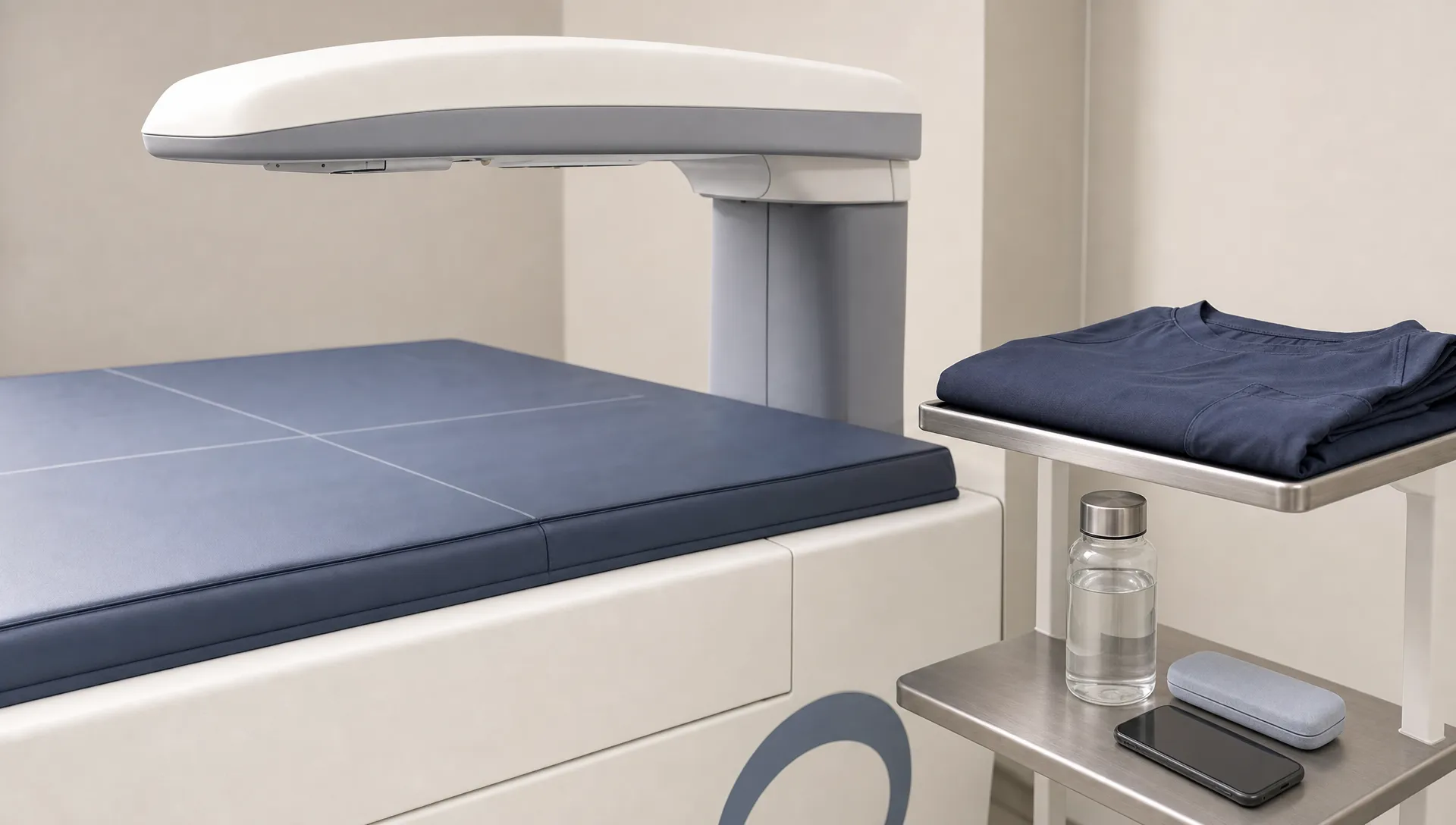
After intake, you may be asked to remove items that contain metal, such as watches, necklaces, belts, keys, wallets, phones, or shoes depending on the protocol. You do not typically need an injection, blood draw, or enclosed tube. A DEXA scanner is open, and the process is quiet and low effort.
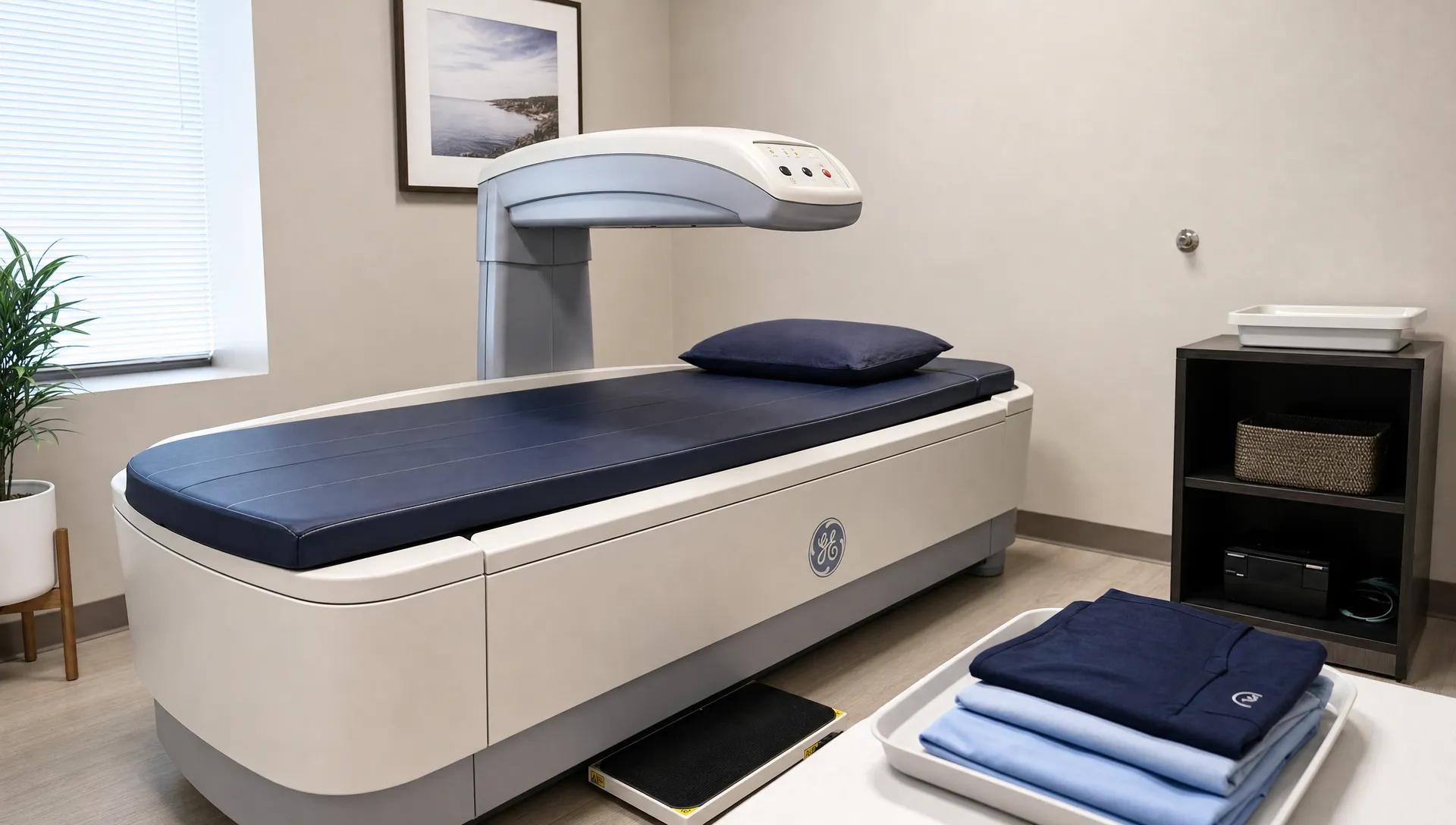
You will lie face-up on a padded scanning table. A trained operator positions your body so the scanner can capture reliable data. For a full-body body composition scan, your arms and legs are usually arranged in a standardized position. Good positioning matters because DEXA results can include regional data, such as left versus right lean mass or fat distribution.
Once you are positioned, the most important job is simple: stay still. Movement can blur the image or make measurements less reliable. You can breathe normally, but avoid shifting, talking with large movements, or adjusting your limbs unless staff tell you to.
Step 3: The Scan Itself
During the scan, a scanning arm passes above your body while the table may move slowly. You do not feel the X-rays. There is no pressure, heat, or pain. Most people describe the experience as easier than expected because there is nothing to do except lie still for a short period of time.
DEXA stands for dual-energy X-ray absorptiometry. The scanner uses two low-energy X-ray beams to distinguish different tissues. In simple terms, bone, lean tissue, and fat absorb energy differently. The system uses those differences to estimate tissue composition with a level of precision that common home scales and tape measurements cannot match.
For body composition, DEXA can measure more than a single body fat percentage. It can help separate total body weight into useful categories and show where fat and lean mass are distributed. This is why athletes, people pursuing fat loss, and people focused on long-term health often prefer DEXA over bathroom-scale body fat estimates.
What the Scanner Measures
A DEXA scan is useful because it provides a detailed picture of body composition and bone health. The exact report format can vary by provider and scan type, but common DEXA metrics include body fat, lean mass, bone measurements, and regional distribution.
| Measurement | What it tells you | Why it matters |
|---|---|---|
| Body fat percentage | The share of your body mass made up of fat tissue | Helps track fat loss more accurately than scale weight alone |
| Fat mass | Total pounds or kilograms of fat tissue | Shows whether weight change is coming from fat, lean mass, or both |
| Lean mass | Muscle and other non-fat soft tissue | Helps assess training progress and muscle preservation |
| Bone density or bone mineral content | Information about skeletal mineral status | Useful for bone health awareness and medical follow-up when needed |
| Visceral fat | Fat stored around internal organs | Relevant because higher visceral fat is associated with cardiometabolic risk |
| Left-right asymmetry | Differences between sides of the body | Can help identify imbalances that may affect training or performance |
| Regional composition | Fat and lean mass by body area | Helps explain where changes are happening, not just total change |
For many people, the most eye-opening part is regional data. Two people can have the same weight and even a similar body fat percentage, but very different fat distribution, muscle mass, and visceral fat profiles.
Step 4: Image Processing and Quality Check
After the scan, the software processes the data. The operator may review the scan for quality and positioning. If there was movement or a positioning issue, the staff may need to adjust or repeat part of the process. This is not common when instructions are followed, but it is one reason stillness matters.
DEXA software separates your body into regions and tissue categories. The report then organizes the measurements into a format that can be interpreted. This is where the scan turns from an image into actionable data.
It is important to remember that DEXA is a measurement tool. It gives high-quality information, but the most useful insights come from interpreting those numbers in context. Your age, sex, training history, goals, recent changes, and health background all affect what the results mean.
Step 5: Reviewing Your Results
Results are where the appointment becomes personal. At DEXA SF, clients receive expert interpretation along with fitness and nutrition guidance, so the numbers are not left for you to decode alone.
A results review may walk through questions like:
- Is your body fat percentage aligned with your goal and health context?
- Are you losing fat while preserving or gaining lean mass?
- Is visceral fat in a range that deserves attention?
- Are there meaningful left-right differences in lean mass?
- Is your current training or nutrition plan producing the changes you expected?
This is also where DEXA is different from simply stepping on a scale. Scale weight can move for many reasons, including water, glycogen, food volume, fat, and muscle. DEXA helps reveal what is changing underneath the total number.
If you want to understand the main sections of a report before your appointment, DEXA SF’s article on what DEXA body results say about your health is a helpful companion to this walkthrough.
How Long Does a DEXA Scan Take?
The scan itself is typically quick. The full appointment length depends on check-in, preparation, positioning, the scan protocol, and how results are reviewed. For most people, the experience feels efficient because there is no recovery time, sedation, or strenuous activity involved.
Here is a simplified timeline of what to expect:
| Appointment stage | What happens | Your role |
|---|---|---|
| Check-in | Staff confirm your information and scan goals | Ask questions and share relevant health details |
| Preparation | You remove metal items and get ready for the table | Wear or change into metal-free clothing if needed |
| Positioning | Staff align your body for accurate measurement | Lie flat and follow positioning instructions |
| Scanning | The scanner arm moves over your body | Stay still and breathe normally |
| Results | Data is processed and explained | Review key metrics and next steps |
The biggest factor under your control is cooperation during positioning and scanning. The more still and relaxed you are, the smoother the appointment tends to be.
Does a DEXA Scan Hurt?
No. A DEXA scan should not hurt. There are no needles, no compression, and no intense physical demands. Some people feel slightly awkward holding still, especially if they are not used to lying flat, but the scan is usually brief.
If you have mobility limitations, recent injuries, or discomfort lying flat, tell the staff before the scan begins. They can explain what is required and help you understand whether the positioning will be manageable.
Is DEXA Safe?
DEXA uses low-dose X-ray technology. The radiation exposure is generally considered very low, especially compared with many other medical imaging procedures. Still, it is appropriate to treat any X-ray-based test with respect. That means disclosing pregnancy or possible pregnancy, following provider instructions, and avoiding unnecessary repeated scans without a clear reason.
For body composition tracking, people often schedule repeat scans at intervals that match their goals. For example, retesting too soon may not show meaningful change, while waiting long enough allows training and nutrition changes to show up in the data. The best timing depends on your plan, your goals, and how quickly measurable change is expected.
How to Make Your Results More Useful Over Time
A single DEXA scan provides a valuable snapshot. Repeat scans create a trend. That trend is often where the most useful information appears, because it shows whether your habits are moving your body composition in the intended direction.
To make comparisons more reliable, try to scan under similar conditions each time. Use the same location when possible, wear similar clothing, scan at a similar time of day, and keep pre-scan food, hydration, and exercise as consistent as you can.
Consistency is one reason choosing the right provider matters. If you are still deciding where to go, DEXA SF’s guide on how to find the right DEXA scan location explains what to look for beyond distance and appointment availability.
What Happens After You Leave?
After the results review, your next step depends on your goal. If your focus is fat loss, the scan may help you evaluate whether your calorie intake, protein target, and training plan are preserving lean mass. If your goal is performance, the scan may highlight muscle distribution or asymmetry. If your concern is bone health, results may guide a conversation with a qualified healthcare professional.
DEXA data is most powerful when it changes decisions. For example, if weight is down but lean mass is dropping too quickly, your plan may need more resistance training, more recovery, or a nutrition adjustment. If scale weight is unchanged but fat mass is down and lean mass is up, the scan can reveal progress the scale hides.
The goal is not to chase one “perfect” number. It is to understand your baseline, connect the data to your goals, and use follow-up scans to see whether your plan is working.
Frequently Asked Questions
Do I need to fast before a DEXA scan? Not always. Requirements vary by provider and scan purpose. For body composition tracking, consistency matters, so many people prefer to scan under similar food and hydration conditions each time. Follow the instructions from your scan location.
Can I work out before a DEXA scan? It is often best to avoid intense exercise immediately before a body composition scan because exercise can temporarily affect hydration and fluid distribution. If you are tracking progress, keep your pre-scan routine consistent.
Do I have to undress for a DEXA scan? Usually you can remain clothed if your clothing is comfortable and free of metal. You may need to remove jewelry, belts, watches, shoes, or other metal-containing items.
Will I feel anything during the scan? No. You will not feel the X-rays. You simply lie still while the scanner arm passes over your body.
How soon do I get DEXA scan results? Results are typically generated after the scan is processed. At DEXA SF, expert interpretation helps you understand what the numbers mean for your body composition, fitness, nutrition, and health goals.
Is DEXA only for bone density? No. DEXA is widely known for bone density analysis, but it is also used for detailed body composition assessment, including body fat, lean mass, visceral fat, and regional muscle balance.
Ready to See What Your Body Composition Really Shows?
A DEXA scan is simple to complete, but the information it provides can be far more useful than a scale, mirror, or basic body fat estimate. From check-in to results, the process is designed to give you clear, precise measurements and guidance you can actually use.
If you are in San Francisco and want professional body composition data with expert interpretation, schedule your scan with DEXA SF. You will get detailed insight into body fat, muscle mass, bone density, visceral fat, asymmetries, and the next steps that make sense for your goals.