
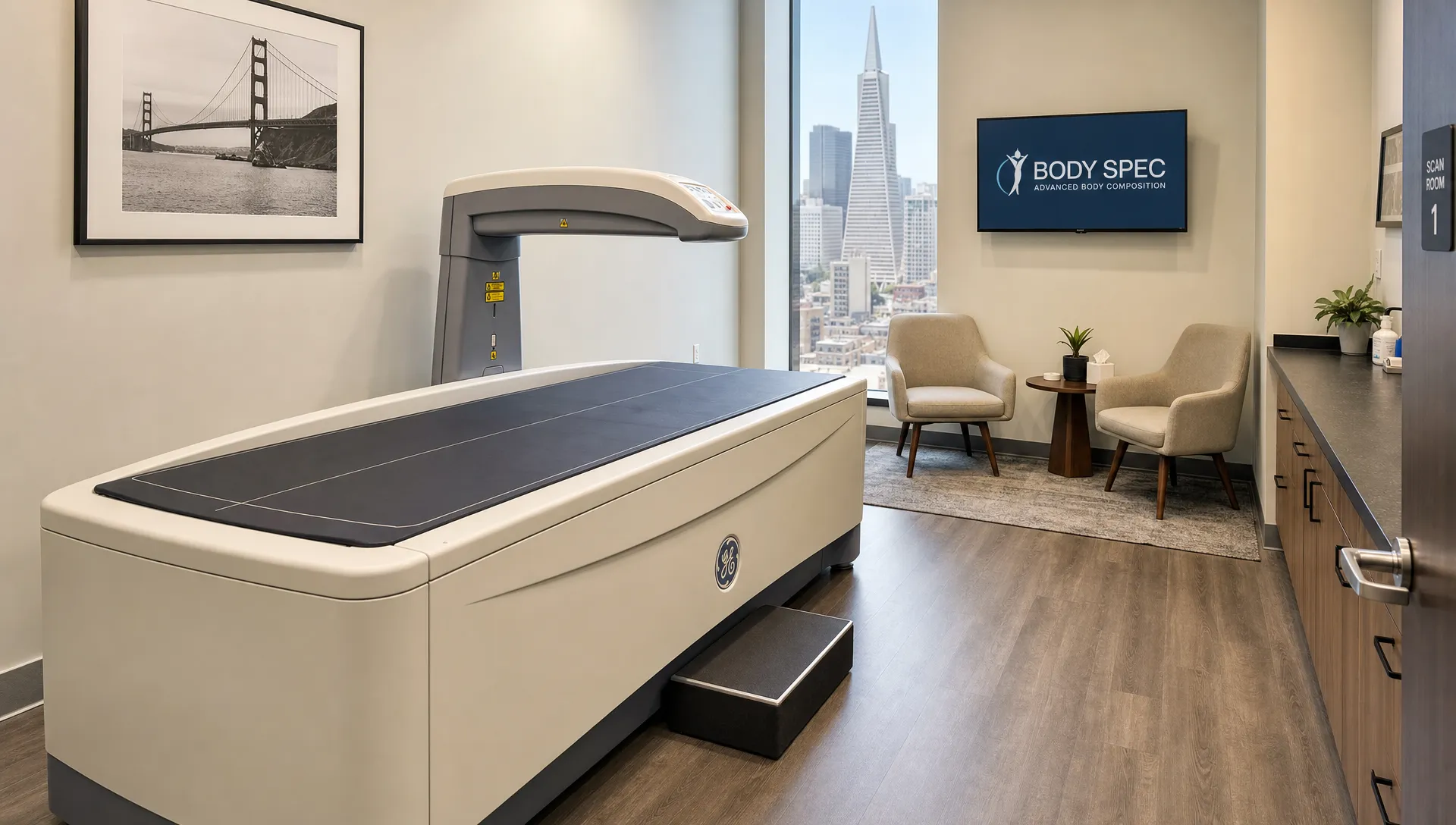
Fat Mass on a DEXA Scan and Better Fat-Loss Goals
A scale can tell you whether your body weight changed. It cannot tell you whether that change came from fat, muscle, water, bone or a combination of all four. That is why fat mass on a DEXA scan is so useful for people who want better fat-loss goals, not just a lower number on the scale.
A DEXA scan fat mass result gives you an absolute amount of fat tissue, usually reported in pounds or kilograms. That number can make your goal more specific: reduce fat mass while preserving lean mass, improving metabolic health markers and avoiding the common trap of dieting yourself into a smaller but less muscular version of the same body.
What fat mass means on a DEXA scan
DEXA stands for dual-energy X-ray absorptiometry. For body composition, it estimates how much of your body is fat mass, lean tissue and bone mineral content. Instead of giving only one broad score, a DEXA report can separate total body fat from regional fat distribution, lean mass and bone density.
Fat mass is the total amount of fat tissue detected across the body. Body fat percentage is different. It tells you what share of your total body mass is fat. Both are useful, but they answer different questions.
For example, if two people both have 30 percent body fat, the person who weighs more will usually have more total fat mass. Likewise, if you gain muscle while losing fat, your body fat percentage can improve even if your scale weight barely moves. This is one reason a DEXA scan can be more helpful than BMI or a smart scale when your goal is body recomposition.
The National Institute of Diabetes and Digestive and Kidney Diseases notes that BMI is a screening tool and does not directly measure body fat. DEXA is valuable because it gives more direct body composition context, especially when weight alone is not telling the full story.
If you want a broader breakdown of the numbers on your report, DEXA SF has a helpful guide to DEXA scan body fat results and how to read them.
Why fat mass is better than scale weight for fat-loss goals
Scale weight is a blunt tool. It includes fat, muscle, water, food volume, inflammation and glycogen. A hard training block, a salty meal or a change in carbohydrate intake can move the scale quickly without reflecting true fat change.
Fat mass is more targeted. It helps you ask better questions:
- Did I actually lose body fat or just body weight?
- Did my lean mass stay stable during the diet?
- Is fat coming down in the trunk or mostly in the limbs?
- Is visceral fat improving along with total fat mass?
- Is my goal realistic for my current body composition?
This matters because two people can lose the same amount of weight and get very different results. One person may lose mostly fat and maintain strength. Another may lose a mix of fat and lean mass, feel worse in training and end up with a lower metabolism than expected.
Here is a simplified example:
| Measurement | Starting point | After 12 weeks, better outcome | After 12 weeks, weaker outcome |
|---|---|---|---|
| Scale weight | 180 lb | 172 lb | 172 lb |
| Fat mass | 54 lb | 46 lb | 49 lb |
| Non-fat mass | 126 lb | 126 lb | 123 lb |
| Body fat percentage | 30% | 26.7% | 28.5% |
| What it suggests | Baseline | Fat loss with lean mass preserved | Some fat loss, but lean mass also dropped |
Both outcomes show an 8 lb drop on the scale. Only one clearly supports a stronger fat-loss goal. The DEXA scan makes the difference visible.
The DEXA metrics that matter most for fat loss
Fat mass is the headline number, but it works best when interpreted alongside other metrics. A strong fat-loss plan should reduce unnecessary fat while protecting the tissue that supports performance, mobility and metabolic health.
| DEXA metric | What it tells you | How it helps your goal |
|---|---|---|
| Total fat mass | The absolute amount of fat tissue on your body | Sets a clear fat-loss target beyond scale weight |
| Body fat percentage | The share of your total mass that is fat | Helps compare body composition over time |
| Lean mass | Muscle and other non-fat soft tissue | Shows whether your diet and training are preserving muscle |
| Visceral fat | Fat stored around abdominal organs | Adds health context beyond appearance or weight |
| Regional fat mass | Fat distribution in areas like trunk, arms and legs | Helps identify where change is happening |
| Left vs. right lean mass | Side-to-side muscle differences | Can reveal asymmetries that affect training focus |
Visceral fat deserves special attention. It is not the same as the subcutaneous fat you can pinch under the skin. Higher visceral fat is associated with greater cardiometabolic risk, so reducing it can be a more meaningful goal than simply reaching a certain clothing size.
Lean mass is the other key guardrail. If your fat mass is dropping but lean mass is dropping quickly too, your plan may be too aggressive, too low in protein, poorly matched to your training or not allowing enough recovery.
How to turn DEXA fat mass into a better fat-loss goal
The best fat-loss goal is not just lower body weight by a certain date. It should define what you want to lose, what you want to preserve and how you will evaluate progress.
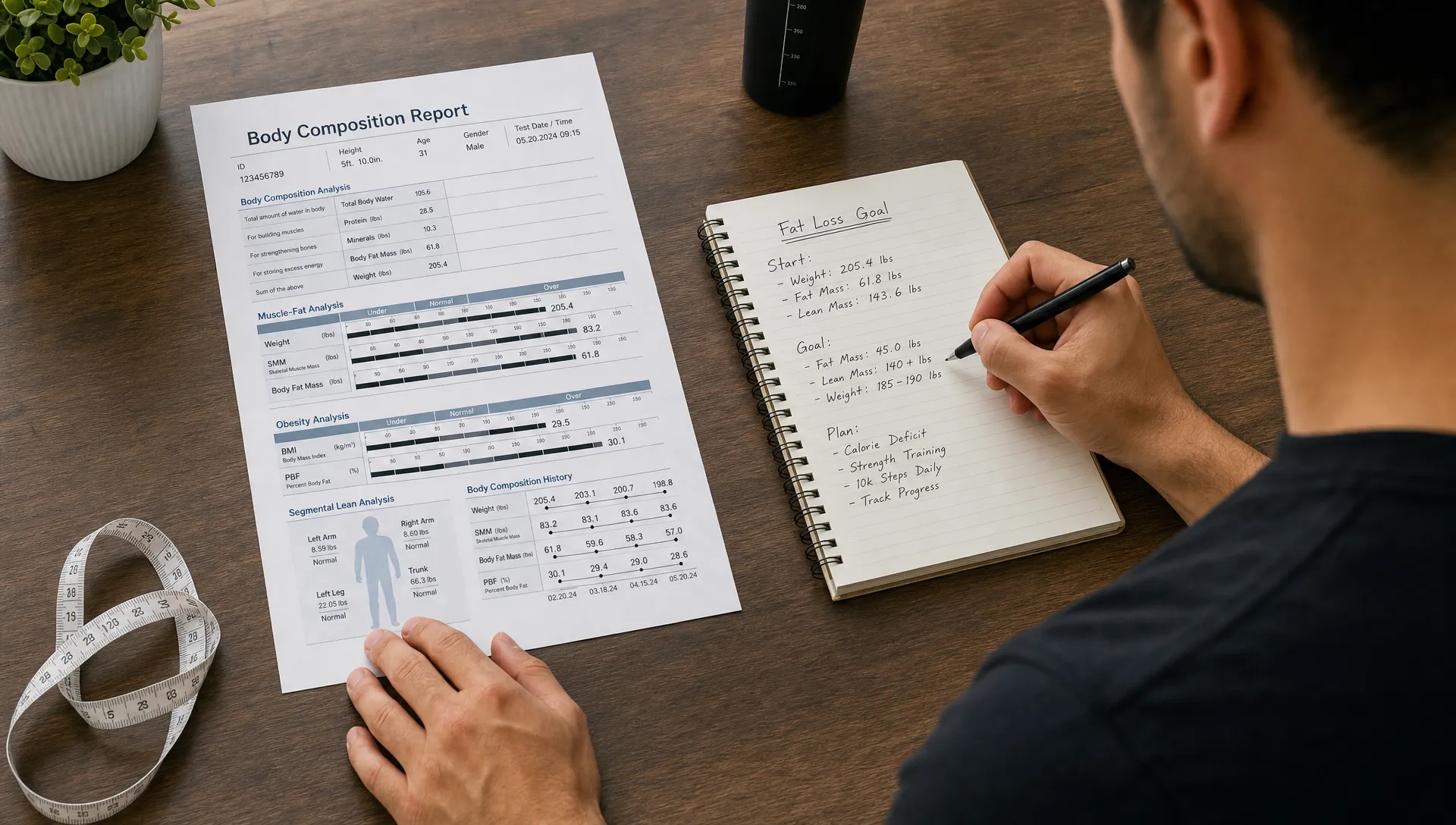
A stronger goal might look like this: reduce total fat mass from 58 lb to 50 lb over 12 to 16 weeks while keeping lean mass stable and maintaining strength in major lifts. That goal is more useful than saying lose 10 pounds because it gives you a clearer target and a quality standard.
Start with your baseline scan. Look at your total fat mass, body fat percentage, visceral fat and lean mass. Then decide which outcome matters most. Someone training for a marathon may prioritize reducing fat mass without compromising leg lean mass. Someone focused on metabolic health may care more about visceral fat and trunk fat. Someone lifting heavily may want a slower rate of fat loss to better preserve lean tissue.
The CDC notes that gradual weight loss of about 1 to 2 pounds per week is more likely to be maintained than rapid weight loss. That does not mean every person should target the same pace. Smaller individuals, leaner athletes and people trying to preserve muscle may need a slower approach. People with more fat to lose may see faster early changes, especially from water and glycogen shifts, before fat loss settles into a steadier rhythm.
A practical DEXA-based goal should include three parts:
- Outcome: Lower fat mass by a specific amount or range.
- Guardrail: Preserve lean mass, training performance or both.
- Timeline: Recheck after enough time for meaningful change, often several weeks rather than a few days.
Do not chase the lowest possible body fat percentage
Body fat percentage gets a lot of attention, but it is not automatically the best goal. A lower percentage can be useful for some athletes or aesthetic goals, yet it can become counterproductive if you sacrifice strength, energy, hormonal health or consistency.
This is where fat mass is more practical. You can set a target range that fits your health and performance, rather than chasing a number that looks impressive but does not match your life. For many people, the right goal is not extreme leanness. It is reducing excess fat enough to improve health markers, movement quality, confidence and long-term sustainability.
A DEXA scan also helps you avoid misreading progress when you gain muscle. If you add lean mass and lose fat at the same time, the scale may barely change. Without body composition data, that can feel like failure. With DEXA data, you may see that your fat mass is down, lean mass is up and your plan is working.
Use regional fat data carefully
DEXA can show where fat is distributed across the body, including trunk, arms and legs. This information is useful, but it should not be mistaken for proof that you can spot-reduce fat from one area.
Your body decides where fat comes off based on genetics, hormones, sex, age and total fat loss. Training your abs does not directly burn belly fat from that exact region. However, seeing regional data can still help you understand your pattern of change. For example, if your total fat mass is down and trunk fat is also trending down, that is a positive sign for many health and performance goals.
Regional lean mass can be equally useful. If one side of your body has noticeably less lean mass than the other, it may be worth adjusting your training. This is especially relevant for athletes, people returning from injury and anyone who has noticed strength differences from side to side.
How often should you repeat a DEXA scan for fat-loss tracking?
A DEXA scan is most useful when it becomes a repeatable measurement system, not a one-time score. Your first scan sets the baseline. Your next scan shows whether your nutrition and training are moving you in the right direction.
For fat-loss goals, repeating too soon can create noise. Hydration, recent training, glycogen and normal day-to-day variation can affect body composition readings. Waiting long enough allows the real trend to stand out.
Many people choose to rescan after a focused block of nutrition and training rather than after every small scale change. The exact timing depends on your goal, starting point and how aggressively you are changing your plan. What matters most is consistency: similar time of day, similar preparation and similar conditions when possible.
DEXA SF explains this tracking mindset in more detail in its guide on how to compare DEXA results without misreading changes.
Common mistakes when using DEXA fat mass for goals
DEXA data is powerful, but the goal still needs to be interpreted well. A few mistakes can make the numbers less useful.
One common mistake is focusing only on body fat percentage. Because body fat percentage is a ratio, it can change when fat mass changes, lean mass changes or both. Always look at the absolute fat mass and lean mass numbers too.
Another mistake is setting an aggressive deadline based on motivation rather than physiology. If the plan requires extreme restriction, poor recovery or training through constant fatigue, the DEXA result may show fat loss at the cost of lean tissue.
A third mistake is treating a single scan like a final verdict. A scan is a snapshot. The trend across scans is what tells you whether your approach is working. If one metric surprises you, review it with a qualified professional before changing everything.
Finally, do not ignore the health context. Bone density, visceral fat and asymmetry data may deserve attention even if your main goal is fat loss. If your scan raises medical concerns, discuss them with a clinician.
What a better fat-loss plan looks like after a DEXA scan
A DEXA-informed fat-loss plan should be specific enough to guide action but flexible enough to fit real life. After your scan, you can use the numbers to adjust nutrition, training and recovery with less guesswork.
If fat mass is higher than expected, the next step may be a moderate calorie deficit, higher protein intake, more daily movement or a more consistent training plan. If lean mass is lower than expected, resistance training and adequate recovery become more important. If visceral fat is the main concern, the plan may emphasize sustainable fat loss, sleep, alcohol intake, cardio fitness and medical follow-up when appropriate.
The value is not just in knowing your numbers. It is in connecting those numbers to decisions. DEXA SF offers professional DEXA body composition scans in San Francisco with measurements for body fat, lean mass, bone density, visceral fat and asymmetries, along with expert interpretation and personalized fitness and nutrition guidance.
If you are deciding whether a scan fits your next goal, this article on which health goals make a DEXA scan most useful can help you match the test to the decision you are trying to make.
Frequently Asked Questions
Is fat mass the same as body fat percentage on a DEXA scan? No. Fat mass is the absolute amount of fat tissue, usually in pounds or kilograms. Body fat percentage is the proportion of your total body mass that is fat. For goal setting, fat mass often gives a clearer target.
Can a DEXA scan tell me exactly how much fat I need to lose? It can show your current fat mass, lean mass, visceral fat and distribution, which makes goal setting more precise. The right amount to lose depends on your health history, performance goals, preferences and professional guidance.
Why did my scale weight drop but my DEXA fat mass barely changed? Some scale changes come from water, glycogen, food volume or lean mass. If fat mass did not change much, your calorie deficit, protein intake, training or tracking consistency may need review.
Can I use DEXA to track muscle while losing fat? Yes. One of the biggest advantages of DEXA is that it can help you see whether lean mass is being preserved while fat mass decreases. This is especially useful for athletes and people using resistance training during fat loss.
How should I prepare for repeat DEXA scans? Try to keep conditions consistent. Schedule at a similar time of day, follow the same food and hydration pattern when possible and avoid comparing scans taken under very different circumstances.
Build fat-loss goals from better data
If you are relying on scale weight alone, you may be missing the information that matters most. A DEXA scan can show whether you are losing fat, preserving lean mass and improving the metrics that actually support your goals.
For a professional body composition scan in San Francisco, schedule with DEXA SF and use your results to create a smarter, more measurable fat-loss plan.