
DEXA Scan Information Every First-Time Visitor Needs
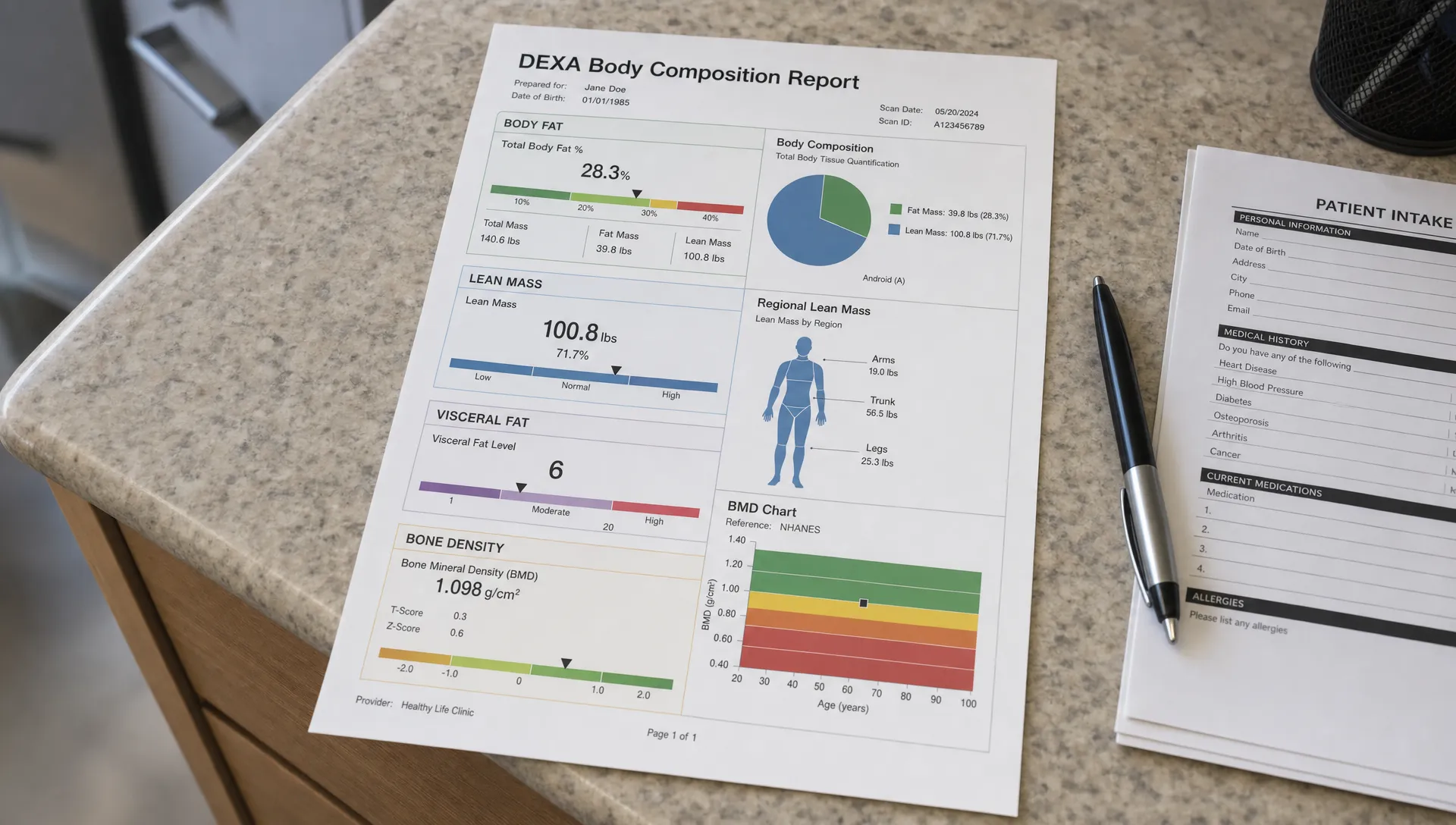
If you are booking your first appointment, the most useful DEXA scan information is not a pile of technical terms. It is a clear answer to five questions: what the scan measures, what happens in the room, how to prepare, what the numbers mean and how you should act on them. A DEXA scan, short for dual-energy X-ray absorptiometry, uses two low-dose X-ray beams to estimate body composition and bone measures with far more detail than a scale or handheld device. For fitness, health optimization, fat loss and muscle tracking, it can give you a baseline that is concrete enough to guide decisions. For medical questions, especially bone density concerns, your results should be discussed with a licensed clinician who knows your history.
First-time visitors usually do not need much preparation, and the scan itself is typically brief. The bigger value comes from understanding what your report can and cannot tell you before you step into the appointment.
Essential DEXA scan information before your appointment
A DEXA scan is best understood as a measurement visit, not a workout test or a judgment of your fitness. You lie still on a scanning table while the machine passes over your body. It estimates how much of your mass is fat, lean tissue and bone mineral content, then organizes that data into a report.
The scan is commonly used for two overlapping purposes. One is bone density assessment, often discussed in medical settings. The other is body composition analysis for people who want a better way to track fat loss, muscle gain, visceral fat or left-right imbalances.
What the scan can measure
Reliable DEXA scan information should separate the measurements clearly because each one answers a different question. A single body weight number cannot tell whether a change came from fat, muscle, water or bone, but DEXA gives a more detailed snapshot of your body composition.
| Measurement | What it shows | Why first-time visitors care |
|---|---|---|
| Body fat percentage | The portion of your body mass estimated as fat | Gives a clearer baseline than weight alone |
| Lean mass | Non-fat, non-bone tissue such as muscle and organs | Helps track strength training and muscle retention |
| Visceral fat | Fat stored around internal organs | Adds context beyond visible or pinchable fat |
| Bone density | Bone mineral measurements | Supports bone health conversations with a clinician |
| Left-right asymmetry | Differences between sides or regions | Can guide training balance and injury prevention discussions |
Some reports may also include metabolic estimates based on your measured body composition. These are useful for planning, but they should not be treated as a direct metabolic lab test.
Why your first scan is a baseline
Your first report is most valuable when you treat it as the start of a trend. A single scan can reveal where you are today, but repeat scans under similar conditions show whether your training, nutrition and recovery choices are moving you in the direction you want.
This is why consistency matters. If your first scan is done after an unusually hard workout, a long fast, travel or major hydration changes, your report may still be useful, but it may be harder to compare later.
What happens during the visit
Good DEXA scan information should make the appointment feel predictable. You will typically check in, confirm basic details, remove metal items if needed and lie on the scanning table in a still position. The scanner arm moves above you, but it does not enclose you like an MRI.
A technologist or trained professional helps with positioning so the scan can capture usable data. For a body composition scan, you are usually asked to stay relaxed and still while the scan is performed. The process is non-invasive, so there are no needles, injections or endurance tasks.
After the scan, the most important part is the results review. Numbers are easy to misunderstand without context. A useful interpretation explains what your body fat, lean mass, bone measurements, asymmetry and visceral fat mean for your goals. If you want a more detailed walk-through of the visit itself, DEXA SF has a guide on how a DEXA scan is done from check-in to results.
How to prepare without overthinking it
Practical DEXA scan information starts with one principle: arrive in a state that represents your normal baseline. Do not try to manipulate the result with extreme dehydration, fasting or last-minute exercise. If the point is to track your real progress, consistency beats perfection.
Wear comfortable clothing without metal when possible. Zippers, large buttons, underwire and heavy jewelry can interfere with positioning or image clarity, so you may be asked to remove certain items. If you take calcium supplements, creatine or other products that affect short-term water or mineral balance, follow the instructions provided by the scan location.
Try to schedule future scans at a similar time of day and under similar conditions. For example, if your first scan is in the morning before training, repeat that pattern later. This makes your trend easier to interpret.
If your appointment is already on the calendar, use this simple DEXA scan prep checklist to reduce avoidable surprises.
How to read your results like a decision-maker
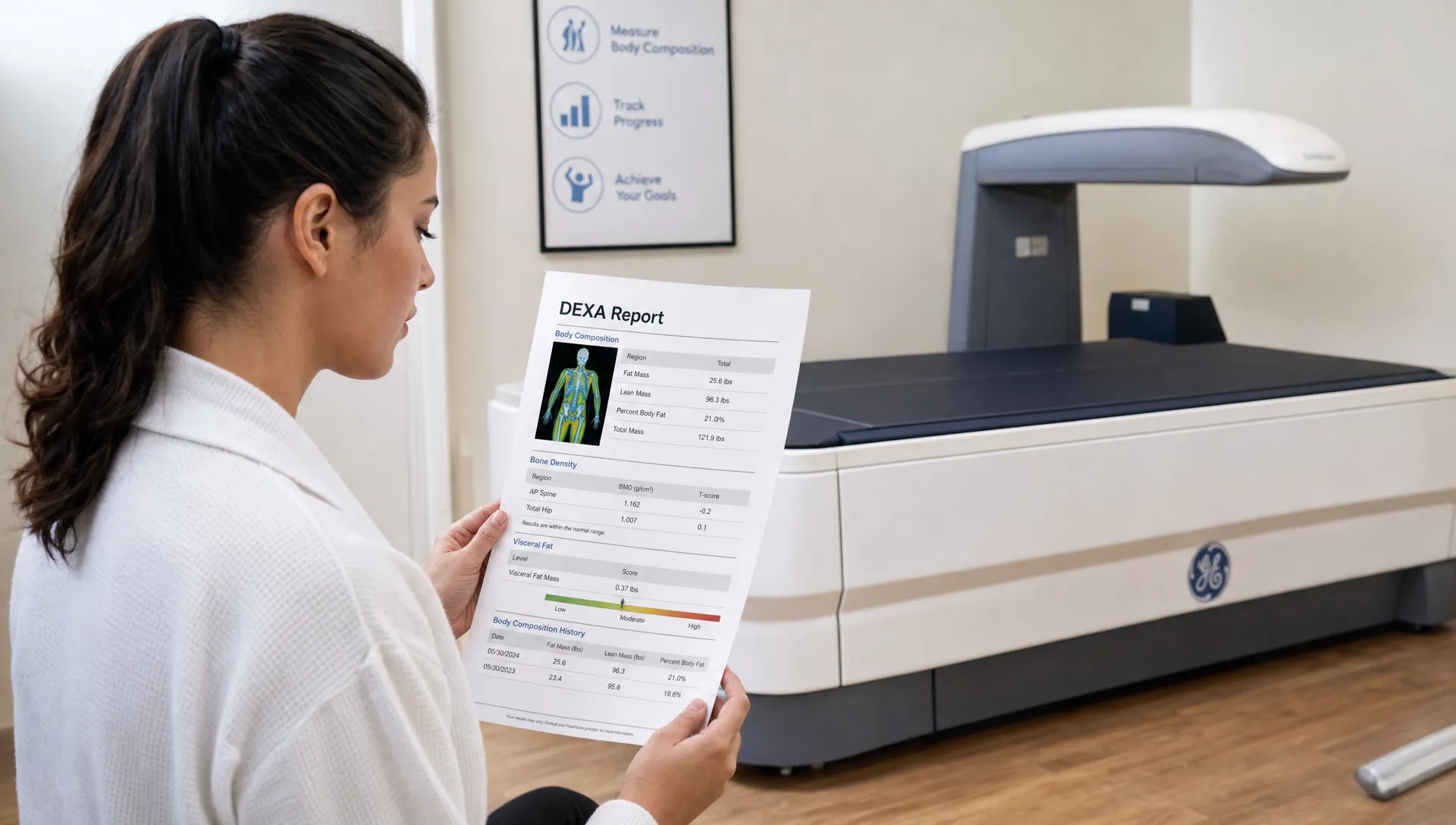
Your report is not a grade. It is a map. The numbers are most useful when they help you decide what to keep doing, what to change and when to measure again.
Body fat and visceral fat
Body fat percentage tells you how much of your total mass is estimated as fat. It is more informative than scale weight because two people can weigh the same and have very different body composition. Your DEXA scan information may also include visceral fat, which adds context because this fat is stored deeper in the abdomen around internal organs.
A higher or lower body fat number is not automatically good or bad without context. Age, sex, training status, medical history and goals all matter. If your goal is fat loss, look at whether fat mass changes over time while lean mass is preserved as much as possible.
Lean mass and asymmetry
Lean mass helps you see whether your training and nutrition are supporting muscle. If your weight is stable but lean mass is increasing and fat mass is decreasing, the scale may hide meaningful progress.
Left-right asymmetry can also be useful. A difference between limbs does not always mean something is wrong, since many people have a dominant side. Large or changing differences, however, can guide conversations with a coach, physical therapist or clinician, especially if they match strength differences or injury history.
Bone density and metabolic context
Bone density results deserve careful interpretation. DEXA is widely used for bone health assessment, and the International Society for Clinical Densitometry publishes clinical positions on how bone density testing should be performed and interpreted in medical contexts. If your concern is osteoporosis risk, fracture risk or medication decisions, bring the report to your healthcare provider.
Metabolic insights are best used as planning support. If your report includes estimated resting metabolic information, treat it as one input alongside hunger, energy, performance, sleep and progress over time.
Safety, limitations and who should ask questions first
Safety-focused DEXA scan information matters because the word X-ray can make first-time visitors nervous. DEXA uses ionizing radiation, but the dose is low compared with many medical imaging exams. RadiologyInfo.org, a patient resource from the American College of Radiology and the Radiological Society of North America, describes DXA as using a very small dose of radiation.
That does not mean every person should scan without discussion. If you are pregnant, think you may be pregnant or have a medical condition that affects imaging decisions, ask the scan provider or your clinician before booking an elective scan. If you recently had imaging with contrast material, implants or other special circumstances, mention that during scheduling.
A DEXA scan also has limits. It estimates tissue compartments based on imaging physics and software analysis. Hydration, recent meals, glycogen changes and positioning can influence comparisons, especially when you are looking for small changes. That is why trends are usually more valuable than tiny differences between two reports.
For a deeper look at radiation exposure and practical safety considerations, review DEXA SF's guide to DEXA scan risks, radiation and safety facts.
Turning the report into better fitness and nutrition choices
Actionable DEXA scan information should lead to a simple plan. If your goal is fat loss, the key question is whether you can reduce fat mass while maintaining enough lean mass and performance. If your goal is muscle gain, watch whether lean mass rises without unwanted fat gain. If your focus is health, visceral fat and bone density may deserve special attention.
A practical follow-up plan often includes three decisions. Choose one or two primary metrics to track, decide what habit changes you will make and set a realistic interval for your next scan. Many people rescan after they have had enough time to produce measurable change, not after every minor fluctuation.
At DEXA SF, first-time visitors can use professional body composition scanning in San Francisco to measure body fat, lean mass, bone density, visceral fat and asymmetry, then review the results with expert guidance. The scan is most useful when paired with fitness and nutrition choices you can repeat consistently.
Frequently Asked Questions
How long does a first DEXA visit take? The scan itself is usually brief, but your total visit may include check-in, positioning and a results review. Ask the location what to expect when you schedule.
Do I need to fast before a DEXA scan? Follow the instructions from your scan provider. For body composition tracking, the main goal is consistency, so repeat scans should be done under similar food, hydration and exercise conditions.
Is a DEXA scan only for athletes? No. Athletes use it, but so do people focused on fat loss, muscle gain, bone health, metabolic planning or getting a more accurate baseline than a bathroom scale can provide.
What is the best DEXA scan information to focus on after the report? Start with the metrics tied to your goal. Body fat and visceral fat matter for fat loss and health goals, lean mass matters for strength goals and bone density matters for bone health discussions.
Ready for a clearer baseline?
If you want more than a scale weight, a professional DEXA scan can show what is changing underneath the number. DEXA SF provides body composition scans in San Francisco with expert interpretation, fitness guidance and nutrition advice based on your results.
Schedule your visit with DEXA SF and leave with data you can actually use for your next training or nutrition decision.