
DEXA Scan Guide for 2026: Benefits, Cost, and Timing
Body weight is an incomplete scorecard. It can drop while you lose muscle, stay flat while you lose fat, or rise while your health and performance are actually improving. A DEXA scan gives you a clearer picture by separating your weight into fat mass, lean mass, and bone-related measurements.
For 2026, that matters more than ever. More people are tracking fitness with wearables, changing body composition through strength training, or losing weight quickly with medical and lifestyle interventions. A scale can tell you that something changed. A DEXA scan helps show what changed.
This guide explains what a DEXA scan measures, the main benefits, what it may cost, when to schedule one, and how to use your results without overreacting to a single data point.
What is a DEXA scan?
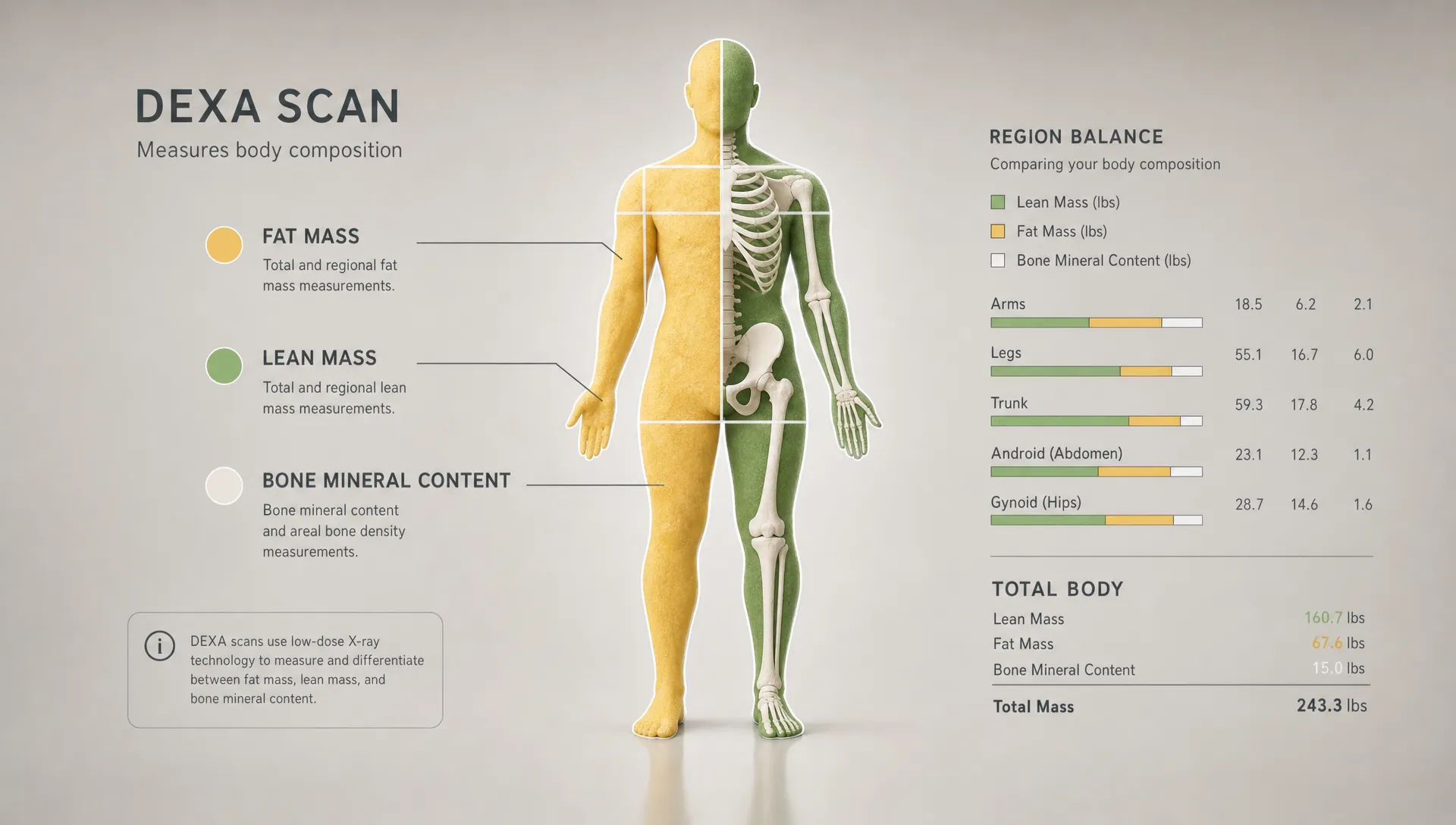
DEXA stands for dual-energy X-ray absorptiometry, sometimes written as DXA. The scan uses two low-dose X-ray beams to estimate the composition of your body. It is widely known for measuring bone mineral density, but it is also used for detailed body composition analysis.
Unlike BMI, which uses only height and weight, DEXA separates your body into major tissue categories. The CDC notes that BMI does not measure body fat directly, which is why two people with the same BMI can have very different muscle mass, fat distribution, and metabolic risk profiles.
A body composition DEXA scan can typically help assess:
| Measurement | What it tells you | Why it matters |
|---|---|---|
| Body fat percentage | The share of your body weight from fat | More useful than weight alone for fitness and health goals |
| Fat mass | Total pounds of fat tissue | Helps track fat loss or gain over time |
| Lean mass | Muscle and other non-fat soft tissue | Important for strength, performance, aging, and metabolism |
| Visceral fat estimate | Fat stored around abdominal organs | A useful marker to discuss in the context of metabolic health |
| Bone mineral data | Bone-related measurements from the scan | Helpful for understanding bone health and possible follow-up needs |
| Regional analysis | Arms, legs, trunk, and left-right differences | Helps identify asymmetries and training priorities |
At DEXA SF, clients can use a professional DEXA scan to understand body fat, lean mass, bone density, visceral fat, asymmetries, and related metabolic insights, with expert interpretation and practical fitness and nutrition guidance.
The biggest benefits of a DEXA scan in 2026
It gives you a more accurate baseline than the scale
A baseline scan is useful because it replaces guesswork with measurable starting data. If you are beginning a fat loss phase, a strength program, a nutrition plan, or a health reset, your starting body composition matters.
For example, losing 10 pounds is not automatically a success if a large portion comes from lean mass. Gaining 5 pounds is not automatically a problem if much of that gain is muscle. DEXA helps you look past the scale and evaluate the quality of the change.
It helps protect lean mass during weight loss
In 2026, many people are focused not just on losing weight, but on losing the right kind of weight. This is especially relevant for anyone making major dietary changes, increasing endurance training, or using medically supervised weight loss strategies.
Lean mass matters because it supports strength, mobility, glucose handling, and daily energy needs. A DEXA scan can show whether your plan is preserving muscle while reducing fat mass. If lean mass is falling faster than expected, it may be a sign to revisit protein intake, resistance training, recovery, or overall calorie targets with a qualified professional.
It shows regional body composition, not just totals
Total body fat percentage is useful, but regional data can be even more actionable. DEXA can show how fat and lean mass are distributed across the trunk, arms, and legs. It can also highlight left-right lean mass differences.
For athletes and active adults, this can be valuable. A runner may discover a meaningful leg asymmetry. A lifter may see that total lean mass is increasing, but not evenly. A person returning from injury may use regional data to monitor whether one side is lagging behind.
It can provide bone health insights
DEXA is best known medically for bone mineral density testing. Bone density matters because low bone mass and osteoporosis can increase fracture risk, often without obvious symptoms. The U.S. Preventive Services Task Force recommends osteoporosis screening for women 65 and older, and for postmenopausal women under 65 who are at increased risk.
A fitness-focused DEXA body composition scan is not a substitute for a clinician-ordered diagnostic evaluation when osteoporosis is suspected. Still, bone-related information can be an important prompt for better conversations with your healthcare provider, especially if you have risk factors such as prior fractures, long-term steroid use, low body weight, or a family history of osteoporosis.
It makes progress easier to interpret
The best reason to get a DEXA scan is not to chase one perfect number. It is to build a trend. A scan can help you answer practical questions such as:
- Did my fat mass decrease while lean mass stayed stable?
- Is my muscle gain showing up in the areas I am training?
- Is my visceral fat trending down?
- Did my last 12 weeks of training produce measurable change?
- Do I need to adjust nutrition, recovery, or program design?
That is why DEXA is most powerful when paired with a plan. Data alone is interesting. Data plus interpretation is useful.
How much does a DEXA scan cost in 2026?
DEXA scan cost depends on the type of scan, location, provider, and whether the scan is being used for medical diagnosis or personal body composition tracking.
Across many U.S. fitness and wellness settings in 2026, self-pay body composition DEXA scans are commonly advertised in the low hundreds of dollars, often around $75 to $250 per scan. Packages, memberships, or repeat-scan bundles may reduce the per-scan price. Hospital-based or clinic-based medical bone density scans may be billed differently and can vary widely before insurance.
For a Bay Area-specific breakdown, DEXA SF has a focused guide on how much a DEXA scan costs in San Francisco.
| Cost factor | Why it changes the price | What to ask before booking |
|---|---|---|
| Scan purpose | Body composition scans and medical bone density scans may be priced differently | Is this for fitness tracking, bone density screening, or both? |
| Provider type | Wellness studios, imaging centers, and hospitals use different billing models | Is the price self-pay or billed through insurance? |
| Report detail | Some providers include interpretation, while others provide only the scan output | Does the appointment include expert review of results? |
| Repeat scans | Packages may lower the per-scan cost | Are comparison reports included for follow-up visits? |
| Location | Prices vary by metro area and overhead | Are there any additional fees beyond the listed scan price? |
Insurance coverage depends on the reason for the scan. A medically indicated bone density test ordered by a clinician may be covered under certain plans. A body composition scan for fitness, performance, or personal tracking is usually self-pay. If coverage matters, confirm with your insurer and provider before your appointment.
When should you get a DEXA scan?
The best time to get your first DEXA scan is before you make a major change. That gives you a clean baseline before your training, nutrition, or medical plan starts influencing the numbers.
The second-best time is when you realize your current metrics are not answering your real question. If your weight is unchanged but your clothes fit differently, your lifts are improving, or your waist measurement is changing, a DEXA scan can help clarify what is happening.
For repeat scans, timing depends on your goal. Scanning too frequently can create noise, because hydration, glycogen, recent exercise, and normal biological variation can influence results. Most people benefit from waiting long enough for meaningful change to occur.
| Goal | Practical scan timing | Why it works |
|---|---|---|
| Fat loss | Baseline, then every 8 to 12 weeks | Allows enough time to see fat mass and lean mass trends |
| Muscle gain | Baseline, then every 12 to 16 weeks | Muscle growth is gradual and needs time to register clearly |
| Body recomposition | Every 8 to 16 weeks | Tracks simultaneous fat loss and lean mass change |
| Athletic performance | Every 3 to 6 months | Helps align training blocks with measurable body composition changes |
| Long-term maintenance | Every 6 to 12 months | Useful for accountability without over-monitoring |
| Bone density follow-up | Follow clinician guidance, often longer intervals | Bone density changes more slowly and may require medical context |
If you are using DEXA to monitor a medical condition, follow your clinician’s recommended schedule. If you are using it for fitness or nutrition, consistency matters more than scanning often.
How to prepare for a DEXA scan
A DEXA scan is quick and noninvasive. According to RadiologyInfo, DEXA uses a very small amount of ionizing radiation and is commonly used for bone density evaluation. You typically lie still on a padded table while the scanner passes over the body.
For first-time patients, the process is usually less intimidating than the name sounds. If you want a deeper walkthrough, DEXA SF’s guide to a DEXA X-ray for first-time patients explains what the scan is and what to expect.
For body composition tracking, preparation is about consistency. Try to repeat similar conditions each time you scan so your trend is easier to interpret.
Good preparation habits include:
- Schedule follow-up scans at a similar time of day when possible.
- Wear comfortable clothing without metal zippers, buttons, or thick seams.
- Remove jewelry, watches, keys, and other metal items before the scan.
- Avoid intense exercise immediately before the appointment if your provider recommends it.
- Keep food, hydration, and bathroom habits similar across repeat scans.
- Tell the provider if you are pregnant, may be pregnant, or recently had imaging with contrast material.
For medical bone density scans, your provider may give additional instructions, such as avoiding calcium supplements for a period before the test. Always follow the instructions from the facility performing your scan.
How to interpret your results without overreacting
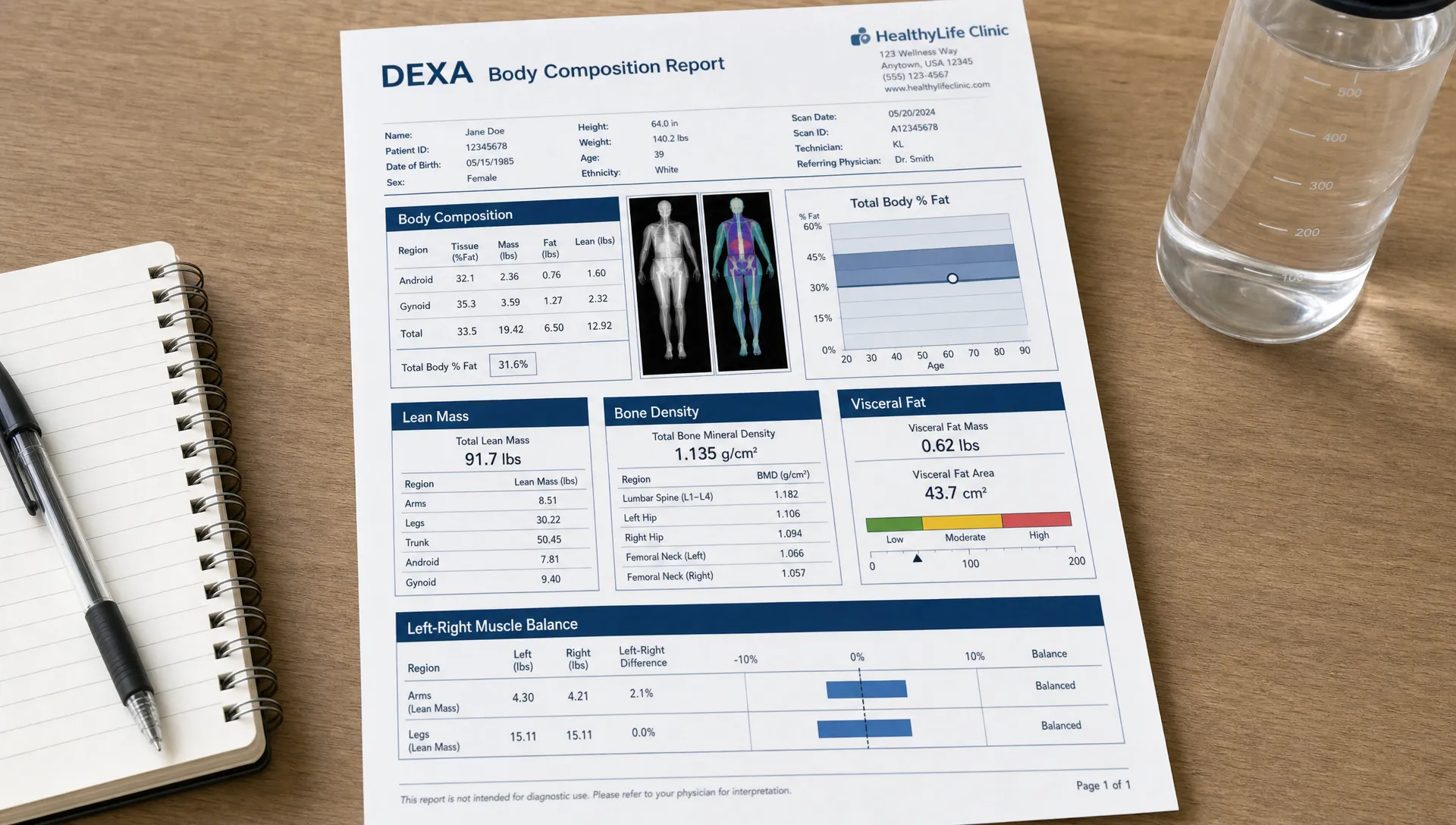
A DEXA report can feel data-heavy at first. The key is to focus on the metrics that match your goal.
If your goal is fat loss, watch fat mass, body fat percentage, trunk fat, and visceral fat trends. If your goal is strength or athletic performance, pay close attention to total lean mass, appendicular lean mass, and left-right balance. If your goal is healthy aging, lean mass and bone-related measurements are both important.
Do not treat one scan as a final verdict. A single scan is a snapshot. Two or more scans under similar conditions create a trend. The trend is where the value is.
It also helps to avoid comparing your results too aggressively with someone else’s. Age, sex, training history, genetics, injury history, medication use, and nutrition all influence body composition. The best comparison is usually you versus your prior scan.
If your report shows unexpectedly low bone density, high visceral fat, or a major asymmetry, use that information as a starting point. A qualified expert can help interpret what it means and whether you should involve a physician, dietitian, physical therapist, or coach.
Who should consider a DEXA scan?
A DEXA scan can be useful for a wide range of people, but the value depends on the decision you plan to make with the data.
You may benefit from a scan if you are starting a serious fitness plan, tracking fat loss, trying to gain muscle, returning from injury, training for a sport, or making a major nutrition change. It can also be helpful if scale weight has become confusing or discouraging because it does not reflect visible or performance-based progress.
People focused on healthy aging may also find DEXA useful. Lean mass tends to become more important with age, and bone health deserves attention long before a fracture occurs. If you have specific bone health risk factors, ask a healthcare professional whether a diagnostic bone density scan is appropriate.
A scan may not be appropriate during pregnancy unless specifically advised by a clinician. It also should not replace medical care if you have symptoms, an eating disorder history, unexplained weight loss, fracture risk, or a condition requiring clinical evaluation.
Choosing a DEXA scan provider
The machine matters, but the experience around the scan matters too. A good provider should help you understand what the numbers mean and how to use them.
Look for a provider that offers clear pricing, consistent scan procedures, understandable reporting, and expert interpretation. If you plan to repeat scans, ask whether you can compare results over time and whether the provider recommends consistent pre-scan conditions.
For body composition goals, interpretation is especially important. A report that says lean mass changed by a certain amount is only the beginning. The better question is what that change suggests about your training, nutrition, recovery, and next steps.
Frequently Asked Questions
Is a DEXA scan safe? DEXA uses a low dose of ionizing radiation, and it is widely used in clinical and wellness settings. If you are pregnant, may be pregnant, or have a specific medical concern, ask your healthcare provider before scheduling.
How long does a DEXA scan take? The scan itself is typically quick, although the full appointment may take longer depending on check-in, positioning, report generation, and interpretation.
How often should I get a DEXA scan? For body composition goals, many people repeat scans every 8 to 16 weeks during active change, or every 6 to 12 months for maintenance. Bone density follow-up should follow clinician guidance.
Will insurance cover a DEXA scan? Insurance may cover a medically indicated bone density scan when ordered under plan criteria. Body composition scans for fitness or personal tracking are usually self-pay.
Do I need to fast before a DEXA scan? Not always. For body composition tracking, the bigger priority is consistency across scans. Follow your provider’s instructions about food, hydration, supplements, and exercise.
Can DEXA tell me my metabolism? A DEXA scan does not directly measure metabolism the way indirect calorimetry does. Some reports include calculated metabolic estimates based on lean mass, which can be useful for nutrition planning when interpreted appropriately.
Ready to turn your goals into measurable data?
If you are in San Francisco and want a clearer picture of your body composition, schedule a DEXA scan with DEXA SF. You will get precise data on body fat, lean mass, bone density, visceral fat, and asymmetries, along with expert interpretation and practical fitness and nutrition guidance to help you decide what to do next.