
What an Affordable DEXA Scan Should Include
An affordable DEXA scan should not feel like a mystery purchase. You are not just paying for a few minutes on a scanner. You are paying for a reliable body composition measurement, a report you can understand and enough guidance to use the data for fat loss, muscle gain, bone health or performance goals.
If you searched for "dexa scan cheap," the better question is: what should be included so the lower price still gives you real value? A scan that only gives you one number, skips explanation or makes repeat tracking difficult may cost less upfront but deliver less insight.
A good affordable DEXA scan should include accurate measurement, key body composition metrics, clear reporting, professional interpretation and transparent pricing. Here is what to look for before you book.
Affordable does not mean stripped down
A lower price is not a problem by itself. In fact, affordability matters because DEXA is most useful when you can repeat it over time and compare results under similar conditions. The issue is when a provider cuts out the parts that make the scan useful.
The goal is not simply to find a dexa scan cheap enough to book once. The goal is to find a scan that gives you a high-quality baseline and can be repeated later, so you can see whether your training, nutrition or health plan is actually changing your body composition.
A fair-priced DEXA scan should still give you:
- A full body composition assessment, not just scale weight or BMI
- Body fat, lean mass, bone-related data and regional breakdowns
- A report that separates fat mass from lean mass
- An explanation of what your numbers mean
- Clear pricing before you arrive
- A process that supports accurate repeat testing
If the scan is inexpensive because the provider is efficient, well organized or offers simple appointment options, that can be a good deal. If it is inexpensive because you receive minimal data and no context, it may not be the bargain it looks like.
The core measurements every affordable scan should include
DEXA, short for dual-energy X-ray absorptiometry, is widely used because it can separate the body into major tissue categories with far more detail than a bathroom scale. It is commonly used for body composition and bone measurements, and RadiologyInfo notes that DEXA uses a very small amount of ionizing radiation.
For body composition, an affordable DEXA scan should include more than a single body fat percentage. At minimum, your report should help you understand what changed, where it changed and whether the change supports your goal.
Body fat percentage and total fat mass
Body fat percentage is the number most people ask for first, but total fat mass is just as important. If your body fat percentage drops, you want to know whether that happened because you lost fat, gained lean mass or both.
A useful report should show total fat mass in pounds or kilograms, along with percentage. This helps you avoid being misled by scale weight. For example, a person may gain weight during a strength phase but still improve body composition if lean mass rises faster than fat mass.
Lean mass and muscle distribution
Lean mass includes muscle and other non-fat, non-bone tissue. It is one of the most valuable DEXA outputs for athletes, strength trainees and anyone trying to preserve muscle during weight loss.
A good report should show total lean mass and regional lean mass. Regional data matters because two people with the same total lean mass can have very different distribution. For performance, injury prevention and training decisions, leg lean mass, trunk lean mass and arm lean mass can all matter.
Visceral fat measurement
Visceral fat sits deeper in the abdomen around internal organs. It is different from subcutaneous fat, which sits under the skin. A body composition DEXA scan may estimate visceral adipose tissue, often called VAT, which can give more meaningful health context than body fat percentage alone.
If you are choosing between scan providers, ask whether visceral fat is included in the standard report or treated as an add-on. If a dexa scan cheap offer excludes visceral fat, the lower price may not be ideal for someone focused on metabolic health.
Bone density or bone-related data
DEXA is also used for bone density assessment. In a body composition setting, you may receive bone mineral content or bone-related metrics. For people with osteoporosis risk, fracture history, long-term low energy availability or medical concerns, diagnostic bone density testing should be discussed with a physician.
That distinction matters. A fitness-focused body composition scan can be extremely useful, but it should not replace medical evaluation when your goal is diagnosing or treating bone disease.
For a broader primer on DEXA measurements and timing, DEXA SF has a helpful DEXA scan guide for 2026 that explains benefits, cost considerations and when repeat scans make sense.
Scan quality matters as much as the report
The best report in the world is not worth much if the scan process is inconsistent. DEXA is highly useful for tracking, but repeatability depends on technique, positioning and protocol.
An affordable DEXA scan should still include a professional scan process. That means the provider should position you consistently, follow manufacturer protocols, account for clothing or metal items that may interfere and explain basic preparation instructions.
You do not need to understand every technical detail before booking, but you should feel comfortable asking simple questions:
- Will I be scanned on the same type of machine for follow-up visits?
- Do you provide the same report format each time?
- How should I prepare before the scan?
- Will someone explain the results after the scan?
- Are all body composition metrics included in the listed price?
Quick scans are convenient, especially in a city like San Francisco where scheduling is tight. Still, speed should not come at the expense of consistency. If you plan to track progress over months, a careful baseline is more valuable than a rushed appointment.
Expert interpretation should not be an afterthought
DEXA data is powerful, but most people need help translating it into action. A scan can tell you that lean mass is down in one leg, visceral fat is higher than expected or total fat mass changed less than scale weight suggested. It cannot, by itself, tell you how to adjust your training and nutrition.
This is where interpretation adds value. A qualified professional can explain which numbers matter most for your goal, what changes are realistic and what to focus on before your next scan. For example, someone trying to lose fat without losing muscle may need a different plan than someone trying to build glute and leg mass for performance.
DEXA SF provides professional DEXA body composition scans in San Francisco with expert interpretation plus fitness and nutrition guidance. That combination matters because the scan is only the beginning. The real value comes from knowing what to do with the results.
What your DEXA report should show
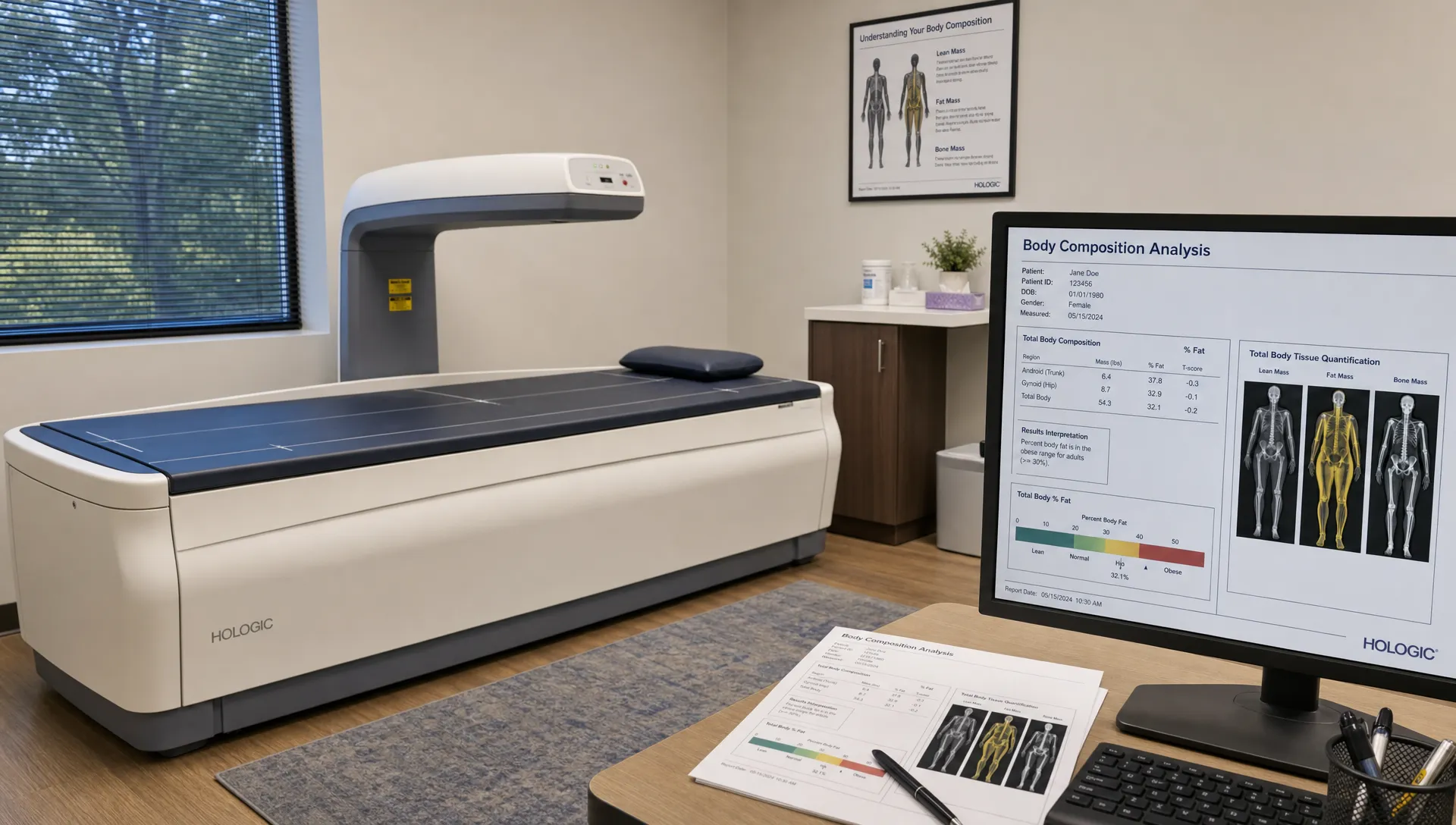
Before booking, ask for a sample report or a summary of what is included. A complete report does not need to be flashy. It needs to be clear, consistent and detailed enough to guide decisions.
| Report item | Why it matters |
|---|---|
| Total body fat percentage | Gives a high-level body composition marker beyond BMI |
| Total fat mass | Shows actual fat tissue change over time |
| Total lean mass | Helps track muscle gain or muscle preservation |
| Regional lean mass | Reveals distribution across arms, legs and trunk |
| Visceral fat estimate | Adds context for metabolic health goals |
| Bone mineral content or density data | Supports bone health awareness and follow-up questions |
| Left vs. right comparison | Helps identify asymmetries that may affect training |
| Trend comparison, if available | Makes repeat scans easier to interpret |
| Plain-language explanation | Helps turn numbers into next steps |
A report that only says you are a certain body fat percentage is not enough for most serious goals. If you are paying for DEXA, the value is in the detail.
Pricing should be transparent before you book
A dexa scan cheap on the booking page can become less affordable if key items cost extra. Some add-ons may be reasonable, but they should be clear before you arrive.
Ask what is included in the listed price. Does it include the scan, the full report and an explanation? Are repeat scans discounted? Is there a separate fee for visceral fat analysis, metabolic data or consultation? You should not have to guess.
| Booking question | What a good answer sounds like |
|---|---|
| What is included in the appointment? | The provider clearly lists scan, report and interpretation details |
| Are there extra report fees? | Any add-ons are disclosed upfront |
| Can I track changes over time? | Reports are consistent enough for repeat comparison |
| Who explains the results? | A trained staff member or qualified expert reviews your data |
| How long does it take? | The scan is quick, but the appointment allows time for accuracy and questions |
If you are comparing local prices, this quick guide to DEXA scan cost in San Francisco can help you understand the factors that affect value, including consultation, packages and scan setting.
When a lower-cost scan is a good choice
A low-cost DEXA scan can be a smart option when it gives you complete metrics and fits your goal. It is especially useful for people who want a baseline before starting a new training block, nutrition plan or body recomposition phase.
It can also be a good choice if you already have a coach, dietitian or physician who can help interpret the report. In that case, the scan still needs to provide the full data set, but you may not need an extended consultation from the scan provider.
A cheaper scan is less ideal when you have medical concerns that require clinical evaluation, when the report is too limited to guide action or when you cannot repeat the scan under similar conditions. DEXA works best as a tracking tool when the process is consistent.
If your goal is unclear, decide that first. Someone focused on bone health, someone training for endurance performance and someone trying to reduce visceral fat all need different takeaways from the same scan. DEXA SF’s article on which health goals make a DEXA scan most useful can help you decide whether now is the right time to scan.
How to get more value from an affordable scan
The easiest way to make a DEXA scan more valuable is to prepare consistently and repeat it at the right interval. The scan is a measurement tool, so your habits around the measurement affect how useful the comparison will be.
Try to schedule repeat scans under similar conditions when possible. Similar time of day, similar hydration, similar meal timing and similar training status can make the trend easier to interpret. Follow the provider’s preparation instructions, wear metal-free clothing and tell the staff about implants, recent contrast imaging or possible pregnancy.
Do not treat DEXA like a daily weigh-in. Body composition changes take time. For many fitness goals, scanning after a meaningful training or nutrition phase gives a clearer picture than scanning too often. The right interval depends on your goal, rate of change and whether you are using the scan for performance, fat loss, muscle gain or bone health awareness.
Finally, write down the action plan after your scan. If your report shows low lean mass in your legs, elevated visceral fat or a meaningful left-right asymmetry, decide what you will change before the next appointment. Affordable scanning becomes much more valuable when each scan leads to a measurable plan.
Frequently Asked Questions
What should an affordable DEXA scan include? It should include a full body composition report with body fat percentage, fat mass, lean mass, regional analysis, visceral fat when available, bone-related data, left vs. right comparisons and expert interpretation.
Is a dexa scan cheap option accurate? It can be accurate if the provider uses a professional DEXA system, follows consistent scan protocols and gives you a complete report. The concern is not the low price itself. The concern is whether important data or interpretation has been removed.
Do I need expert interpretation after a DEXA scan? Most people benefit from it. DEXA results can be detailed, and interpretation helps you understand which metrics matter for your goal and what changes to make before your next scan.
Is DEXA only for people trying to lose weight? No. DEXA can be useful for fat loss, muscle gain, athletic performance, body recomposition, asymmetry tracking, visceral fat awareness and bone health monitoring.
How often should I repeat a DEXA scan? It depends on your goal. Many people wait until they have completed a meaningful training or nutrition phase so the next scan can show real change. If you have medical concerns, ask your healthcare provider for timing guidance.
Book a DEXA scan that gives you more than a number
If you want an affordable scan, look for value, not just the lowest sticker price. A strong DEXA appointment should give you precise body composition data, clear interpretation and practical next steps.
DEXA SF offers professional DEXA body composition scans in San Francisco, including body fat assessment, lean mass evaluation, bone density analysis, visceral fat measurement, asymmetry detection, metabolic data insights and personalized fitness and nutrition guidance. You can schedule a scan with DEXA SF when you are ready to turn your body composition data into a plan.