
Is a DEXA Scan the Most Accurate Body Fat Test?
Short answer: yes, for most people, a DEXA scan is one of the most accurate body fat tests available outside of a research lab. It is not perfect, and it is not the only high-quality method, but it gives a more complete and repeatable picture than most consumer options.
The longer answer depends on what you mean by most accurate. If you mean the best practical test for tracking fat mass, lean mass, regional body composition, and visceral fat over time, DEXA is hard to beat. If you mean the absolute research benchmark, a multi-compartment laboratory model or imaging tools such as MRI may be more specialized, less accessible, and much more expensive.
So, if you are asking whether a DEXA scan is an accurate body fat test, the answer is yes, with an important caveat: the quality of the scan, the consistency of your preparation, and the way your results are interpreted all matter.
What body fat accuracy actually means
Body fat testing is trickier than it sounds because most methods do not directly count every pound of fat in the body. They estimate body composition using physical assumptions.
A bathroom scale measures total weight, not what that weight is made of. BMI uses height and weight, but the CDC explains that BMI does not directly measure body fat. Skinfold calipers estimate fat from a few pinched sites. Smart scales estimate fat from electrical resistance. Hydrostatic weighing and air displacement estimate body density, then convert that into body fat percentage.
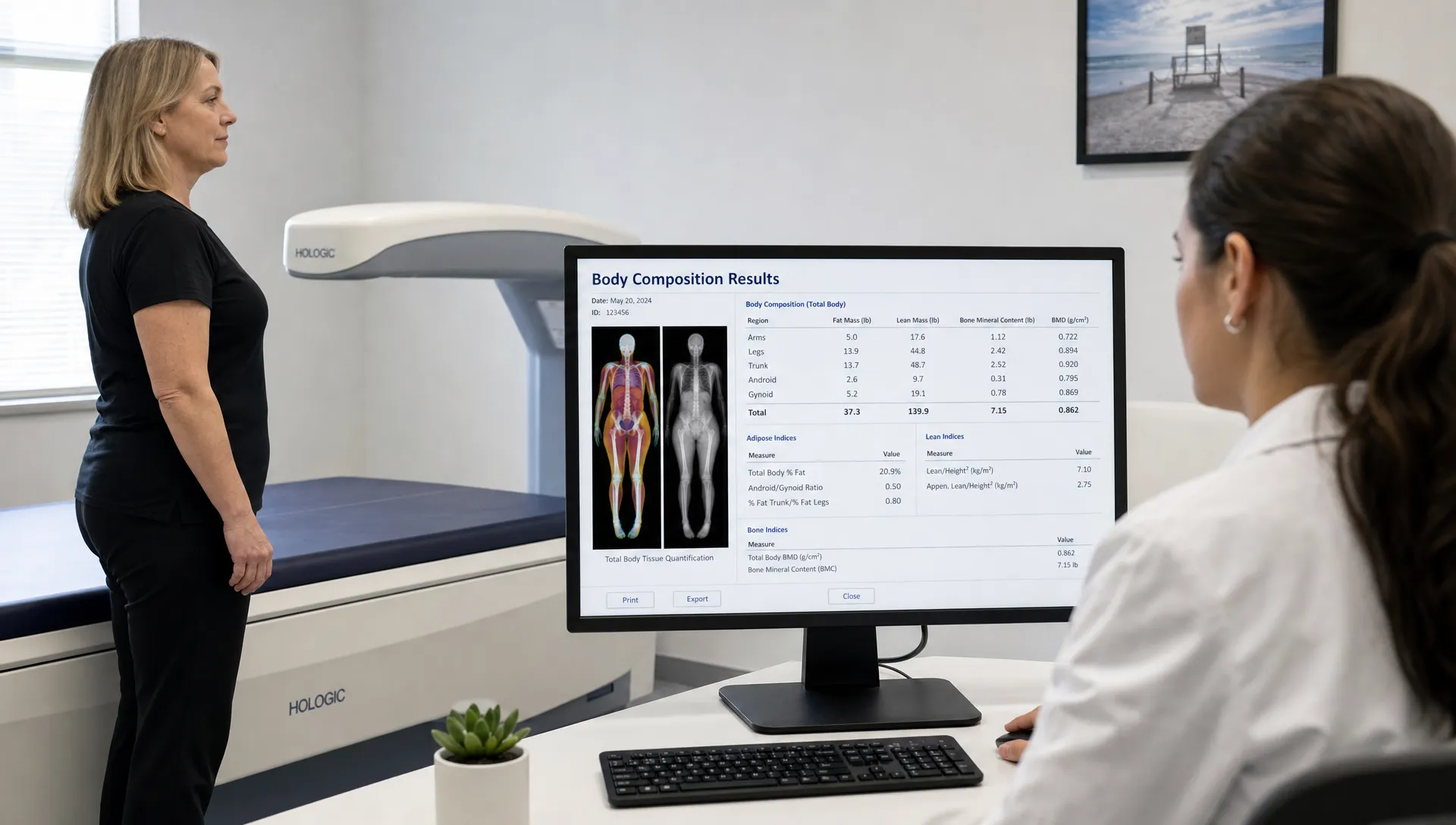
DEXA, short for dual-energy X-ray absorptiometry, takes a different approach. It uses low-dose X-ray beams to estimate how much of your body is bone mineral content, lean tissue, and fat tissue. That is why it can report not only total body fat percentage, but also where fat and lean mass are distributed.
Accuracy has two parts:
- Absolute accuracy: how close the result is to your true body composition.
- Precision: how consistently the test gives the same result when nothing meaningful has changed.
For health and fitness tracking, precision is especially important. Even if no test is a perfect measurement of every cell in your body, a highly repeatable test can show whether you are losing fat, gaining muscle, or maintaining lean mass over time.
Why DEXA is considered one of the best body fat tests
DEXA has earned its reputation because it provides detail that most other tests cannot. Instead of giving only a single body fat percentage, it separates your results into compartments and regions.
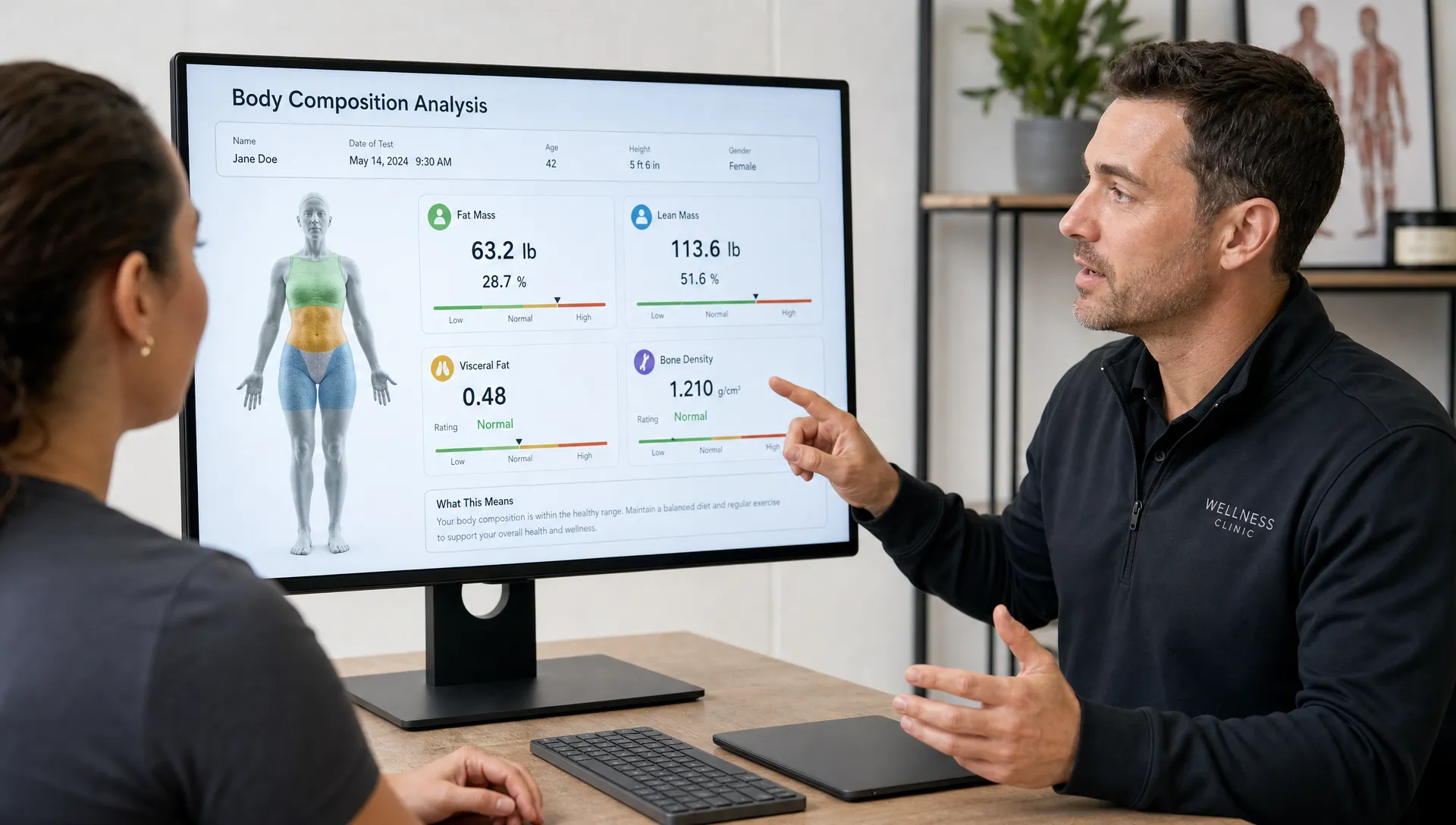
A typical DEXA body composition report can include total fat mass, lean mass, bone mineral content, body fat percentage, visceral fat estimates, and regional breakdowns for the arms, legs, trunk, and sometimes left-to-right differences. That makes it useful for far more than simply asking whether your body fat percentage went up or down.
This matters because two people can have the same body weight and very different body composition. One person may carry more lean mass, another more fat mass. Two people can also have the same body fat percentage but store fat differently, which may influence health and performance goals.
DEXA is also valuable because it measures bone mineral content as part of the scan. DEXA technology is widely used for bone density testing in clinical settings, and organizations such as Cleveland Clinic describe DXA scans as a key tool for evaluating bone density. In a body composition setting, that same underlying technology helps separate bone from soft tissue, which improves the usefulness of the report.
If you want a deeper technical look at expected error ranges, assumptions, and repeatability, DEXA SF has a focused guide on how accurate a DEXA scan is for body fat percentage.
How DEXA compares with other body fat tests
No body fat test is perfect. The best choice depends on whether you care most about convenience, cost, regional data, repeatability, or clinical-level insight.
| Body fat test | What it estimates | Main strengths | Main limitations |
|---|---|---|---|
| DEXA scan | Fat mass, lean mass, bone mineral content, regional body composition | Detailed, repeatable, regional results, visceral fat estimate | Results can vary by machine, software, positioning, hydration, and prep |
| Smart scale or BIA | Body fat based on electrical impedance | Convenient, inexpensive, easy to use often | Sensitive to hydration, food intake, exercise, and device quality |
| Skinfold calipers | Subcutaneous fat from measured pinch sites | Low cost, useful with a skilled tester | Operator dependent, less useful for visceral fat and uneven fat distribution |
| Bod Pod | Body density using air displacement | Noninvasive, relatively quick | Sensitive to clothing, hair, breathing, and density assumptions |
| Hydrostatic weighing | Body density using underwater weighing | Historically respected lab method | Less convenient, requires full submersion, depends on residual lung volume estimates |
| MRI or CT | Tissue imaging, often used medically or in research | Highly detailed for specific tissues and visceral fat | Expensive, less accessible, CT involves higher radiation exposure than DEXA |
| 4-compartment model | Combines several measures to estimate body composition | Often treated as a research benchmark | Not practical for routine consumer tracking |
The biggest difference is that DEXA does not just estimate a single number. It gives a structured body composition profile. That is why it is often the most practical answer for someone who wants better data than a scale, calipers, or a fitness tracker can provide.
Is DEXA more accurate than a smart scale?
For body fat testing, yes, DEXA is generally more accurate and more informative than a smart scale.
Smart scales typically use bioelectrical impedance analysis, often called BIA. The device sends a small electrical current through the body and estimates body composition based on how easily that current passes through tissues. Since water conducts electricity well, hydration status can significantly affect the result.
That means a smart scale reading can change after a salty meal, a hard workout, a long flight, a menstrual cycle shift, or a change in hydration. The number may still be useful as a rough trend if you measure under consistent conditions, but it is not the same level of analysis as a DEXA scan.
DEXA can show whether weight change is coming from fat mass, lean mass, or both. It can also show whether muscle is changing more in one limb than another. For anyone training seriously, dieting, recovering from injury, or trying to understand stubborn body composition changes, that extra detail is often the point.
Is DEXA more accurate than skinfold calipers?
Usually, yes, especially if you want total and regional body composition rather than an estimate based on a few surface measurements.
Skinfold testing can be useful when performed by a highly trained practitioner using a consistent protocol. It is inexpensive and can track change over time. The problem is that it measures only subcutaneous fat at selected sites. It does not directly assess visceral fat, bone mass, or lean mass. It can also be less reliable in people with very high or very low body fat, and results can vary from one tester to another.
DEXA reduces operator dependence because the scan itself captures the full body. Positioning still matters, and expert interpretation still matters, but the test does not rely on manually pinching and measuring a few sites.
Is DEXA more accurate than hydrostatic weighing or Bod Pod?
DEXA is often more useful, but the comparison is not as simple as ranking one method first in every situation.
Hydrostatic weighing and Bod Pod testing estimate body density, then use equations to estimate body fat percentage. These methods can perform well, but they depend on assumptions about tissue density and, in the case of hydrostatic weighing, accurate estimation of air remaining in the lungs. Small errors can affect the final body fat percentage.
DEXA has different assumptions. It separates tissue using X-ray attenuation, then reports fat, lean mass, and bone mineral content. It also provides regional results that density-based methods do not. If your goal is to understand where fat or lean mass changed, DEXA provides a clearer answer.
When DEXA may not be perfectly accurate
DEXA is highly useful, but it is still an estimate. Several factors can influence results, especially if you are comparing scans over time.
Hydration can affect lean mass estimates because lean tissue includes water. A very hard workout, carbohydrate loading, dehydration, alcohol, or a large meal before the scan may shift the result. Positioning also matters. If your arms, legs, or torso are placed differently from one scan to the next, regional results can be affected.
Different DEXA machines and software versions may also produce slightly different outputs. That is why it is best to repeat scans on the same machine, at the same facility, under similar conditions. If your first scan is done in San Francisco and your second scan is done elsewhere on a different device, the trend may be less clean.
For the most reliable repeat data, try to keep these variables consistent:
- Scan at a similar time of day.
- Avoid intense training right before the scan.
- Arrive normally hydrated, not dehydrated or overhydrated.
- Avoid unusually large meals immediately before the scan.
- Wear similar scan-appropriate clothing each time.
- Use the same scanner and facility when possible.
This does not mean your result is fragile or untrustworthy. It simply means DEXA works best as a standardized measurement, not a random one-off number taken under completely different conditions every time.
What DEXA tells you that body fat percentage alone cannot
Body fat percentage is useful, but it can also be misleading if you treat it as the only number that matters.
For example, a person can lose weight and see body fat percentage stay similar because fat and lean mass both decreased. Another person can gain weight and improve body composition because lean mass increased more than fat mass. Someone else might have a normal scale weight but higher visceral fat than expected.
DEXA helps clarify these differences by showing the components behind your weight. If you are tracking a fitness or nutrition plan, the most useful questions are often more specific than whether your weight changed:
- Did fat mass decrease?
- Did lean mass stay stable or increase?
- Did visceral fat improve?
- Did the trunk, legs, or arms change differently?
- Are there left-to-right asymmetries that matter for training?
- Is bone density worth discussing with a medical professional?
If you are new to the report, it helps to understand which DEXA scan body fat composition metrics matter most before focusing too much on one headline number.
Who benefits most from DEXA body fat testing?
DEXA is not only for athletes or people trying to reach very low body fat. It can be useful for anyone who wants a clearer baseline and a better way to measure progress.
It is especially helpful if you are starting a fat loss plan, changing your training program, building muscle, returning from injury, monitoring body composition with age, or trying to understand why the scale is not matching your effort. It can also be valuable for people who want insight into visceral fat, since waist measurements and scale weight do not always tell the full story.
Athletes may use DEXA to identify lean mass changes by region or spot asymmetries that could influence performance. People focused on long-term health may care more about visceral fat and bone density. People pursuing weight loss may use it to confirm that they are preserving lean mass while reducing fat mass.
In each case, the value comes from interpretation. A body fat percentage without context can create confusion. A DEXA report reviewed with someone who understands body composition can become a practical plan.
So, is DEXA the most accurate body fat test?
For most people, DEXA is the best combination of accuracy, detail, accessibility, and practical value. It is more informative than BMI, a bathroom scale, most smart scales, and skinfolds. It is more convenient than hydrostatic weighing for many people, and it provides regional data that density-based tests cannot.
It is not the final word in every scientific context. Advanced research models may be better for validation studies, and medical imaging may be better for very specific diagnostic questions. But for a real-world body composition scan that can guide training, nutrition, fat loss, muscle gain, and health tracking, DEXA is one of the strongest options available.
The key is to use it correctly. Treat your first scan as a baseline. Repeat scans under similar conditions. Focus on trends, not tiny one-day fluctuations. Most importantly, interpret body fat percentage alongside fat mass, lean mass, visceral fat, regional distribution, and bone metrics.
Frequently Asked Questions
Is a DEXA scan accurate for body fat? Yes. DEXA is one of the most accurate and detailed body fat tests available to consumers, especially when scans are performed consistently on the same machine and interpreted by qualified experts.
Is DEXA more accurate than a scale? Yes. A scale only measures total body weight. DEXA estimates fat mass, lean mass, bone mineral content, visceral fat, and regional distribution, which makes it much more useful for understanding body composition.
Can DEXA results be wrong? DEXA results can be influenced by hydration, recent exercise, large meals, positioning, machine differences, and software differences. That is why standardized preparation and repeat scans at the same facility are important.
How often should I get a DEXA scan for body fat tracking? Many people scan every 3 to 6 months, depending on their goals and how quickly their training or nutrition plan is changing. Scanning too often may make normal short-term variation look more important than it is.
Does DEXA measure visceral fat? DEXA can estimate visceral fat in the abdominal region, which is one reason it is more informative than methods that only estimate total body fat percentage.
Is DEXA safe? DEXA uses low-dose X-ray technology. It is generally considered a low-radiation scan, but you should tell the provider if you are pregnant or may be pregnant, and ask a healthcare professional if you have medical concerns.
Get a clearer answer than the scale can give
If you want to know whether your weight change is actually fat loss, muscle gain, or something else, a DEXA scan can give you the clarity that ordinary measurements miss.
DEXA SF provides professional DEXA body composition scans in San Francisco, including body fat assessment, lean mass evaluation, bone density analysis, visceral fat measurement, asymmetry detection, expert interpretation, and personalized fitness and nutrition guidance. Schedule a scan to establish your baseline and make your next training or nutrition decision with better data.