
DEXA Scan for Body Fat Composition: Key Metrics to Know
A bathroom scale can tell you whether your weight changed. It cannot tell you whether you lost fat, gained muscle, reduced visceral fat, or simply shifted water and glycogen. That is why a DEXA scan for body fat composition is so useful: it separates body weight into more meaningful parts.
For anyone working on fat loss, strength, metabolic health, or long-term wellness, the real value of DEXA is not just the final body fat percentage. It is the set of metrics behind that number. When you know which measurements matter, you can make better decisions about training, nutrition, recovery, and retesting.
What a DEXA scan actually measures
DEXA stands for dual energy X-ray absorptiometry. During a body composition scan, the system uses two low energy X-ray beams to estimate how much of your body is fat mass, lean soft tissue, and bone mineral content. RadiologyInfo.org explains that DEXA is widely used for bone density testing, and whole body scans can also provide detailed body composition information.
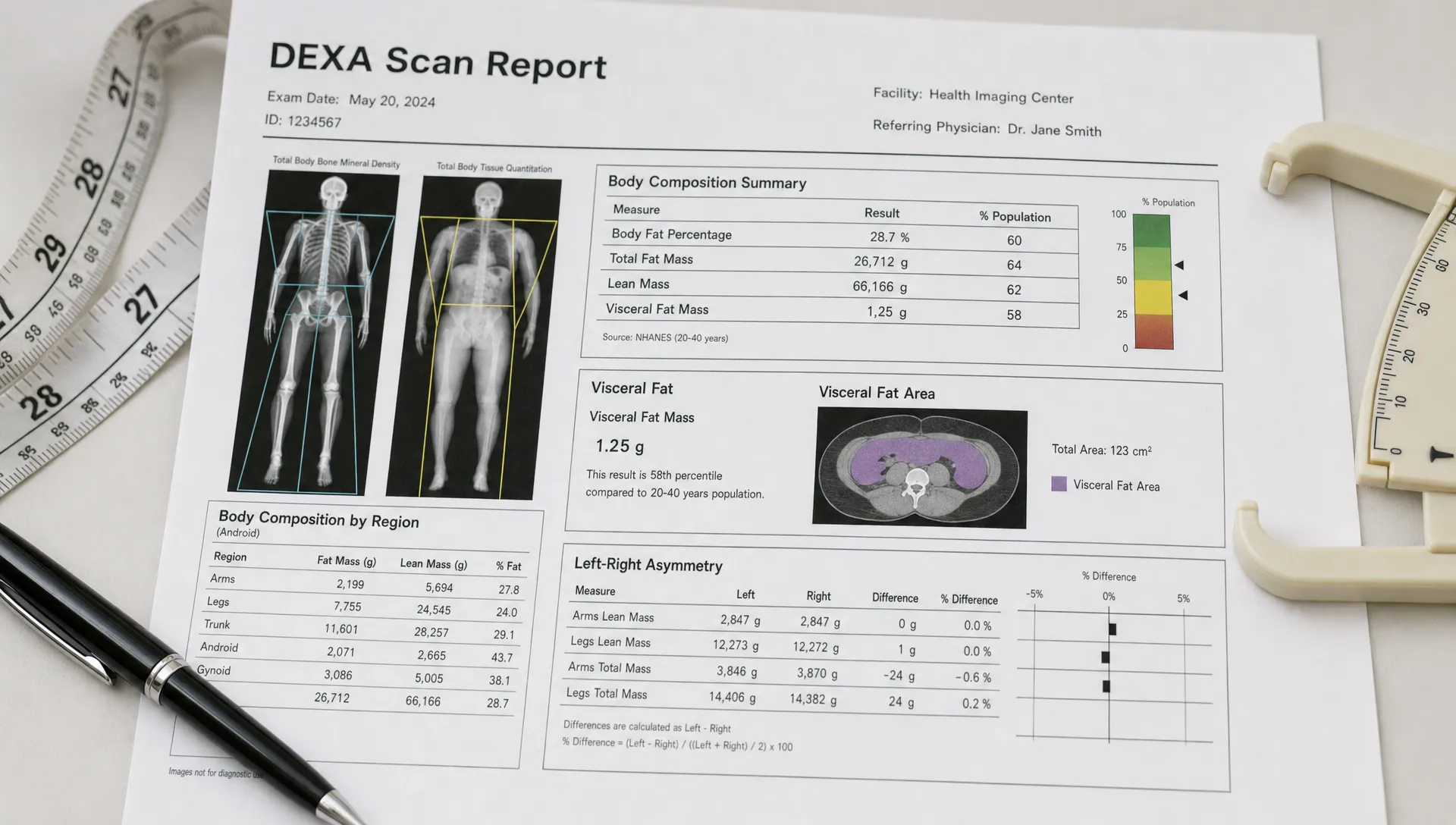
The important point is that DEXA does not treat your body as one number. It creates a regional map. You can see fat and lean mass in the trunk, arms, legs, and other areas, plus left vs. right differences. That makes it more useful than BMI, tape measurements, or a smart scale when you want to understand what is actually changing.
DEXA is often considered the practical gold standard for consumer-accessible body composition testing because it is quick, noninvasive, and highly detailed. Still, it is not magic. The best results come from knowing what each metric means and tracking changes under consistent conditions.
The key DEXA body composition metrics at a glance
A DEXA report can feel dense at first, but most body composition goals revolve around a core set of measurements.
| Metric | What it tells you | Why it matters |
|---|---|---|
| Body fat percentage | The share of total body mass that is fat | Useful for a high-level snapshot and long-term trend tracking |
| Total fat mass | The absolute amount of fat tissue, often shown in pounds or kilograms | More actionable than percentage alone for fat loss goals |
| Lean mass | Lean soft tissue, including muscle, organs, water, and glycogen | Helps you see whether training and nutrition are preserving or building lean tissue |
| Visceral fat | Fat stored around internal organs in the abdominal area | Important for metabolic health and risk reduction goals |
| Regional fat distribution | Where fat is stored across the trunk, arms, legs, and android or gynoid regions | Shows patterns that body weight cannot reveal |
| Left vs. right asymmetry | Differences between sides of the body | Useful for training balance, injury prevention, and rehab conversations |
| Bone mineral density or content | Bone health related measurements | Provides context for long-term health, especially during weight loss or aging |
| Metabolic estimates | Estimated calorie needs based partly on body size and lean mass, if included | Helps guide nutrition planning, but should be interpreted as an estimate |
If you want a broader report-by-report walkthrough, DEXA SF also has a helpful guide to DEXA scan interpretation.
Body fat percentage: the headline number
Body fat percentage is usually the first number people look for. It tells you what proportion of your body weight is fat. For example, if someone weighs 180 pounds and has 25 percent body fat, their estimated fat mass is 45 pounds.
This number is useful because it gives you a simple snapshot of body composition. It also makes it easier to compare progress over time than body weight alone. If your scale weight stays the same but your body fat percentage goes down, that may mean you gained lean mass while losing fat.
The mistake is treating body fat percentage as the only metric that matters. Because it is a ratio, it can change when fat mass changes, lean mass changes, or both. A lower percentage is not always better if it comes with excessive lean mass loss, poor recovery, or unsustainable dieting. Use it as a summary, not the whole story.
Total fat mass: the fat loss anchor
For fat loss, total fat mass is often more actionable than body fat percentage. It shows the estimated amount of fat tissue on your body, usually in pounds or kilograms. If your goal is to lose fat while keeping muscle, this number should trend downward while lean mass remains relatively stable.
Imagine two people who both lose 5 pounds. One loses 5 pounds of fat and maintains lean mass. The other loses 2 pounds of fat and 3 pounds of lean mass. The bathroom scale shows the same result, but the DEXA scan tells a very different story.
That distinction matters for athletes, strength trainees, and anyone who wants to improve health without sacrificing function. Fat mass helps you judge whether your nutrition plan is producing the intended change.
Lean mass: important, but often misunderstood
DEXA lean mass is not exactly the same as pure muscle mass. It is lean soft tissue, which includes skeletal muscle, organs, connective tissue, body water, and stored glycogen. This does not make the metric less useful. It simply means you should interpret it carefully.
For most people, lean mass trends are valuable in three ways. First, they show whether a fat loss phase is preserving lean tissue. Second, they help strength trainees see whether a building phase is producing measurable changes. Third, regional lean mass can show whether one area is lagging compared with another.
Lean mass can fluctuate with hydration, carbohydrate intake, recent training, inflammation, and recovery status. If you train hard the day before a scan, or arrive unusually dehydrated, your results may look different. That is why consistency matters when you compare scans.
Visceral fat: the health-focused metric many people overlook
Visceral adipose tissue, often shortened to VAT, is fat stored deeper in the abdomen around internal organs. Unlike subcutaneous fat, which sits under the skin, visceral fat is more closely associated with cardiometabolic risk.
DEXA can estimate visceral fat in the abdominal region. This is one reason a DEXA scan for body fat composition can be useful even for people who are not focused on aesthetics. Two people may have the same body fat percentage, but the person with more visceral fat may have a different health profile.
A downward trend in visceral fat can be meaningful even when the scale does not change dramatically. Exercise, improved sleep, nutrition changes, reduced alcohol intake, and sustainable fat loss can all influence this area over time. Your DEXA results should be interpreted alongside blood pressure, lab markers, family history, and medical guidance when health risk is the main concern.
Regional fat distribution: where your body stores fat
Total body fat percentage does not tell you where fat is stored. DEXA regional data can show how much fat is located in the trunk, legs, arms, android region, and gynoid region. The android area generally refers to the abdominal region, while the gynoid area refers to the hip and thigh region.
This matters because body composition changes are not always evenly distributed. Someone may lose fat quickly from the trunk while seeing slower change in the hips or thighs. Another person may reduce leg fat but keep more abdominal fat. Regional tracking helps you separate normal genetic patterns from actual progress.
Regional metrics can also make your goals more realistic. You cannot spot reduce fat from a chosen body part, but you can observe where your body tends to change first and where it changes last. That can make a long-term plan feel less frustrating.
Left vs. right asymmetry: the performance and injury-prevention clue
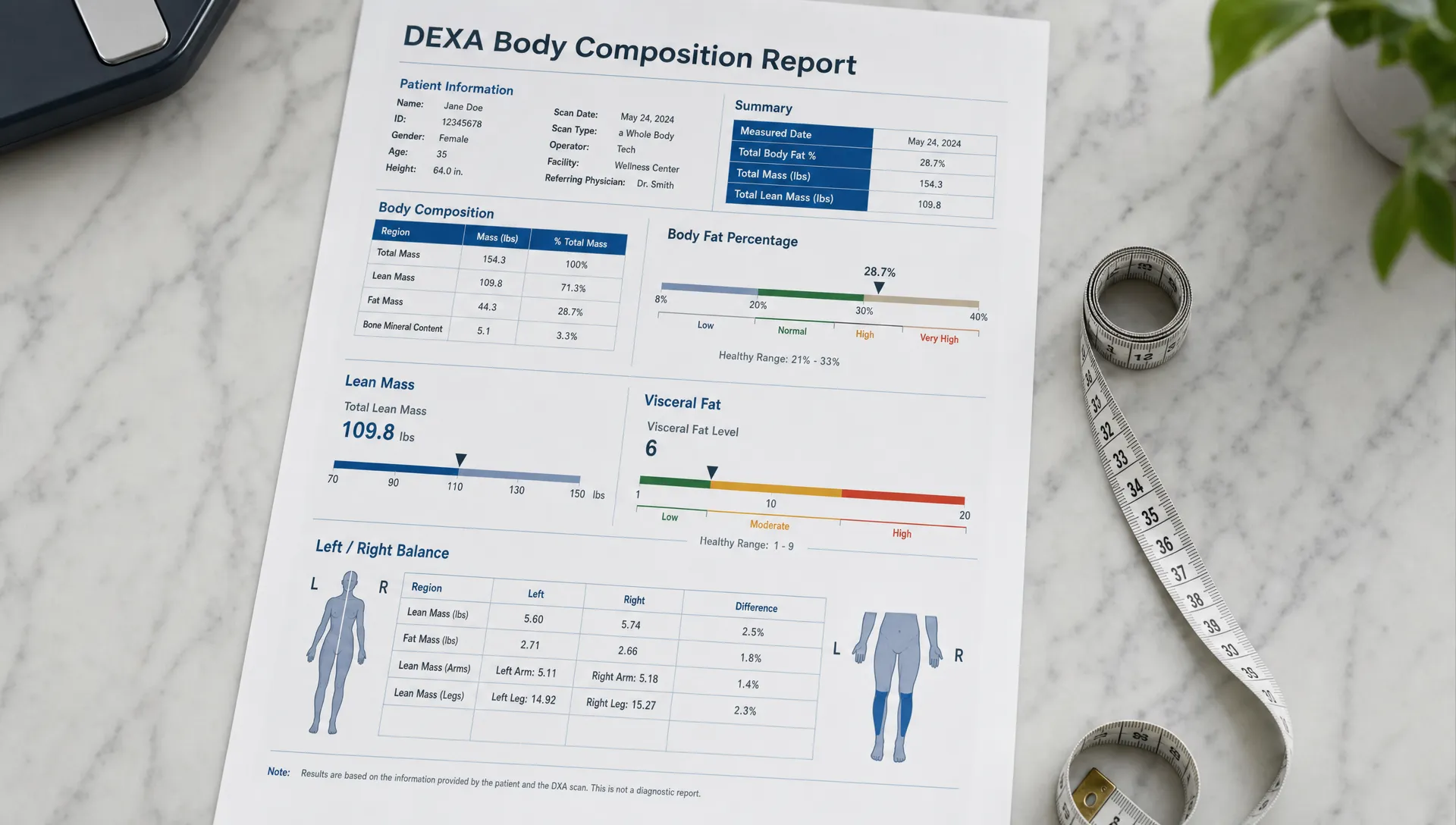
A DEXA scan can compare lean mass and fat mass between the left and right sides of the body. This can be especially useful for athletes, runners, lifters, cyclists, and anyone returning from injury.
Some asymmetry is normal. Most people have a dominant side. The key is whether the difference is large, persistent, or connected to pain, performance limitations, or movement issues. For example, a noticeable lean mass difference between legs may support a conversation with a coach, physical therapist, or clinician about single-leg strength, mobility, or rehabilitation.
This is where DEXA becomes more than a fat loss tool. It can help refine training decisions. For practical ways to connect scan data with programming, see this guide on DEXA body composition analysis for smarter training.
Bone metrics: not body fat, but still important
Even if your primary goal is body composition, bone data deserves attention. Depending on the scan type and report, you may see bone mineral content, bone mineral density, or related values. These measurements provide context for skeletal health.
Bone metrics are especially relevant during aggressive weight loss, endurance training blocks, low energy availability, menopause, aging, or a history of fractures. Losing fat can be beneficial, but not if the process compromises long-term health.
If your scan includes clinical bone density values such as T-scores or Z-scores, interpretation should come from a qualified medical professional. Body composition scans can provide useful context, but medical diagnosis and treatment decisions belong with your clinician.
Metabolic estimates: helpful, but not a direct measurement
Some DEXA reports or scan consultations include estimated metabolic information, such as resting metabolic rate or daily calorie needs. These estimates are often based on body size, lean mass, sex, age, and prediction equations.
That can be useful for nutrition planning, but it is not the same as directly measuring metabolism through indirect calorimetry. Treat metabolic numbers as starting points. Your real-world trend, including body weight, hunger, performance, energy, and scan changes, should guide adjustments.
For example, if your estimated intake suggests a calorie deficit but your fat mass is not changing over several weeks, the plan may need refinement. If lean mass is dropping quickly, you may need more resistance training, more protein, more recovery, a smaller deficit, or medical guidance depending on the situation.
Which metrics matter most for your goal?
The best DEXA metric depends on what you are trying to accomplish. A physique athlete, a busy professional improving health markers, and someone rebuilding after injury should not all focus on the same number.
| Goal | Primary metrics to track | What progress usually looks like |
|---|---|---|
| Fat loss | Fat mass, body fat percentage, visceral fat, lean mass | Fat mass trends down while lean mass is maintained as much as possible |
| Muscle gain | Lean mass, appendicular lean mass, regional balance, fat mass | Lean mass increases while fat gain stays within your intended range |
| Body recomposition | Fat mass, lean mass, body fat percentage | Fat mass decreases and lean mass increases, often with modest scale change |
| Metabolic health | Visceral fat, trunk fat, body fat percentage, bone metrics | Visceral and trunk fat improve alongside relevant clinical markers |
| Performance or rehab | Left vs. right asymmetry, regional lean mass, total lean mass | Side-to-side gaps narrow and performance measures improve |
| Long-term wellness | Body fat percentage, visceral fat, lean mass, bone measures | Health-related metrics remain stable or improve over repeated scans |
A good scan review should connect the numbers to your actual goal. If you are trying to run faster, body fat percentage alone is not enough. If you are trying to reduce cardiometabolic risk, visceral fat may deserve more attention. If you are dieting, lean mass preservation is critical.
How to make your DEXA scans comparable
DEXA is precise, but your preparation can still affect results. Hydration, food intake, recent exercise, and glycogen levels can shift lean mass estimates. The goal is not to create perfect lab conditions. The goal is to repeat similar conditions each time.
Before each scan, try to keep these variables consistent:
- Use the same facility and scanner whenever possible.
- Schedule scans at a similar time of day.
- Avoid unusually hard training right before your appointment.
- Keep food, fluid, and sodium intake reasonably similar before each scan.
- Follow the facility's instructions about clothing, metal objects, and preparation.
- Tell the technician about implants, recent contrast imaging, or possible pregnancy.
Retesting too often can lead to overreaction. Many people tracking fitness or fat loss do well with scans every 8 to 16 weeks, depending on the pace of their plan. Bone density monitoring usually follows a longer timeline and should be guided by a clinician when medical risk is involved.
Common mistakes when reading DEXA body composition results
The first mistake is chasing the lowest possible body fat percentage without considering health, performance, or sustainability. A number that looks impressive may not be ideal if energy, hormones, sleep, mood, or training quality suffer.
The second mistake is comparing your results too closely with someone else's. Age, sex, height, training history, genetics, sport, and health status all affect body composition. Your best benchmark is usually your own previous scan.
The third mistake is ignoring lean mass during fat loss. If your weight is dropping quickly but lean mass is falling too, the plan may be too aggressive or poorly supported. Resistance training, adequate protein, sleep, and recovery are often the difference between weight loss and better body composition.
The fourth mistake is treating one scan as a final verdict. A DEXA scan is a high quality snapshot. Its power comes from repeated, consistent measurements and expert interpretation.
Frequently Asked Questions
What is the most important DEXA metric for fat loss? Total fat mass is often the most actionable fat loss metric because it shows the estimated amount of fat tissue you carry. Body fat percentage is useful too, but it can change because of shifts in either fat mass or lean mass.
Is a DEXA scan more useful than BMI? For body composition, yes. CDC guidance describes BMI as a screening measure, not a direct measure of body fat. DEXA provides more detail by estimating fat mass, lean mass, visceral fat, and regional distribution.
Can DEXA measure muscle mass? DEXA estimates lean soft tissue, which includes muscle but also water, organs, glycogen, and other nonfat tissue. It is very useful for tracking lean mass trends, but it should not be interpreted as a perfect measure of pure muscle tissue.
How often should I get a DEXA scan for body composition? For fitness and nutrition goals, many people retest every 8 to 16 weeks so there is enough time for meaningful change. The right timing depends on your goal, plan, and whether you are tracking fat loss, muscle gain, or health-related metrics.
Does visceral fat matter if my body fat percentage is normal? Yes. Body fat percentage is a whole-body average, while visceral fat focuses on deeper abdominal fat. Someone can have a reasonable body fat percentage but still benefit from lowering visceral fat, especially when metabolic health is a priority.
Turn your body composition data into a smarter plan
A DEXA scan gives you more than a body fat percentage. It shows what changed, where it changed, and what you may need to adjust next. The most useful metrics are the ones tied to your goal: fat mass for fat loss, lean mass for strength and recomposition, visceral fat for health, asymmetry for performance, and bone data for long-term resilience.
If you are in San Francisco and want precise body composition data with expert interpretation, DEXA SF provides professional DEXA scans that assess body fat, lean mass, bone density, visceral fat, asymmetry, and related metabolic insights, along with fitness and nutrition guidance to help you act on your results.