

How to Review Your DEXA Scan Analysis With Confidence
Your DEXA scan analysis should help you make a decision, not leave you guessing whether every highlighted number is a problem. A useful review connects the report to your goals, explains what the measurements can and cannot tell you and identifies anything that needs clinical follow-up.
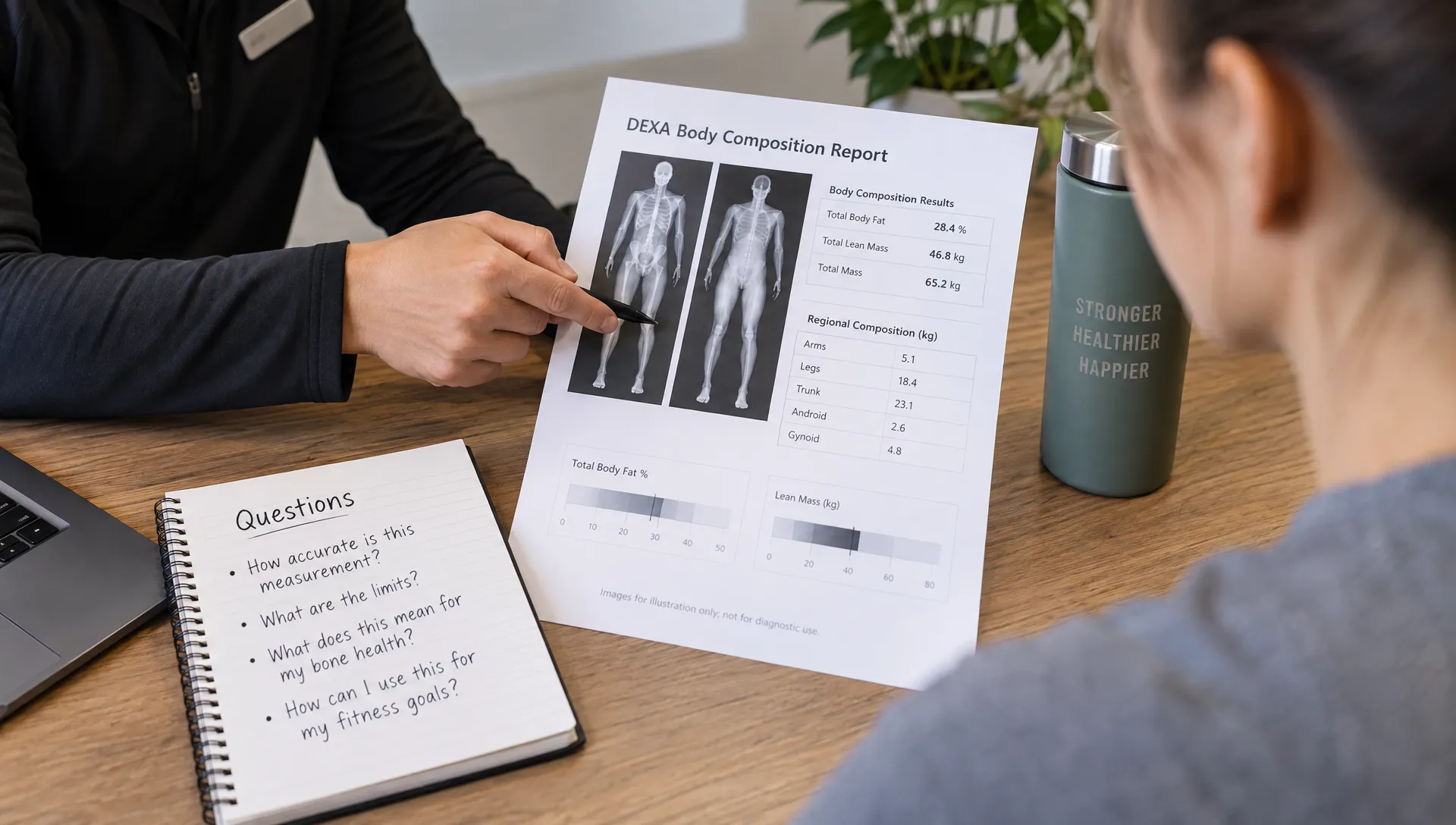
You do not need to memorize every abbreviation to participate confidently. Start by checking the context, ask how the results were calculated and leave with a short written plan. The approach below focuses on having that conversation, rather than treating your report as a pass-or-fail scorecard.
Start with the decision you want to make
Before reviewing individual results, finish this sentence: “I booked this scan because I want to understand…” Your answer determines which findings deserve the most attention.
If your goal is fat loss, total fat mass and the distribution of that fat may be more useful than a single body fat percentage. If you are strength training, regional lean mass can provide context, but it cannot replace strength testing or tell you exactly how much contractile muscle you have.
If you are concerned about osteoporosis, first establish whether you received a dedicated clinical bone density examination. A whole-body composition scan is not interchangeable with the hip and lumbar spine measurements used in standard osteoporosis assessment.
Tell the person reviewing your results about relevant injuries, recent weight changes and current training. Your history can explain why a number deserves attention, or why it does not support the conclusion you initially drew.
Check the foundation of your DEXA scan analysis
Before discussing whether a result is “good,” confirm that the report belongs to you and matches the service you booked. Check the scan date, identifying details, units and any demographic information used for reference comparisons or equations.
Ask whether the operator noted positioning difficulties, movement, metal artifacts or other limitations. An implant or an unusual scan position may affect a regional measurement without making every result unusable.
Also mention circumstances that could influence interpretation. Recent strenuous exercise, changes in hydration and food in the digestive tract can affect body composition measurements. You do not need to decide how much each factor mattered yourself. Ask whether the provider considers the scan suitable as a baseline.
Keep the answer practical: “Is there anything about this scan that should limit how we use the results?” That question is more useful than expecting any measurement method to be perfectly accurate under every condition.
If you need help decoding individual fields, this guide to understanding your DEXA report provides the terminology behind them.
Separate measurements, estimates and recommendations
A trustworthy DEXA scan analysis distinguishes the scanner’s findings from software estimates and the advice built around them. These categories can appear together on a report, even though they answer different questions.
| Report item | What it describes | A useful review question |
|---|---|---|
| Body fat percentage | Fat mass relative to total scanned mass | What does this add beyond total fat mass? |
| Lean soft tissue mass | Nonfat soft tissue, including muscle, organs and water | How much can this tell us about my muscle? |
| Regional lean mass | Lean tissue assigned to areas such as an arm or leg | Could positioning or my injury history affect this finding? |
| Visceral fat estimate | A software-derived estimate of fat around abdominal organs | Which units and reference range does this system use? |
| Bone mineral density | Mineral content per unit area at the measured site | Is this a clinical diagnostic measurement or a whole-body finding? |
| Resting metabolic rate, if included | Usually an equation-based energy estimate on a composition report | Was this estimated or measured separately? |
DEXA does not directly measure resting calorie expenditure. Direct measurement generally requires a separate indirect calorimetry test that assesses respiratory gases. If your report includes a calorie estimate, ask which equation was used before treating it as a precise nutrition prescription.
The same distinction applies to lean mass: it is not a direct inventory of skeletal muscle alone.
Ask what a flagged result actually means
Reference ranges are context, not automatic targets
A color, percentile or category may compare your result with a reference population. It does not necessarily establish your ideal training target or diagnose a condition.
Ask who is represented in that reference group and whether the comparison accounts for relevant characteristics, such as age or sex. A percentile describes your position within a group; it does not independently establish whether a result is healthy.
For visceral fat, confirm the units before discussing the number. Different systems may report mass, volume or area, so an online cutoff may not apply to your report. Elevated visceral fat can warrant a broader health discussion, but the scan alone does not diagnose diabetes or cardiovascular disease.
Your DEXA scan analysis should explain why a finding matters for you, rather than relying on a red box to do the explaining.
Left-right differences need a functional check
A difference between limbs can reflect training history, dominance, an old injury, positioning or measurement variability. There is no single percentage difference that automatically proves an injury or dictates a corrective exercise program for everyone.
Ask whether the difference is large enough to investigate and what would help clarify it. Strength testing, a movement assessment or a physical therapy evaluation may provide more actionable information than the scan alone, especially if you have pain or weakness.
Bone findings deserve the right clinical pathway
The International Society for Clinical Densitometry’s adult positions distinguish how bone density results should be interpreted in different populations. T-scores are generally used for postmenopausal women and men aged 50 or older. Z-scores are preferred for females before menopause and males younger than 50.
A Z-score of -2.0 or lower is described as “below the expected range for age.” That wording is not interchangeable with an osteoporosis diagnosis. Likewise, osteoporosis classification using a T-score of -2.5 or lower requires an appropriate clinical population and valid measurement site.
If your body composition report flags low bone density, ask whether a dedicated hip and spine examination or clinician review is needed. In your DEXA scan analysis, a whole-body bone finding should not be presented as a substitute for that assessment.
Work through one number before accepting a conclusion
Consider a simplified, hypothetical report showing 160 pounds of total scanned mass: 40 pounds of fat, 117 pounds of lean soft tissue and 3 pounds of bone mineral content. In this example, body fat is 25% because 40 divided by 160 equals 0.25.
That calculation explains the percentage, but it does not establish a weight-loss goal. It also does not mean the person has 117 pounds of muscle. The lean tissue category includes other tissues and water, while bone mineral content is not the same as the total weight of the skeleton.
Ask the reviewer to walk through a calculation from your own report. Then ask: “What can we reasonably conclude from this, and what would be going beyond the data?” Understanding one result thoroughly can help you assess the rest more critically.
Turn the review into one or two priorities
A useful DEXA scan analysis ends with a manageable plan, not simultaneous attempts to optimize every number. Choose a primary goal and identify the additional information needed to support it.
For fat loss, the conversation might focus on reducing fat mass while maintaining strength and adequate nutrition. For muscle gain, it might connect regional lean tissue findings with training performance, recovery and food intake. A concerning bone finding belongs on a clinical follow-up pathway rather than becoming a self-directed supplement plan.
Ask your reviewer to explain the reasoning behind each recommendation. “Because the report says so” is not enough. Good guidance should account for your health history, preferences, current habits and the limitations of the measurement.
Write down the goal, the proposed action and how you will judge whether it is helping. Depending on your situation, useful indicators may include strength, symptoms, energy levels or clinician-directed testing alongside body composition.
If repeat scanning is appropriate, agree on its purpose before choosing a date. The interval should allow time for meaningful change, not simply satisfy curiosity. When that time comes, comparing DEXA results between scans requires attention to measurement consistency and normal variability.
Bring these questions to your results review
You can keep the conversation focused without becoming a technical specialist. Bring your report, your main goal and a brief account of relevant health or training changes.
These questions help turn your DEXA scan analysis into an explanation you can use:
- Which two or three findings matter most for my goal, and why?
- Were there any scan limitations that affect interpretation?
- Which results are estimates, and which reference ranges apply to me?
- Does anything need review by a clinician or physical therapist?
- What action would you recommend first, and what supports that recommendation?
- What should I monitor before deciding whether to scan again?
Before leaving, summarize the plan in your own words. If you cannot explain why you are taking an action, ask for clarification. You should also know whom to contact if questions arise after you have had time to read the report.
Frequently asked questions
Can I review my DEXA report myself? You can check the units, understand the main categories and prepare questions. A DEXA scan analysis still benefits from professional interpretation when findings are unexpected, reference ranges are unclear or a recommendation could affect your health.
Does a high body fat percentage automatically mean I am unhealthy? No single body composition number establishes your overall health. Fat distribution, medical history, blood pressure, laboratory findings and physical function can all matter. Discuss the result in that broader context rather than treating a percentage as a diagnosis.
Should I change my workouts because one leg has less lean mass? Not automatically. First ask whether the difference is reliable and whether it corresponds to weakness, pain or functional limitations. A training adjustment should follow an assessment, not just a highlighted measurement.
What if my results do not match how fit I feel? Fitness and body composition are related but different. DEXA does not measure aerobic capacity, strength, mobility or endurance. Use the report alongside those indicators rather than expecting it to summarize every aspect of your fitness.
Get guidance you can act on
DEXA SF provides body composition scans in San Francisco with expert interpretation and personalized fitness and nutrition guidance. Bring your main goal and questions so the results discussion addresses what matters to you.
If you are ready to establish a baseline, schedule a scan with DEXA SF. Leave with a clear understanding of the findings, the limits of the report and your next practical step.