
How to Prepare for a Body Fat Percentage Scan
Preparing for a body fat percentage scan is mainly about arriving under normal, repeatable conditions, not trying to produce the lowest possible number. Follow your provider’s instructions, stay normally hydrated, avoid a hard workout immediately beforehand and wear comfortable clothing without metal. If you plan to track progress, your meal timing and activity before this appointment should also be practical to repeat next time.
This guide focuses on DEXA body composition scans. Other methods, such as bioelectrical impedance or air-displacement testing, may have different preparation requirements.
Start with your provider’s instructions
Before changing your routine, check the appointment confirmation or contact the scanning facility. Ask whether it requires fasting, limits exercise beforehand or has specific clothing requirements. Instructions for a whole-body composition scan may differ from those for a medical bone density examination.
The International Society for Clinical Densitometry’s official positions recommend consistent preparation for body composition testing, including factors such as food intake, exercise, bladder status and time of day. Consistency matters especially when comparing multiple scans.
Your first body fat percentage scan establishes a useful baseline only if the conditions are representative of your routine. Dehydrating yourself, skipping meals unnecessarily or changing your training schedule to influence the result can make that baseline less useful.
If you have diabetes, take medication with food or have a condition that affects fluid intake, ask how to prepare safely. Do not change prescribed medication or medically necessary eating and drinking schedules on your own.
How to prepare for a body fat percentage scan
DEXA estimates fat mass, lean soft tissue and bone mineral content using low-dose X-rays. Lean soft tissue includes water and other nonfat tissues, so it is not a direct measurement of muscle alone. That distinction explains why preparation affects comparisons.
Keep hydration normal
Drink according to your usual needs and any medical guidance you follow. Neither deliberate dehydration nor drinking a large amount of water just before the scan helps establish a representative result.
Fluid changes can influence body weight and lean soft tissue estimates. Arriving after a sweaty workout, sauna session or unusually heavy drinking session may create conditions that are difficult to reproduce at your next visit.
If you normally carry a water bottle, keep doing so. The goal is ordinary hydration, not a special “scan-day” fluid target. If the facility provides a specific drinking protocol, use that instead of general advice.
Follow the facility’s meal guidance
A provider may request a fasting period or suggest scheduling before breakfast. Do not assume that every DEXA appointment requires fasting, and do not extend a requested fast to improve the number.
For a body fat percentage scan, matching meal timing between visits is more useful than inventing a restrictive routine. Food and fluid in your digestive tract contribute to what is measured, while changes in carbohydrate intake can alter glycogen stores and associated water.
Keep your eating pattern reasonably typical in the days beforehand. Avoid deliberately carb-loading or cutting carbohydrates just for the appointment. You do not need a special cleanse, supplement or “fat-burning” meal.
If your first scan is performed in the morning under the provider’s fasting instructions, record that detail. For follow-up visits, ask whether you should use the same schedule.
Avoid arriving straight from strenuous exercise
Ask the facility whether it recommends avoiding vigorous exercise during the preceding day. At minimum, do not schedule a demanding workout immediately before the appointment unless the provider explicitly permits it.
Heavy lifting, long endurance sessions and exercise in hot conditions can change hydration and glycogen status. Recent training can also produce temporary fluid shifts in exercised tissues. Those changes are not the same as gaining or losing muscle.
A body fat percentage scan is easier to compare over time when it is not preceded by an unusually hard training session. A rest day or similar point in your weekly training schedule can make repeat appointments easier to standardize.
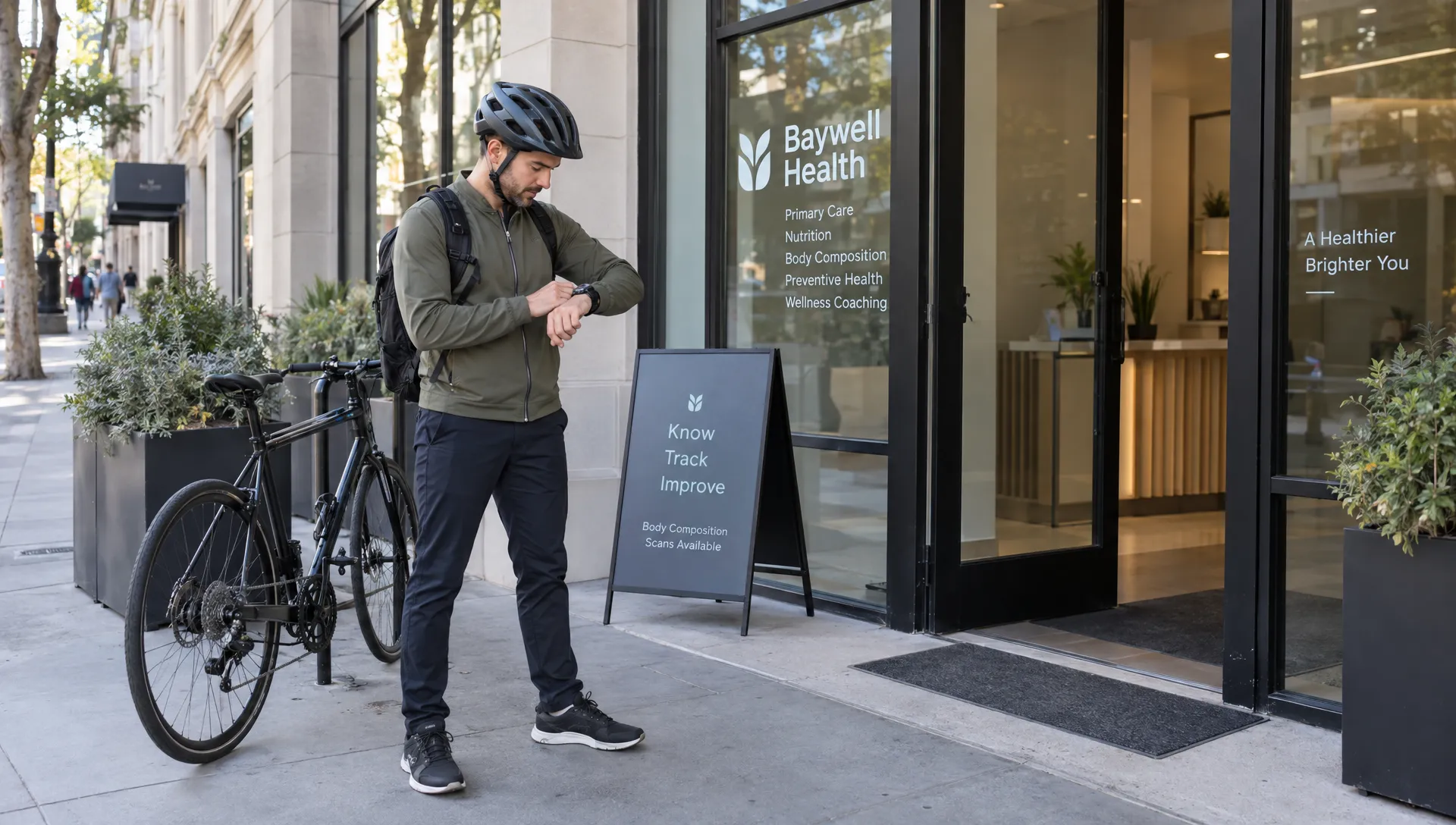
Routine movement is different from strenuous exercise. You generally do not need to avoid normal walking, but allow time to cool down if you arrive after a brisk walk or bike commute.
Choose clothing that will not interfere with the scan
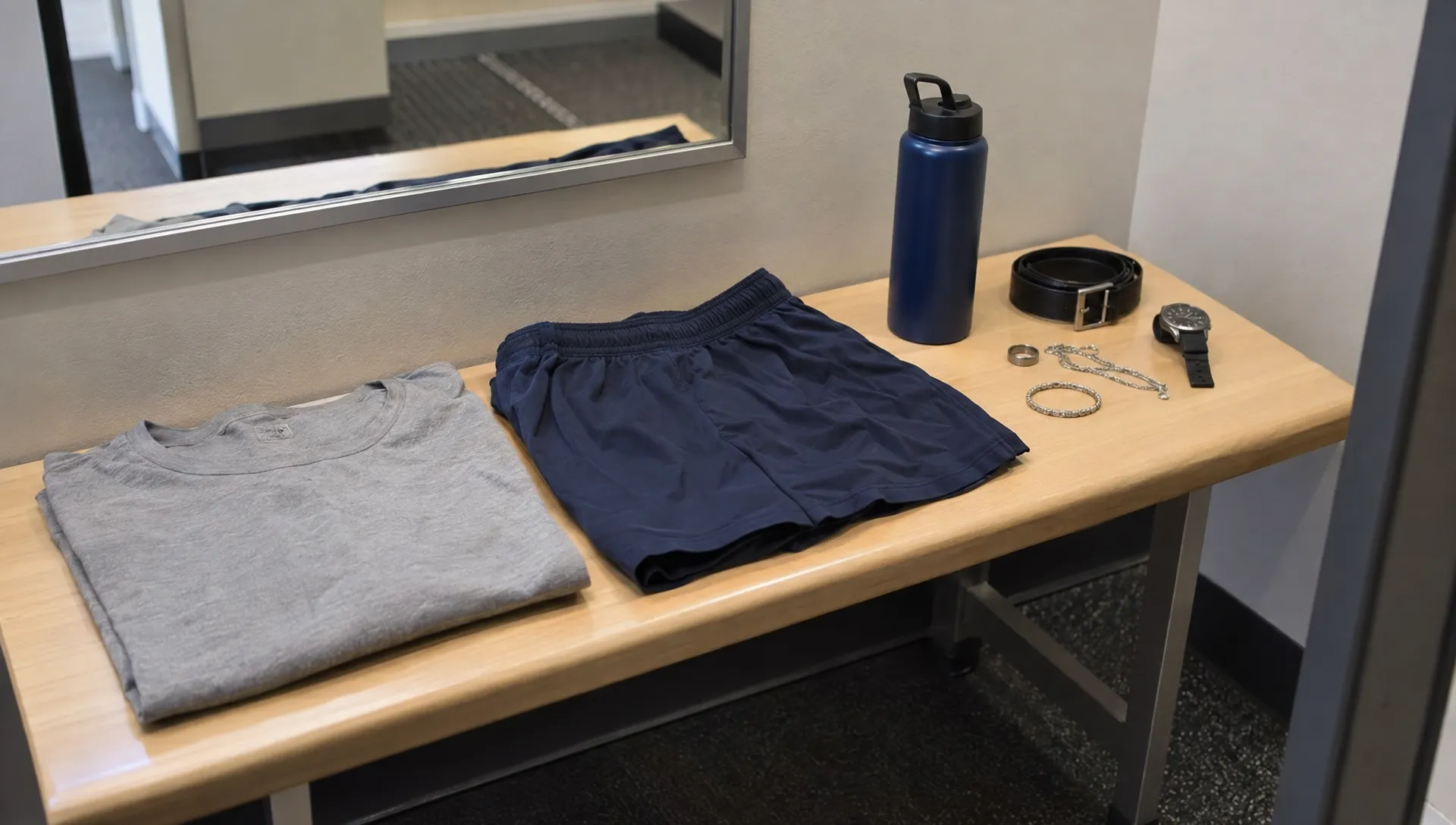
Select lightweight, comfortable clothing without metal zippers, buttons, underwires or decorative hardware. A plain T-shirt with metal-free shorts or leggings may be suitable, but confirm the facility’s requirements. Some providers may ask you to change into a gown.
Be prepared to remove jewelry, watches, belts and other removable metal items. Tell the technician about body piercings that cannot be removed rather than trying to conceal them.
For your body fat percentage scan, similar clothing across visits also removes one avoidable source of variation. You do not need the exact same outfit, but a lightweight outfit is easier to reproduce than heavy layers.
Metal implants are a separate issue. A joint replacement, surgical hardware or another implanted device does not automatically prevent testing, but the technician needs to know about it because it may affect positioning or interpretation.
Share relevant medical information before the appointment
Tell the provider if you are pregnant or might be pregnant before a DEXA scan is performed. DEXA uses ionizing radiation, and a routine body composition appointment should not proceed during pregnancy without appropriate medical guidance.
Also mention recent imaging procedures involving barium, injected contrast material or a nuclear medicine tracer. These can affect some DEXA measurements, and the facility may recommend waiting before scanning. The appropriate interval depends on the procedure and the provider’s protocol.
The RadiologyInfo guide to bone densitometry, maintained by the American College of Radiology and Radiological Society of North America, explains these pregnancy and recent-imaging precautions. Its instructions concern bone density testing, so confirm which preparation details apply to your body composition appointment.
Before a body fat percentage scan, it is also worth disclosing medical conditions that significantly affect fluid balance, recent surgery or difficulty lying flat. This helps staff determine whether testing or interpretation needs adjustment.
Some bone density appointments require withholding calcium supplements beforehand. Do not assume that rule applies to every body composition scan; ask your facility and do not stop prescribed treatment without guidance.
Know what to expect when you arrive
Allow enough time for check-in, screening questions and removal of metal items. Use the restroom shortly before the scan if possible, since consistent bladder status helps standardize preparation.
During a typical whole-body DEXA scan, you lie on a padded table while the scanner passes above you. Staff position your arms and legs and ask you to remain still. Tell the technician if pain, limited mobility or anxiety makes the requested position difficult.
Afterward, ask which results are available and how they should be interpreted. Body fat percentage is only one measurement; fat mass, lean mass and regional findings add context. Our guide to reading DEXA body fat results explains those distinctions without reducing the report to a single score.
Whole-body bone measurements also should not be treated as a substitute for a dedicated diagnostic osteoporosis evaluation when one is medically indicated.
Make the preparation repeatable for follow-up scans
The most useful preparation for your next body fat percentage scan starts with a brief record of this one. You do not need a detailed diary, just enough information to recreate the main conditions.
| Factor | What to record |
|---|---|
| Appointment timing | Time of day and whether it fits your usual routine |
| Food intake | Whether you fasted and roughly when you last ate |
| Hydration | Your normal intake and any unusual dehydration or fluid changes |
| Exercise | When you last trained and whether the session was demanding |
| Testing setup | Facility, scanner if known and any positioning accommodations |
When possible, return to the same facility using the same scanner and a similar preparation routine. Different systems or analysis methods can complicate comparisons even when both appointments are conducted correctly.
Ask the provider how much change would be meaningful given its measurement precision. A small difference is not automatically proof of fat loss or muscle gain. Preparation reduces avoidable variation, but no body composition method is perfectly exact. For more context, see how accurate DEXA is for body fat percentage.
Frequently asked questions
Do I have to fast before a DEXA body composition scan? Follow the facility’s instructions. Some providers use fasting protocols to standardize measurements, while others do not require fasting. If fasting could affect your health or medication schedule, discuss that before the appointment.
Can I drink water before a body fat percentage scan? Usually, normal hydration is appropriate unless your provider gives different instructions. Avoid deliberately dehydrating yourself or drinking an unusually large amount immediately beforehand. Follow any medical fluid restrictions you already have.
Can I work out on the day of my scan? Ask the facility about its exercise policy. Avoid a strenuous session immediately before testing, since sweating and temporary tissue-fluid changes can affect comparison with other scans. Scheduling the appointment before training is often simpler.
Should I try to weigh less on scan day? No. Restricting water or food to lower your scale weight can create an unrepresentative baseline. The purpose is to measure your body composition under consistent conditions, not to achieve a temporary low reading.
Plan your DEXA appointment in San Francisco
DEXA SF provides DEXA body composition scans in San Francisco, along with expert interpretation and personalized fitness and nutrition guidance. Before your visit, confirm the preparation instructions and mention any relevant medical concerns. Then choose a routine you can repeat, so future results are easier to compare.