
How to Choose a Reliable Body Fat Assessment
Searching for a “body fat assessment near me” can turn up everything from a gym’s handheld device to a dedicated DEXA scanning service. Those options do not provide interchangeable results. A reliable assessment should use a method suited to your goal, control the conditions that affect measurement and explain what the numbers actually mean. The most useful result is not the one with the most decimal places, but one you can interpret and compare responsibly over time.
Decide what you need the assessment to answer
Before comparing appointments, identify the decision you want the test to support. Tracking fat loss during a nutrition program is different from investigating changes in regional lean mass or evaluating a medical concern.
For general progress tracking, you may mainly need a repeatable estimate of total fat mass and body fat percentage. For strength training, regional measurements can add context that a single whole-body percentage misses. If your concern involves osteoporosis, unexplained weight changes or another health condition, ask a clinician which evaluation is appropriate rather than choosing a fitness assessment on your own.
Also consider how you will use the result afterward. A detailed baseline is valuable only if it leads to a sensible plan or helps answer a question. You do not need every available metric simply because a report includes it.
Write down your goal before booking: “I want to understand whether my weight change reflects fat loss, lean tissue changes or both.” That gives the provider something concrete to address.
What makes a “body fat assessment near me” result reliable?
Reliability starts with knowing the measurement method. “Body scan” and “body composition analysis” are broad labels, not descriptions of a specific technology.
| Method | What it assesses | What to check before choosing it |
|---|---|---|
| Bioelectrical impedance analysis, including many smart scales | Estimates body composition using electrical impedance and prediction equations | Preparation requirements, device type and consistency between visits |
| Skinfold testing | Uses subcutaneous skinfold measurements to estimate body fat | Tester experience, measurement sites and the equation used |
| Air displacement plethysmography, often called Bod Pod | Estimates body composition from body density | Clothing requirements, preparation and how the procedure is performed |
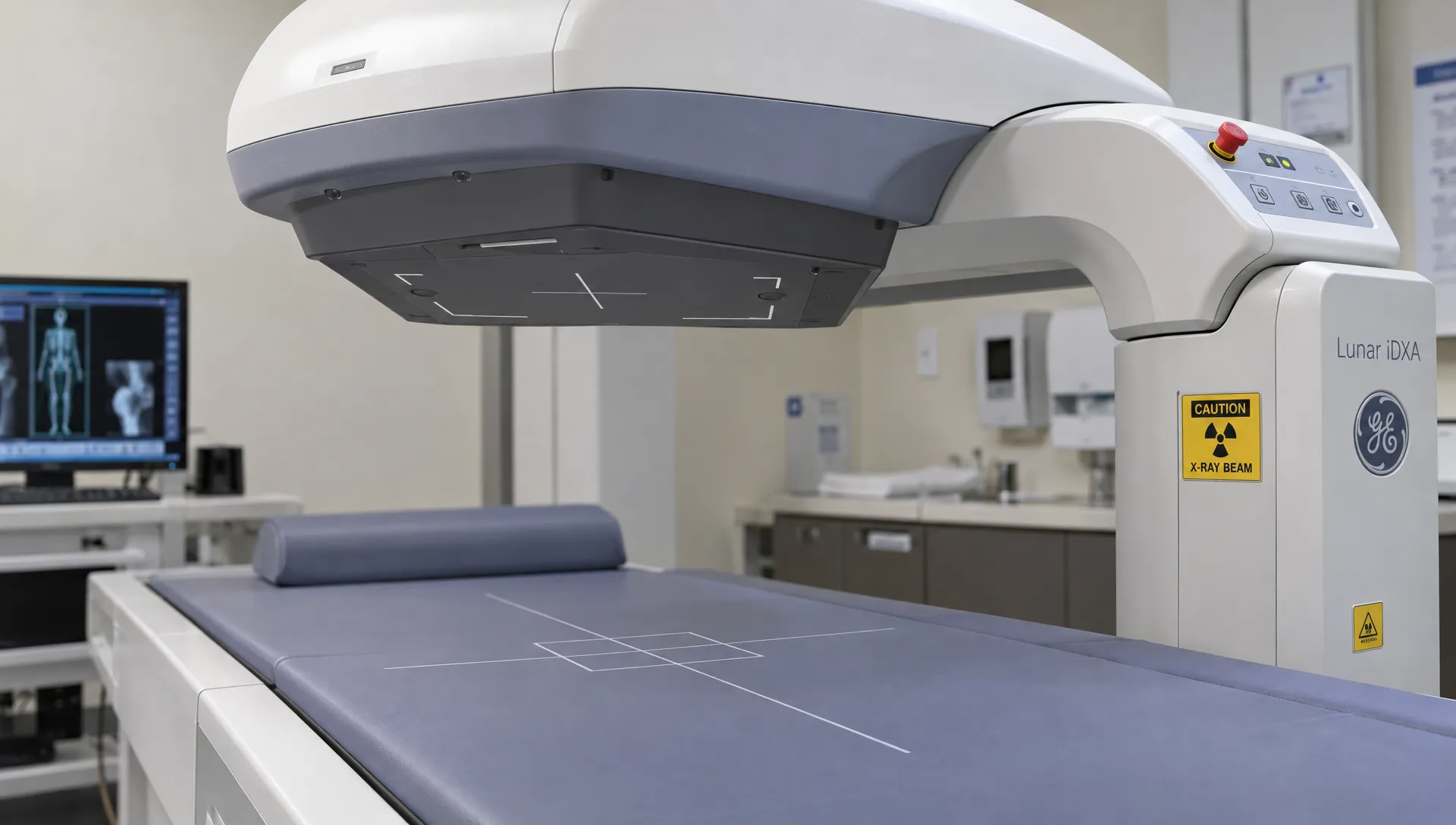
| DEXA, also called DXA | Estimates fat mass and lean soft tissue and measures bone mineral content using X-rays | Positioning, equipment consistency, quality control and report interpretation |
No method measures every aspect of body composition without assumptions. Even a sophisticated device can produce misleading comparisons if preparation or analysis changes between visits.
DEXA is useful when you want whole-body and regional information, but its lean soft tissue measurement is not a direct measurement of skeletal muscle alone. For a deeper comparison of methods, our explanation of whether DEXA is the most accurate body fat test covers that distinction.
When comparing results for “body fat assessment near me,” look past the technology’s name and ask what the test actually measures.
Look for repeatability, not promises of perfect accuracy
Accuracy and precision answer different questions. Accuracy describes how close a measurement is to a reference value. Precision describes how consistently a method produces results when the measurement is repeated under comparable conditions.
For progress tracking, both matter. A test that gives an impressive-looking percentage but fluctuates substantially between visits may not help you identify a real change.
The International Society for Clinical Densitometry’s official positions call for facility-specific precision assessment for DXA body composition measurements. That is a useful principle when evaluating a service: ask how the facility assesses repeatability rather than accepting a generic claim about the scanner’s accuracy.
A provider should be able to explain whether a small difference could fall within measurement variability. For example, a change from 24.0% to 23.8% body fat does not automatically establish meaningful fat loss. The interpretation depends on the method’s precision and the conditions of both tests.
For any provider you find through “body fat assessment near me,” ask: “How do you distinguish a real change from normal measurement variation?”
A clear explanation is more useful than an unsupported promise of exact results. Likewise, “our machine is calibrated” is not a complete answer to questions about positioning, preparation or repeat-test consistency.
Check preparation and measurement conditions
Your body is not identical from one appointment to the next. Food intake, hydration, recent exercise and other short-term changes can affect measurements, with some methods more sensitive than others.
Ask for written preparation instructions before your appointment. Do not assume instructions for one technology apply to another, and avoid deliberately dehydrating yourself to influence the result.
Useful questions include:
- Food and fluids: Should you follow a particular eating or drinking schedule, and how should you reproduce it at your next visit?
- Exercise: Should strenuous training be avoided before testing, and for how long?
- Clothing and positioning: What should you wear, and how will the provider keep positioning consistent?
- Future comparisons: Can follow-up testing use the same device, protocol and analysis approach?
DEXA uses low-dose X-rays. Tell the provider if you are pregnant or might be pregnant before scheduling. Also mention recent contrast imaging or nuclear medicine testing so the facility can advise on timing. RadiologyInfo’s guidance on DXA explains these preparation and safety considerations.
A convenient “body fat assessment near me” is worth less if you cannot reproduce its testing conditions at your next appointment. Choose a process you can realistically follow, including a comparable appointment time when practical.
Ask for a report you can interpret
Request a sample report or an explanation of the outputs before paying. The provider should clarify which values come from the measurement, which are calculated and which are estimates based on a model.
Fat mass and body fat percentage answer different questions. Fat mass describes the amount of fat, while body fat percentage describes its share of total body weight. Reading both helps prevent confusion when body weight changes.
Lean mass also needs context. With DEXA, lean soft tissue includes water and other nonfat soft tissues, not just muscle. A short-term increase should not automatically be described as new muscle growth.
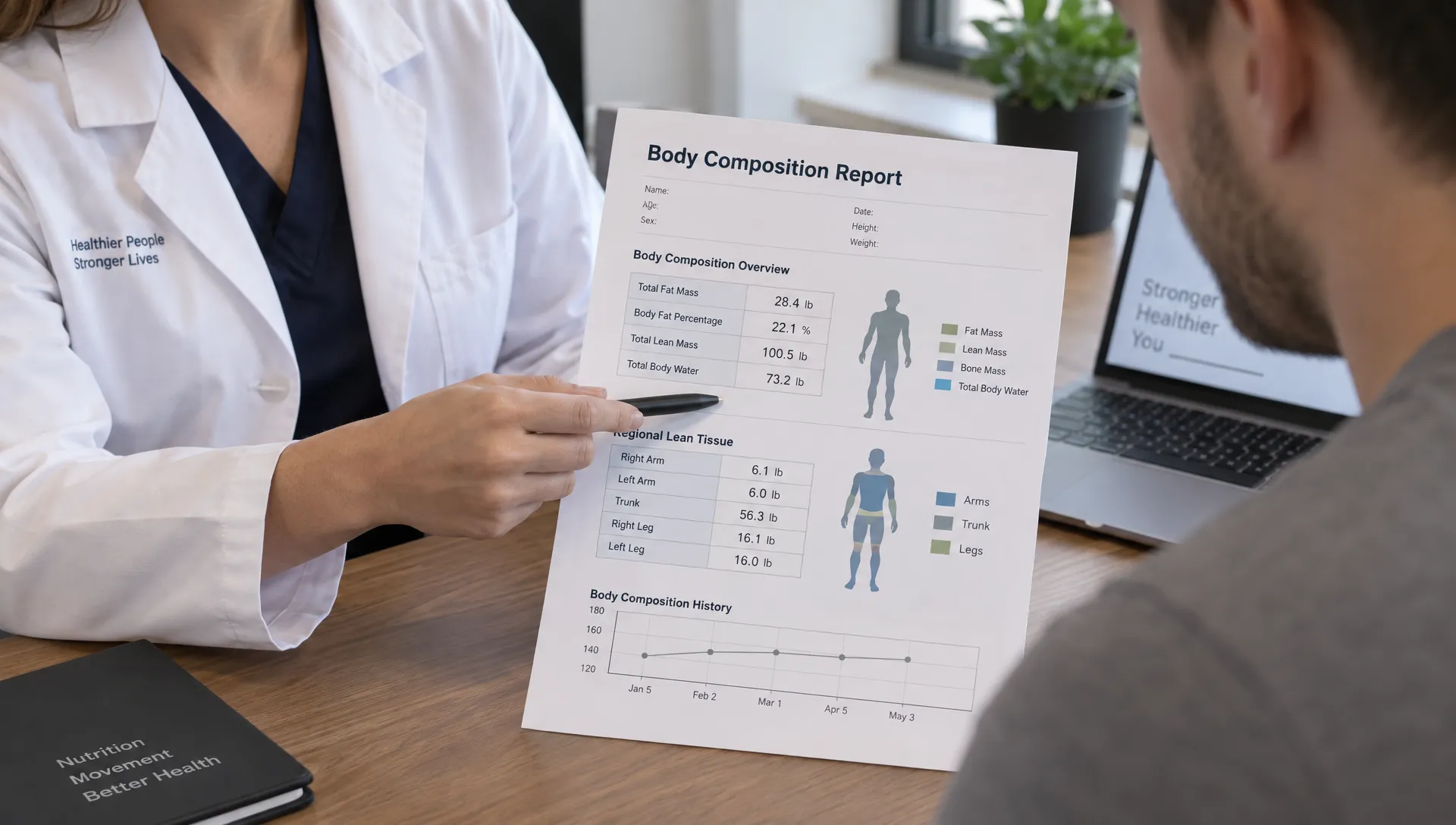
If a report includes visceral fat, ask whether the value is an estimate and how the provider interprets it. If it includes a resting metabolic rate, ask whether that number is calculated or measured through a separate test such as indirect calorimetry.
Bone information requires a similar distinction. A body composition scan should not automatically be treated as a dedicated diagnostic osteoporosis evaluation, which uses specific skeletal sites and clinical interpretation.
The best “body fat assessment near me” for your needs should explain these limitations without making the report feel unusable. You should leave knowing what the results support, what remains uncertain and what action, if any, makes sense.
Evaluate the follow-up, not just the appointment
A useful assessment connects the findings to your original goal. That might mean maintaining your current training approach, reviewing nutrition habits or gathering more information before changing anything.
Ask who will interpret the results and what their qualifications cover. Operating a device, providing fitness coaching and evaluating a medical concern are different responsibilities. A responsible provider stays within their scope and recommends clinical follow-up when appropriate.
For training decisions, our guide to using a body scan for fat and muscle to guide your workouts explains how regional measurements can add context without treating every difference as a problem.
When evaluating a “body fat assessment near me,” compare the full service rather than the advertised test price alone. Confirm whether interpretation is included, whether you receive your report and how future comparisons will be handled.
Be cautious if a provider treats one percentage as a diagnosis, promises perfect accuracy or uses the result to pressure you into supplements or a restrictive diet. A finding should come with an explanation, not an automatic sales pitch.
Finally, agree on a reason for retesting. Repeating an assessment too soon can emphasize normal variability rather than meaningful progress. The interval should reflect your goal, the expected pace of change and the method’s ability to detect it.
Frequently asked questions
Is the cheapest assessment necessarily unreliable? No. A lower-cost method can be useful when it matches your goal and follows a consistent protocol. The problem is paying for a result without understanding the method, its limitations or the support included.
Can I compare body fat percentages from different devices? Not as though they were interchangeable. Different technologies, prediction equations and software can produce different estimates. For tracking, use the same method and comparable conditions whenever possible. If you switch methods, treat the new result as a new baseline unless there is a justified comparison approach.
What should I ask before booking a body fat assessment near me? Ask which method is used, how to prepare, what the report includes and who explains it. Also ask how the provider handles measurement variability when comparing follow-up results. Those answers reveal more than a claim that the test is “advanced.”
Does a body fat percentage tell me whether I am healthy? Not by itself. Body composition is one piece of information alongside medical history, physical function and other health measures. Avoid treating a single percentage as a diagnosis or a universal target.
Should everyone choose DEXA? No. DEXA offers detailed whole-body and regional information, but the right choice depends on your question, access and circumstances. Pregnancy requires specific safety consideration, and medical concerns may call for a different clinical evaluation.
Choose an assessment that supports your next decision
For a San Francisco option, DEXA SF provides professional DEXA body composition scans with expert interpretation and personalized fitness and nutrition guidance. Its services include body fat assessment, lean mass evaluation, visceral fat measurement and asymmetry detection.
Before scheduling, share your goal and ask about preparation, report details and follow-up comparisons. A reliable assessment should give you more than a number: it should help you understand what that number can reasonably tell you.