
How Bone Mass Density Fits Into Your Fracture Risk
A low-trauma fracture often feels sudden, but the risk usually builds for years. Bone mass density is one of the clearest signals we have because it reflects how much mineralized bone is present in a measured area. A DEXA scan can quantify that signal far more precisely than a bathroom scale or visual assessment, which is why clinicians rely on it when they evaluate bone health.
Still, your fracture risk is not determined by one number. Age, fall risk, past fractures, medications, hormones, nutrition, training history and medical conditions can all change what the same scan result means for two different people.
How bone mass density fits into your fracture risk
In everyday conversation, bone mass density usually refers to bone mineral density, or BMD. Strictly speaking, bone mass and bone density are not identical. Bone mineral content describes how much mineral is present, while density relates that mineral content to the scanned area. Fracture prediction typically relies on BMD because it is standardized, comparable and strongly linked to bone strength.
Why density matters, but does not tell the whole story
Bone works like living infrastructure. It remodels in response to hormones, loading, nutrition and age. When density drops, the internal structure of bone can become less resistant to bending, compression or twisting forces. That is why lower BMD is associated with higher risk of hip, spine and wrist fractures.
The limitation is that a scan cannot fully capture how likely you are to fall, how quickly you react, whether you take sedating medications or whether your vision and balance are changing. Those factors often determine whether a weakened bone is ever stressed enough to break.
T-scores turn density into clinical context
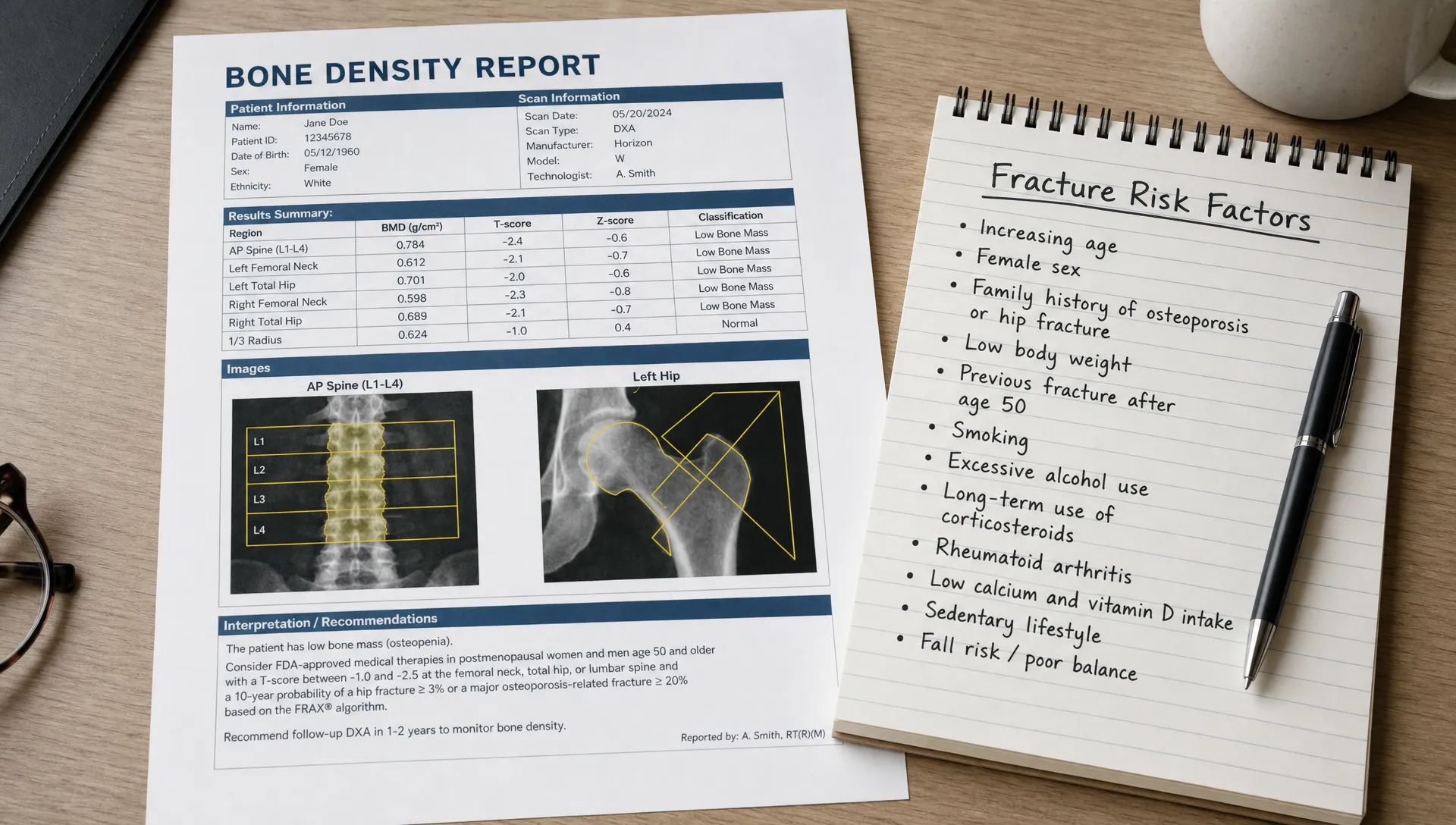
When bone mass density falls below expected levels, your report may translate it into a T-score. This compares your BMD with that of a healthy young adult reference population. A T-score of -1.0 or above is generally considered normal, between -1.0 and -2.5 is called low bone mass or osteopenia and -2.5 or lower meets the densitometric definition of osteoporosis.
Those categories are useful, but they are not a complete risk forecast. Someone with osteopenia and multiple risk factors may have a higher short-term fracture probability than someone with osteoporosis by T-score but no falls, no prior fracture and strong protective habits. For measurement basics, DEXA SF has a helpful guide to what a BMD scan measures and when to get one.
| Factor | What it tells you | Why it matters for fractures |
|---|---|---|
| BMD or T-score | Mineral density compared with a reference group | Lower values usually mean less mechanical reserve |
| Prior fragility fracture | History of breaking a bone from a minor fall or impact | One of the strongest warning signs for future fracture |
| Age | Time-related changes in bone, muscle, balance and vision | Fracture probability rises with age even at the same BMD |
| Fall risk | Likelihood of impact | Many fractures happen because of the fall, not just the bone |
| Medications and conditions | Steroid use, endocrine issues, malabsorption and other factors | Can accelerate bone loss or increase instability |
The risk factors that sit beside density
For many adults, bone mass density is most useful when it is interpreted alongside the rest of their health picture. Two people can share the same T-score and have different fracture risks because their bodies, environments and histories are different.
Age and hormones change the meaning of the same score
Age is not just a number in bone health. With aging, bone remodeling often becomes less efficient, muscle power tends to decline and reaction time may slow. Hormonal changes matter too. The years around menopause can bring faster bone loss because estrogen helps regulate bone turnover. In men, low testosterone and certain chronic illnesses can contribute to declining bone strength.
The U.S. Preventive Services Task Force recommends screening women 65 and older for osteoporosis and screening postmenopausal women younger than 65 when clinical risk factors indicate higher risk. Individual circumstances can justify earlier evaluation, especially after a low-trauma fracture.
Prior fractures and family history raise the stakes
A previous fragility fracture changes the conversation. If you broke your wrist after a standing-height fall, that injury may be a sign that your skeleton is less resilient than expected. Family history also matters, especially a parental hip fracture.
That is why bone mass density should be paired with a careful review of fracture history. A scan can show current density, but your injury history shows how your bones have performed under real-world stress.
Medications, medical conditions and lifestyle can shift risk
Glucocorticoids, some hormone-suppressing therapies, certain anti-seizure medications and conditions that affect nutrient absorption can reduce bone strength over time. Low energy availability, disordered eating, heavy alcohol use and smoking can also affect bone health.
Training history matters in the other direction. Resistance training and impact-loading activities can support bone and muscle, when they are appropriate for your body and medical status. Nutrition plays a supporting role through protein, calcium, vitamin D and overall energy intake.
How clinicians combine scan results with probability
A DEXA result is a measurement. Fracture risk is a probability. To connect the two, clinicians often use risk calculators such as FRAX, which estimates 10-year probability of major osteoporotic fracture and hip fracture using clinical risk factors, with or without femoral neck BMD.
FRAX is not a substitute for medical judgment, but it helps explain why bone mass density is only one piece of the decision. The tool includes factors such as age, sex, weight, height, prior fracture, parental hip fracture, smoking, glucocorticoid use, rheumatoid arthritis and alcohol intake.
Why the hip often gets special attention
Hip fractures are serious because they can lead to hospitalization, loss of independence and long recovery periods. Femoral neck BMD is commonly used in fracture risk models because it predicts hip fracture risk and is measured consistently across DEXA systems.
Spine results matter too, especially when vertebral fracture risk is a concern. However, spine measurements can sometimes be affected by arthritis, calcification or other changes that make the number look better than the true bone quality. That is one reason expert interpretation matters.
Same density, different risk profiles
Consider three simplified examples. These are not treatment rules, but they show how context changes interpretation.
| Scenario | Density result | Other risk factors | Likely clinical concern |
|---|---|---|---|
| Active 42-year-old | Slightly below expected for age | No prior fracture, strong training history, no steroid use | Monitor causes and trends, focus on prevention |
| 67-year-old | Osteopenia | Prior wrist fracture and parental hip fracture | Risk may be high enough to discuss treatment options |
| 78-year-old | Mildly low BMD | Balance issues, sedating medications, recent falls | Fall prevention becomes urgent along with bone care |
What your result can and cannot predict
A person can have similar bone mass density on two scans and still face a different fracture outlook if their fall risk, muscle mass or medications change. DEXA is powerful because it makes an invisible risk measurable, but it cannot predict every event in daily life.
Trends can be more useful than a single snapshot
One scan tells you where you are today. A repeat scan, when appropriate, shows whether your bone density is stable, improving or declining. Trend interpretation depends on scan quality, body positioning, machine consistency and the least significant change used by the testing site or clinic.
Avoid overreacting to tiny changes. Small differences can reflect measurement variation rather than true biological change. The more useful question is whether the trend is large enough to matter and whether it matches your training, nutrition, medication or health history.
Body composition adds another layer
Lean mass, especially in the legs and hips, can influence balance, mobility and the ability to recover from a stumble. Visceral fat and metabolic health can also shape the broader prevention plan. This is where a whole-body DEXA scan can be useful, since it can evaluate bone density, fat mass, lean mass and asymmetries in the same visit.
If your bone mass density has declined, the next step is not simply to “try harder.” It is to identify likely drivers, such as low protein intake, inadequate resistance training, low vitamin D, medication effects, hormone changes, under-fueling or an unrecognized medical issue.
Practical ways to lower fracture risk
Improving bone mass density is only one goal. Reducing fractures means building a system around stronger bones, better movement, safer environments and informed medical decisions.
Build strength and impact gradually
Resistance training can help maintain muscle and place healthy mechanical stress on bone. Impact work, such as hopping or jumping, may help some adults but is not appropriate for everyone. If you have osteoporosis, a history of fracture or significant pain, get medical or professional guidance before adding higher-impact exercise.
Balance training deserves equal attention. Tai chi, single-leg stability drills and structured fall-prevention programs can reduce the chance that a trip becomes a fracture. The CDC emphasizes fall prevention strategies such as medication review, vision checks, strength and balance exercise and home safety improvements.
Support bone with nutrition and recovery
Calcium and vitamin D matter, but bone also needs enough total energy and protein. Active adults who diet aggressively, skip recovery or train through chronic fatigue may undermine the very adaptations they want.
Sleep, sunlight exposure, alcohol intake and smoking status all belong in the bone health conversation. If your DEXA results show low density or unexpected change, consider reviewing your report with a clinician and asking targeted follow-up questions. This DEXA SF guide to questions after a bone density analysis can help you prepare.
When a DEXA scan is especially useful
A DEXA scan is most valuable when the result will change what you do next. That may mean confirming a diagnosis, creating a baseline before a major training or nutrition change, evaluating risk after a fragility fracture or tracking whether a prevention plan is working.
For people in San Francisco who want precise body composition and bone data, DEXA SF provides professional DEXA scans with expert interpretation, including body fat, lean mass, bone density, visceral fat, asymmetry and metabolic insights. The result is not just a number. It is a clearer starting point for fitness, nutrition and bone health decisions.
Frequently Asked Questions
Is bone mass density the same as bone mineral density? In most consumer conversations, the terms are used to mean the same thing. Clinically, DEXA reports usually refer to bone mineral density, or BMD, which is the standardized measurement used for T-scores and fracture risk assessment.
Can I have normal density and still fracture a bone? Yes. A hard fall, poor balance, certain medications, low muscle mass or a previous fracture can raise risk even when BMD is not in the osteoporosis range.
Does low bone mass always mean I need medication? Not always. Treatment decisions usually depend on your T-score, fracture history, age, risk calculator results and medical profile. A clinician can help decide whether lifestyle changes, further testing or medication is appropriate.
How often should bone density be checked? Timing depends on your age, baseline result, risk factors and whether you are making or monitoring treatment changes. Some people need closer follow-up, while others can wait longer between scans.
Turn your scan into a prevention plan
Fracture prevention works best when you know your numbers and understand the context around them. A DEXA scan can show where your bones, muscle and body composition stand today, while expert interpretation can help you decide what deserves attention next.
If you are ready for objective data, schedule a professional scan with DEXA SF and use your results to build a smarter plan for strength, nutrition and long-term bone health.