
Before You Get a DEXA Scan, Ask These 6 Questions
Before you get a dexa scan, make sure the appointment will answer the question that brought you there. Tracking fat loss, checking bone health and assessing changes in lean mass can involve different protocols, reports and follow-up needs. A booking labeled “DEXA” does not automatically tell you which of those services you are buying.
The most useful questions go beyond how long the scan takes. They reveal whether the provider can produce a meaningful baseline, explain the limits of the measurements and help you decide what to do next. Use these six questions when comparing providers or confirming your appointment.
1. Is this the right exam for my goal?
Start by telling the provider what decision you want to make afterward. For example: “I want to see whether my weight loss includes a reduction in lean mass” or “My clinician recommended testing for osteoporosis.” Those goals are not interchangeable.
If you want to get a dexa scan for bone health, ask whether you need a clinical bone density examination, rather than a whole-body composition scan. Clinical testing commonly evaluates the hip and lumbar spine. A whole-body report may include bone measurements, but it should not automatically be treated as an equivalent diagnostic examination.
For fitness tracking, ask whether the appointment includes whole-body and regional measurements of fat and lean tissue. If visceral fat or left-right comparisons matter to you, confirm that those outputs are included rather than assuming every report contains them.
RadiologyInfo’s explanation of bone densitometry, published by the American College of Radiology and Radiological Society of North America, describes the clinical examination and its uses.
A useful answer connects your goal to a specific exam. Be cautious if the provider suggests that any DEXA appointment will cover body composition tracking, osteoporosis diagnosis and every other health concern equally well.
2. Can I compare results reliably when I get a dexa scan again?
A baseline becomes more valuable when a later scan can be compared with it. That comparison depends on more than using the same technology.
Ask how the facility maintains measurement consistency. Relevant details include equipment quality checks, staff training, positioning procedures and whether follow-up scans use the same machine and analysis methods. Changes in equipment or software can complicate comparisons, even when both reports look similar.
Then ask: “How do you distinguish a real change from measurement variability?” A report with decimal places can look more certain than the underlying measurement actually is.
The International Society for Clinical Densitometry’s adult positions address precision assessment and least significant change. These concepts help determine whether a difference is larger than the expected variation in measurement. The relevant threshold depends on the measurement, facility and protocol, not a universal number you should apply to every report.
Also confirm how the provider handles changes in hydration, recent exercise and other conditions that can affect body composition results. Consistent preparation makes comparisons easier to interpret, although it cannot eliminate all variation.
A strong provider can explain why a small difference may not justify changing your training or diet. Promises to detect every tiny gain in muscle or loss of fat deserve closer scrutiny.
3. What preparation and safety rules apply to me?
Ask for the facility’s written instructions before your appointment. Preparation advice should match the examination you are receiving, rather than being copied from a different type of scan.
Tell the provider about possible pregnancy, recent imaging involving contrast or radioactive tracers, metal implants and any difficulty lying flat or transferring onto the table. These details can affect whether, when or how the examination should proceed. If you may be pregnant, contact the facility before booking and discuss the situation with your clinician.
Before you get a dexa scan, clarify whether the facility has instructions about food, fluids, exercise, supplements and clothing. Do not assume that fasting or avoiding water is necessary. Unusual dehydration can make a body composition baseline less representative of your normal condition.
For a clinical bone density examination, instructions may include avoiding calcium supplements beforehand. Follow the facility’s guidance and do not stop prescribed medication without medical advice. Ask about recent contrast studies rather than choosing your own waiting period.
DEXA uses a low dose of X-rays, so the provider should be able to explain the radiation exposure and screening process without calling the examination “radiation-free.” If accessibility is a concern, confirm table limits and available assistance as well.
Once those questions are settled, the simple DEXA preparation checklist can help you organize the practical details.
4. Which report values are measurements, and which are estimates?
Ask to see an anonymized sample report or have the provider describe its contents. This is more informative than a promise of “complete metabolic insights.”
DEXA estimates body composition from X-ray attenuation. Its outputs can be useful, but the labels need careful interpretation. In particular, lean mass is not the same as skeletal muscle mass. Lean soft tissue includes water, organs and other nonfat tissues, so a change in lean mass does not automatically mean an equivalent change in muscle.
When you get a dexa scan, ask how the provider explains the following distinctions:
| Report item | What to clarify |
|---|---|
| Body fat percentage | How the estimate fits your goals and whether comparisons use a consistent protocol |
| Regional lean mass | Why lean tissue is not a direct measurement of muscle alone |
| Visceral fat | Whether the equipment provides an estimate and how it should be interpreted |
| Bone measurements | Whether they come from a whole-body scan or a dedicated clinical examination |
| Metabolic metrics | Whether they are calculated estimates or separately measured values |
For example, a resting metabolic rate calculated from body composition is not the same as energy expenditure measured through indirect calorimetry. Likewise, a left-right difference does not diagnose an injury or identify its cause.
Look for explanations that make the report more useful without presenting it as a comprehensive medical diagnosis.
5. Who will explain my results and help me act on them?
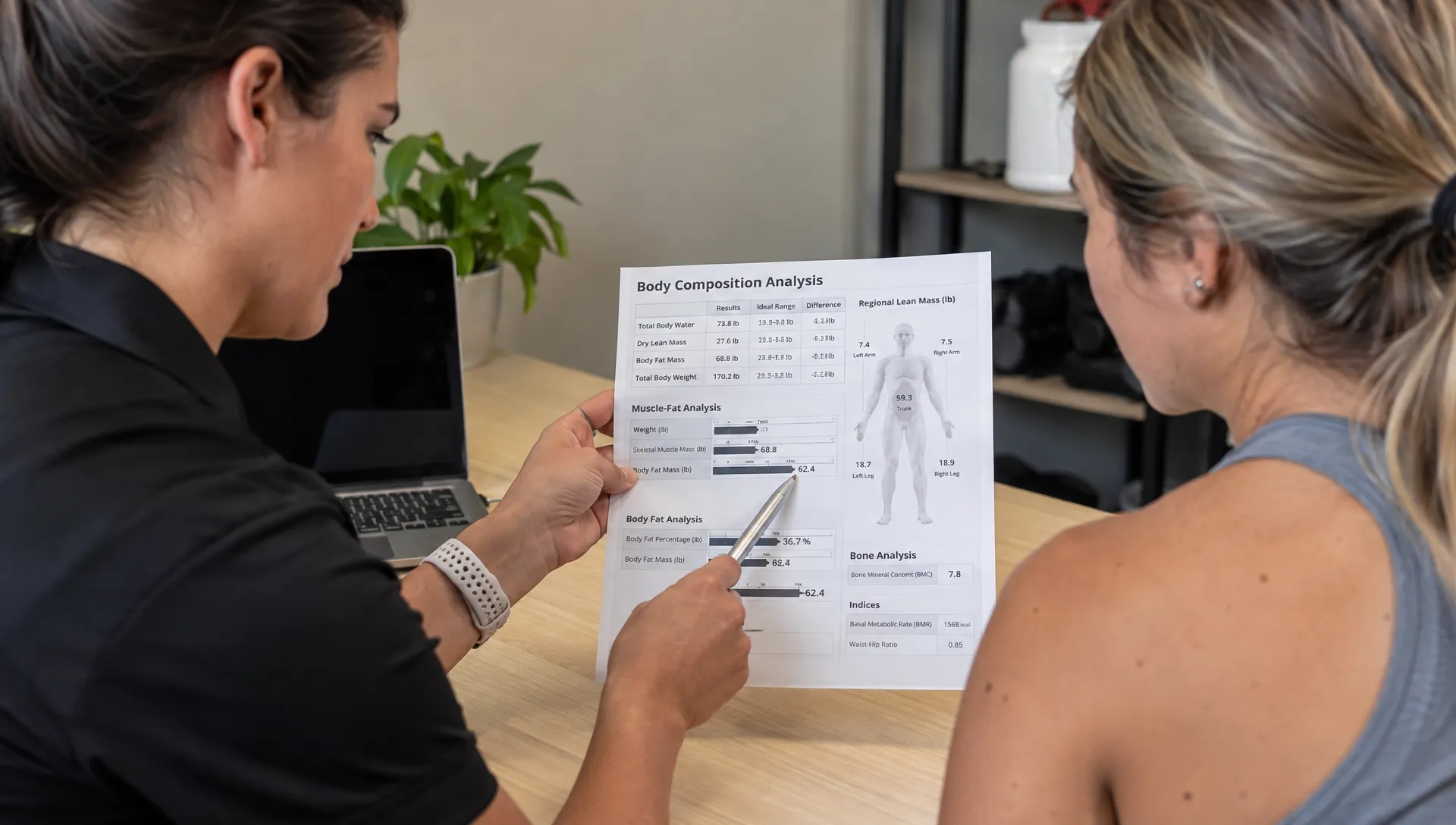
Confirm whether your appointment includes a results discussion or simply delivery of a report. Neither arrangement is automatically wrong, but you should know what you are paying for.
Ask who provides the interpretation, what qualifications they hold and what falls within their scope of practice. General fitness coaching, individualized nutrition advice and medical diagnosis are different services. A provider should be clear about which they offer and when a finding requires a clinician’s attention.
If you get a dexa scan to guide a training or nutrition change, the discussion should connect the findings to your actual goal. It should not stop at identifying a body fat percentage or comparing you with a reference group.
For example, if lean mass appears to have declined during weight loss, a useful conversation considers measurement variability, preparation conditions, dietary intake and training history before attributing the entire change to muscle loss. That context can prevent an unnecessary overhaul of a plan that may still be working.
The guide to reviewing your DEXA scan analysis with confidence offers a framework for that conversation.
Good interpretation includes limits and next steps. Be wary of advice that treats one scan as proof of a medical condition or uses the result mainly to pressure you into buying supplements or a restrictive program.
6. What does the price include, and what would follow-up cost?
Ask for the total appointment price and a clear description of what is included. Two providers can advertise the same type of scan while offering different levels of reporting and support.
Before you get a dexa scan, confirm these details:
- Whether the price includes the full report and a results discussion
- Whether regional measurements, visceral fat estimates or other advertised outputs are included
- Whether fitness or nutrition guidance carries a separate charge
- What a repeat scan costs and whether purchasing a package is optional
- What happens if technical problems prevent a usable examination
If the appointment is for clinical bone density testing, ask about referral requirements, billing and insurance separately. Do not assume a fitness-oriented body composition appointment will be covered in the same way as a medically indicated examination.
Follow-up timing is another part of value. Ask why the provider recommends a particular interval and what change they expect to assess. Scanning more frequently does not necessarily produce more useful information, especially when expected changes are smaller than measurement variability.
You should leave the booking conversation knowing what you will receive, who will explain it and what future tracking would involve. That is a better basis for comparison than the advertised scan price alone.
Frequently Asked Questions
Do I need a referral? Requirements depend on the examination, provider and billing arrangement. Ask whether you are booking a clinical bone density study or a body composition service, then confirm any referral requirements before paying.
Will a scan tell me exactly how many calories to eat? No. An estimated resting metabolic rate is only one input. Daily energy needs also depend on activity and other factors, and a nutrition plan should account for your goals, health history and response over time.
How often should I repeat the examination? There is no single interval that fits everyone. Body composition tracking should allow enough time for meaningful change. Clinical bone density follow-up should follow your clinician’s recommendation and the reason for testing.
Make your appointment fit your goal
The best reason to get a dexa scan is to answer a clear question with results you can interpret and use. Keep these six questions handy when you contact a provider.
For body composition testing in San Francisco, DEXA SF offers assessments of body fat, lean mass, bone density and visceral fat, along with expert interpretation and personalized fitness and nutrition guidance. Explain your goal when scheduling, then confirm the examination details, preparation instructions and support included in your appointment.