

Medications That May Affect Your Bone Mineral Density Test
Some medications can change your bone mineral density test results by affecting bone over months or years. Others, including calcium-containing supplements taken shortly before the scan, may interfere with the measurement itself. Those are different problems, and they call for different responses.
Do not stop a prescription medication to prepare for a DEXA scan unless your prescribing clinician tells you to. Skipping a dose will not reverse medication-related bone loss, and interrupting treatment can be harmful.
The useful step is to bring an accurate medication history, follow the imaging center’s preparation instructions and make sure the clinician interpreting your results knows what you take. This guide explains which medications deserve attention, what can affect scan accuracy and how to discuss the findings without making unnecessary treatment changes.
How medications can affect a bone mineral density test
Medication effects fall into three categories:
- Changes in bone strength: Some treatments increase bone breakdown, reduce bone formation or alter hormones that help maintain bone.
- Changes in the measurement: Calcium tablets or certain contrast materials can interfere with X-ray measurements if they are present near the area being scanned.
- Intended treatment effects: Osteoporosis medications may maintain or increase bone density, which helps clinicians evaluate treatment response.
A medication can also increase fracture risk without causing a large drop in measured density. For example, medicines that cause dizziness or sedation may increase the likelihood of falling. A DEXA result does not capture that risk by itself.
The distinction matters: a scan affected by material in the digestive tract may need different preparation or timing. A scan showing genuine bone loss calls for clinical evaluation, not simply another appointment after skipping medication.
Medications to include in your scan history
This table highlights common groups worth discussing. It is not a list of medications everyone should avoid.
| Medication group | Examples | Why it matters |
|---|---|---|
| Systemic glucocorticoids | Prednisone, prednisolone, dexamethasone | Can cause bone loss and increase fracture risk, particularly with ongoing exposure |
| Estrogen- or testosterone-lowering treatments | Anastrozole, letrozole, androgen deprivation therapy | Reduced sex hormone levels can accelerate bone loss |
| Certain antiseizure medications | Phenytoin, carbamazepine, phenobarbital, valproate | May affect vitamin D metabolism or bone health through other mechanisms |
| Excess thyroid hormone replacement | Levothyroxine doses that suppress TSH more than intended | Can increase bone turnover, particularly in postmenopausal adults |
| Injectable progestin contraception | Depot medroxyprogesterone acetate | Can reduce bone density during use |
| Certain diabetes medications | Pioglitazone, rosiglitazone | Are associated with increased fracture risk, especially in women |
| Certain HIV treatments | Tenofovir disoproxil fumarate | Can contribute to bone loss; effects differ among treatment regimens |
| Osteoporosis treatments | Bisphosphonates, denosumab, bone-building therapies | May maintain or increase density and influence follow-up interpretation |
The presence of one of these drugs on your list does not predict what your bone mineral density test will show. Dose, duration, age, underlying illness and previous fractures all affect the clinical picture.
Glucocorticoids deserve an early conversation
Systemic glucocorticoids are among the most important medications to flag. They can reduce bone formation, and fracture risk may increase before a dramatic change appears on a scan. Bone loss can begin within the first months of ongoing treatment.
The American College of Rheumatology’s glucocorticoid-induced osteoporosis guideline recommends fracture-risk assessment for adults starting or continuing glucocorticoids at a prednisone-equivalent dose of at least 2.5 mg daily for more than three months. That threshold is a reason to assess risk, not a dividing line between completely safe and unsafe use.
Tell your clinician about repeated courses as well as daily treatment. Include the usual dose, approximate treatment dates and the condition being treated. Inhaled, topical and injected steroids have different exposure patterns from oral or intravenous treatment, so identify the route rather than listing only “steroids.”
Your clinician may recommend a bone mineral density test, vertebral fracture assessment or other evaluation based on your overall risk. Do not wait for symptoms: osteoporosis often causes no noticeable warning before a fracture.
Cancer treatments and other hormone-related medications
Estrogen and testosterone help maintain bone. Treatments that lower these hormones can therefore affect skeletal health.
Aromatase inhibitors such as anastrozole, letrozole and exemestane reduce estrogen levels and can accelerate bone loss. Androgen deprivation therapy for prostate cancer can also reduce density and increase fracture risk. The oncology team should help coordinate monitoring and any protective treatment.
Not all hormone-related drugs behave the same way. Tamoxifen, for example, has different skeletal effects before and after menopause and may help preserve bone in postmenopausal patients. Avoid assuming that every breast cancer medication carries the same risk.
Depot medroxyprogesterone acetate contraception can also lower bone density during use. Density often improves after discontinuation, but recovery varies. Whether a bone mineral density test is appropriate depends on the person’s wider risk profile, not simply the fact that they receive the injection.
Antiseizure drugs, thyroid replacement and other medications
Some antiseizure medications affect vitamin D metabolism, while others may influence bone through different pathways. Seizures and medication-related balance problems can also increase fall risk. A clinician may review nutrition, vitamin D status and fracture history alongside the scan.
With thyroid replacement, the concern is generally excess exposure, not appropriately dosed levothyroxine itself. Persistently suppressed thyroid-stimulating hormone, or TSH, can signal a need to review treatment. Some thyroid cancer patients intentionally receive TSH-suppressing therapy, so any adjustment must account for the reason it was prescribed.
Proton pump inhibitors and selective serotonin reuptake inhibitors also come up frequently in bone-health discussions. Research has linked their use with fractures in some populations, but those associations do not establish that the medication directly caused bone loss. The underlying illness and other health factors may contribute.
A bone mineral density test cannot establish medication causation on its own. These findings support a medication review when appropriate, not automatic discontinuation or routine scanning for everyone who takes these drugs.
Osteoporosis medications can improve the result
Some medications affect density in the direction treatment is intended to achieve. Bisphosphonates and denosumab reduce bone breakdown. Bone-building treatments, including teriparatide and abaloparatide, stimulate bone formation.
An increase in density may support a favorable treatment response, but a stable result can also be meaningful. Treatment success is not defined by a larger number at every visit. Your clinician also considers new fractures, adherence, side effects and whether the measured change exceeds the facility’s precision limits.
Bring the names and dates of treatments you have already stopped, including injections and infusions. Their effects may remain relevant long after the last dose.
Do not delay or stop denosumab because a result looks reassuring. Unplanned discontinuation can lead to rapid bone loss and vertebral fractures. Any transition requires a clinician-directed plan. A better bone mineral density test result does not necessarily mean the underlying fracture risk has disappeared.
Preparing for the scan without interrupting treatment
For most routine prescriptions, preparation does not mean taking a medication break. Follow your imaging center’s instructions and ask specifically about any supplement or medication you are unsure about.
RadiologyInfo’s bone densitometry guidance, provided by the American College of Radiology and Radiological Society of North America, advises avoiding calcium supplements for at least 24 hours before the examination. Calcium tablets in the digestive tract can interfere with measurements. This instruction is about scan accuracy, not because a day of calcium use changes your bones.
Ask whether the center’s instructions also apply to your calcium-containing multivitamin or antacid. You generally do not need to avoid normal dietary calcium unless the facility says otherwise.
Before your bone mineral density test, report recent barium studies, contrast-enhanced imaging or nuclear medicine examinations. Depending on the material, scan region and timing, the center may recommend waiting. Do not assume that every type of imaging requires the same interval.
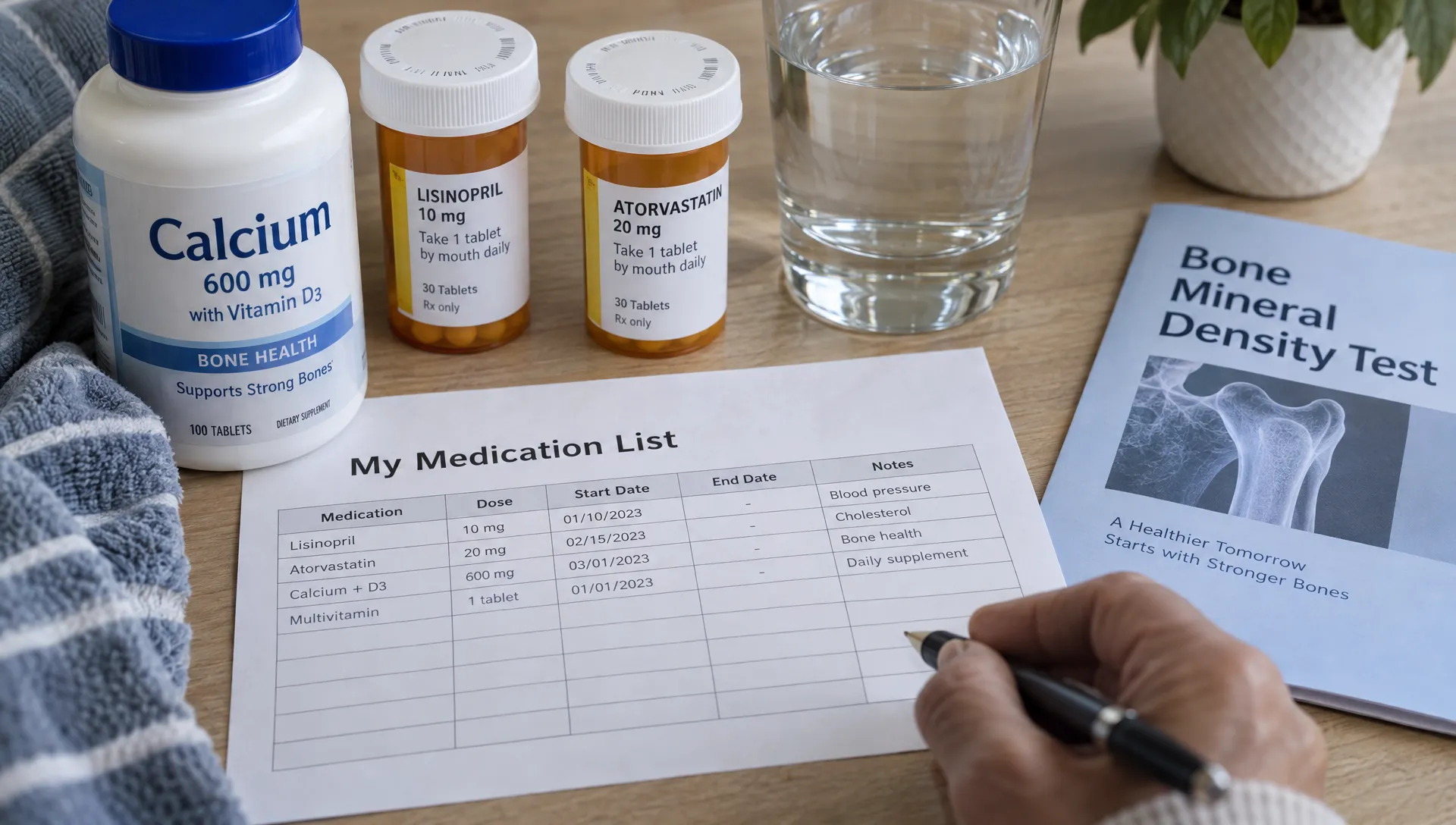
Bring a medication timeline, not just a list
A current prescription list is helpful, but it can miss exposures that still matter. Bring the following information if available:
- Medication and supplement names, including nonprescription products.
- Current doses and whether treatment is daily, intermittent, injected or infused.
- Approximate start and stop dates for steroids, hormone therapies and osteoporosis treatments.
- Recent dose changes, missed osteoporosis doses or treatment switches.
- Dates of recent contrast studies or nuclear medicine examinations.
You do not need perfect records to attend the appointment. A pharmacy list, medication bottles or a patient portal summary can help fill gaps. If you have previous DEXA reports, bring those too, preferably with the facility and scanner information included.
How medication history changes interpretation
A low result does not prove that a drug caused the problem. Aging, menopause, low body weight, malabsorption, endocrine conditions and the illness being treated can all contribute. For example, someone taking prednisone may also have an inflammatory disease that affects bone health independently.
Similarly, an unexpectedly high result is not always evidence of unusually strong bones. Spinal arthritis, vertebral changes or other artifacts can raise lumbar spine measurements. The interpreting clinician should review image quality rather than relying only on the reported number.
For follow-up testing, ask whether the change exceeds the facility’s least significant change, the threshold used to distinguish a likely biological change from measurement variability. Comparisons are generally most useful on the same device at the same facility. Results from different scanners may not be directly comparable without appropriate cross-calibration.
Your bone mineral density test belongs in a broader fracture-risk assessment. For help understanding the report’s terminology, DEXA SF’s guide to bone mineral density scan results explains BMD, T-scores and Z-scores without treating any single number as the whole diagnosis.
Confirm that you are booking the right type of DEXA
DEXA is used for both body composition assessment and diagnostic bone density testing, but the examinations are not interchangeable.
A whole-body composition scan can report bone-related measurements alongside fat and lean mass. A diagnostic osteoporosis evaluation generally uses specific skeletal sites, commonly the lumbar spine and hip. The International Society for Clinical Densitometry’s adult positions describe the sites and methods used for clinical assessment.
If your prescribing clinician wants monitoring because of prednisone, cancer therapy or another medication, ask which examination and skeletal sites are needed before booking. Confirm that the report will answer that clinical question.
The repeat-testing interval should also be individualized. A medication change, new fracture or condition associated with rapid loss may justify a different schedule from routine follow-up. A short interval does not automatically produce more useful information.
Frequently asked questions
Should I stop my medication before a bone mineral density test? Usually not. Continue prescribed treatment unless your clinician directs otherwise. Follow the imaging center’s instructions about calcium supplements and disclose recent contrast studies. Skipping a bone-affecting medication briefly will not reverse its long-term effects.
Can one dose of prednisone change my result? A single dose is unlikely to cause a meaningful, measurable density change. Ongoing exposure, repeated courses and cumulative dose are more relevant. Report your treatment history rather than focusing only on what you took the morning of the scan.
Do calcium supplements make bone density look higher? Long-term calcium intake supports bone health when it helps meet your nutritional needs. Separately, a calcium tablet remaining in the digestive tract can interfere with X-ray measurements. That preparation issue is why centers commonly advise holding calcium supplements beforehand.
Does a normal result mean a bone-affecting medication is safe for me? A normal result is reassuring but does not eliminate fracture risk. Glucocorticoid exposure, previous fractures and fall risk can influence decisions even when density is not in the osteoporosis range. Continue the monitoring plan recommended by your clinician.
Plan a scan that answers your clinical question
Before scheduling, tell the center why you are being tested and which medications prompted the referral. Ask your prescribing clinician what result would change your care, then bring your medication timeline and previous reports.
DEXA SF offers DEXA body composition assessment in San Francisco, including bone density information and expert interpretation. Confirm whether the available examination meets your clinician’s requirements for diagnostic hip and spine testing or medication monitoring. The right scan, paired with the right history, is more useful than a number without context.