

Is DEXA the Gold Standard for Measuring Body Composition?
If you care about more than the number on a scale, you have probably heard DEXA described as the gold standard for measuring body composition. That description is mostly earned, but it deserves context. DEXA is not magic, and no single test answers every health, performance or medical question. What it does extremely well is provide a precise, repeatable map of fat, lean tissue and bone that most consumer methods cannot match.
For athletes, weight loss clients, strength trainees and anyone tracking health over time, that difference matters. A bathroom scale can tell you whether total weight changed. DEXA can show whether that change came from fat, lean mass, bone mineral content or shifts in specific body regions. That makes it useful not only for assessment, but also for better decisions.
Why DEXA is called the gold standard for measuring body composition
DEXA stands for dual energy X-ray absorptiometry. The scanner uses two low-dose X-ray energy levels to distinguish bone mineral, fat tissue and lean soft tissue. RadiologyInfo, a patient resource from the American College of Radiology and the Radiological Society of North America, describes DXA as a test that uses a very small amount of ionizing radiation, most famously for bone density assessment.
The body composition advantage comes from imaging. Unlike BMI, which the CDC notes does not measure body fat directly, DEXA does not rely on height and weight alone. In practical health and performance testing, DEXA has become the gold standard for measuring body composition because it measures body regions separately instead of reducing the body to one score.
What a DEXA scan measures beyond weight
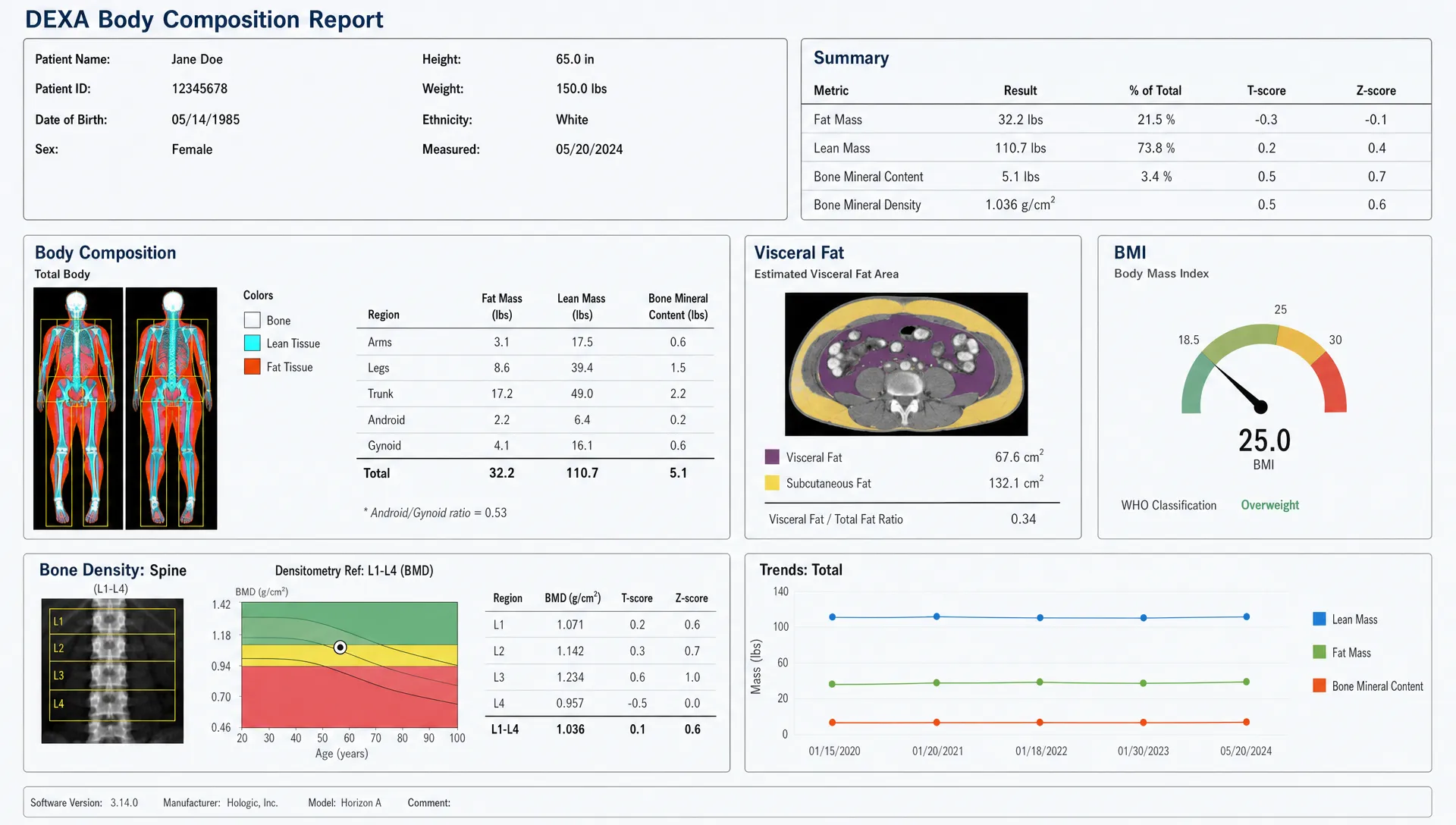
A quality DEXA report gives you a much richer picture than body weight or body fat percentage alone. The exact report format varies by provider and scanner software, but body composition scans commonly include several key outputs.
- Total body fat percentage, which shows what share of body mass is fat tissue
- Total fat mass, which is often more actionable than percentage alone
- Lean mass, including regional lean tissue in the arms, legs and trunk
- Visceral adipose tissue, the fat stored deeper in the abdominal region
- Bone mineral content and bone density related metrics
- Regional distribution, including left vs. right asymmetries
This combination of whole-body and regional data is why DEXA is treated as the gold standard for measuring body composition by many coaches, clinicians and performance-minded clients. If you want a deeper breakdown of which numbers are most useful, DEXA SF has a guide to the DEXA body composition metrics that matter most.
How DEXA compares with other body composition tests
Most body composition tools are useful within limits. The question is not whether a method can provide a number, but how much confidence you should place in that number and whether it can guide decisions over time.
| Method | What it tells you | Main strength | Main limitation |
|---|---|---|---|
| BMI | Weight relative to height | Fast and free | Does not directly measure fat or muscle |
| Skinfold calipers | Subcutaneous fat estimate | Low cost and portable | Highly dependent on technician skill |
| Bioelectrical impedance | Estimated fat and lean mass from electrical resistance | Convenient and common in gyms | Sensitive to hydration, food intake and device quality |
| Bod Pod or hydrostatic weighing | Body density based estimate | Useful for total body composition | Limited regional detail |
| CT or MRI | Detailed tissue imaging | Excellent for specific anatomy | Cost, access and radiation for CT |
| DEXA | Fat, lean mass, bone and regional distribution | Strong precision with detailed outputs | Still requires consistent testing conditions |
Against those tradeoffs, DEXA is the gold standard for measuring body composition for people who want more detail than a smart scale and more practicality than research imaging. If you currently use impedance testing, this InBody vs DEXA comparison for Bay Area athletes explains where the two methods differ.
Accuracy depends on repeatability, not one perfect number
A single scan can be eye-opening, but the real value appears when you compare results over time. If your goal is fat loss, muscle gain, improved bone health or better symmetry, trend data is more useful than obsessing over one decimal point.
To get the most reliable comparison, try to keep testing conditions similar each time. Use the same facility and scanner when possible, schedule scans under similar hydration and meal conditions, avoid unusually hard training right before testing and compare absolute fat mass or lean mass alongside percentages.
Used this way, DEXA earns its reputation as the gold standard for measuring body composition because it helps separate real progress from normal weight fluctuation. A person can lose scale weight but also lose lean mass. Another person can stay the same weight while gaining lean mass and losing fat. DEXA makes those differences visible.
When DEXA is the right tool
DEXA is especially useful when your goals require specific information. If you are training for strength, regional lean mass can show whether your program is building tissue where expected. If you are focused on metabolic health, visceral fat measurement may be more informative than waist size alone. If you are recovering from injury or correcting imbalances, side-to-side asymmetry can guide smarter training.
It can also help people who feel stuck. Scale weight may stall even when body composition improves, especially during resistance training or nutrition changes. At DEXA SF, scans can be paired with expert interpretation, fitness guidance and nutrition advice so the numbers become a practical plan rather than a confusing report.
Limitations to understand before you scan
Calling DEXA the gold standard for measuring body composition does not mean it is perfect for every question. DEXA estimates lean soft tissue, but it does not directly measure muscle fiber quality or strength. It can show regional lean mass changes, but it cannot tell you whether a training program is optimal without context from performance, recovery and nutrition.
Hydration, glycogen storage, recent food intake and scanner calibration can influence results, especially lean mass. That is why consistency matters. DEXA also involves low-dose ionizing radiation, so people who are pregnant or may be pregnant should discuss testing with a qualified medical professional before scheduling.
For bone health, DEXA has a long clinical history. The International Society for Clinical Densitometry publishes official positions on DXA use and interpretation for bone density testing, which is separate from general fitness tracking. If you have a medical concern such as osteoporosis risk, review your results with a healthcare provider.
How to use your DEXA results well
The best DEXA result is one that changes what you do next. Instead of focusing only on body fat percentage, look at the pattern. Are you carrying more visceral fat than expected? Is lean mass balanced between sides? Did a calorie deficit reduce fat mass while preserving lean tissue? Are bone density metrics worth discussing with a clinician?
The practical value of the gold standard for measuring body composition is that it gives you a clearer baseline and a better way to evaluate change. For most people, the next step is not to test constantly. It is to use the report to refine training, nutrition, recovery and follow-up timing.
If you are in the Bay Area and want precise data with interpretation, you can schedule a professional DEXA scan in San Francisco and use the results to guide your next phase of training or health planning.
Frequently Asked Questions
Is DEXA more accurate than BMI? Yes. BMI is a height and weight calculation, not a direct body composition test. DEXA separates fat, lean tissue and bone, which makes it far more informative for most fitness and body composition goals.
Does DEXA measure muscle mass directly? DEXA measures lean soft tissue, which includes muscle along with water and other non-fat, non-bone tissue. It is very useful for tracking lean mass trends, but it does not measure muscle strength or quality.
How often should I get a DEXA scan? Most people do best by testing after enough time has passed for meaningful change, such as after a training block or nutrition phase. Weekly scans usually add noise rather than insight.
Is a DEXA scan safe? DEXA uses a very small amount of ionizing radiation, but it is still radiation. If you are pregnant, may be pregnant or have a medical concern, ask a qualified healthcare professional before scanning.
Can DEXA help with fat loss? DEXA can help you see whether weight loss is coming from fat, lean tissue or both. That feedback makes it easier to adjust calories, protein intake, resistance training and recovery.
Make your next measurement count
DEXA is not valuable because it gives you more numbers. It is valuable because it gives you better questions to act on. If your current tools only show weight, DEXA can clarify what is changing inside that weight and help you make smarter decisions with less guesswork.