
Bone Mass Explained: What Your Numbers Really Mean
Bone mass can sound like a simple number, but it is really a window into how much mineralized bone tissue your body has, how strong that bone may be, and how your results compare with expected ranges. If you have ever looked at a DEXA report and wondered whether your bone mass is “good,” “low,” or simply normal for you, the answer depends on several numbers working together.
A DEXA scan can estimate bone mineral content, bone mineral density, and body composition in one quick appointment. The key is knowing what each metric means, what it does not mean, and when a result should prompt a conversation with a qualified clinician.
What bone mass actually means
In everyday language, bone mass usually refers to the amount of bone tissue in your body. More specifically, DEXA technology can report bone mineral content, often abbreviated as BMC, which estimates the mineral content of bone in grams. This is one way to describe “how much bone” is present in a scanned region.
Bone mass is closely related to bone strength, but it is not the same thing. Your risk of fracture depends on multiple factors, including bone density, bone quality, age, fall risk, medications, family history, hormone status, and medical conditions. That is why a DEXA scan is valuable: it provides objective numbers that can be interpreted in context rather than relying on weight, appearance, or guesswork.
It also helps to separate bone mass from body weight. Two people can weigh the same and have very different amounts of fat, muscle, and bone. Likewise, someone who looks lean or athletic can still have low bone density, especially if they have risk factors such as under-fueling, low vitamin D, hormonal changes, or a history of stress fractures.
Bone mass vs. bone density: the difference that matters
Bone mass and bone density are related, but they are not interchangeable.
Bone mineral content (BMC) estimates the total mineral amount in a bone region, usually reported in grams. Bone mineral density (BMD) estimates mineral content relative to scanned area, usually reported as grams per square centimeter. DEXA scans most often use BMD to assess bone health because density is more strongly tied to fracture risk than raw mineral amount alone.
Think of it this way: a larger person may naturally have more total bone mineral content because their bones are larger. But density helps answer a different question: how mineral-rich is the bone for its size? That is why BMD, T-scores, and Z-scores are central to bone health interpretation.
If you are new to DEXA testing and want a broader overview of the appointment itself, DEXA SF’s bone density scan guide explains what to expect and why the test matters.
The main bone numbers on a DEXA report
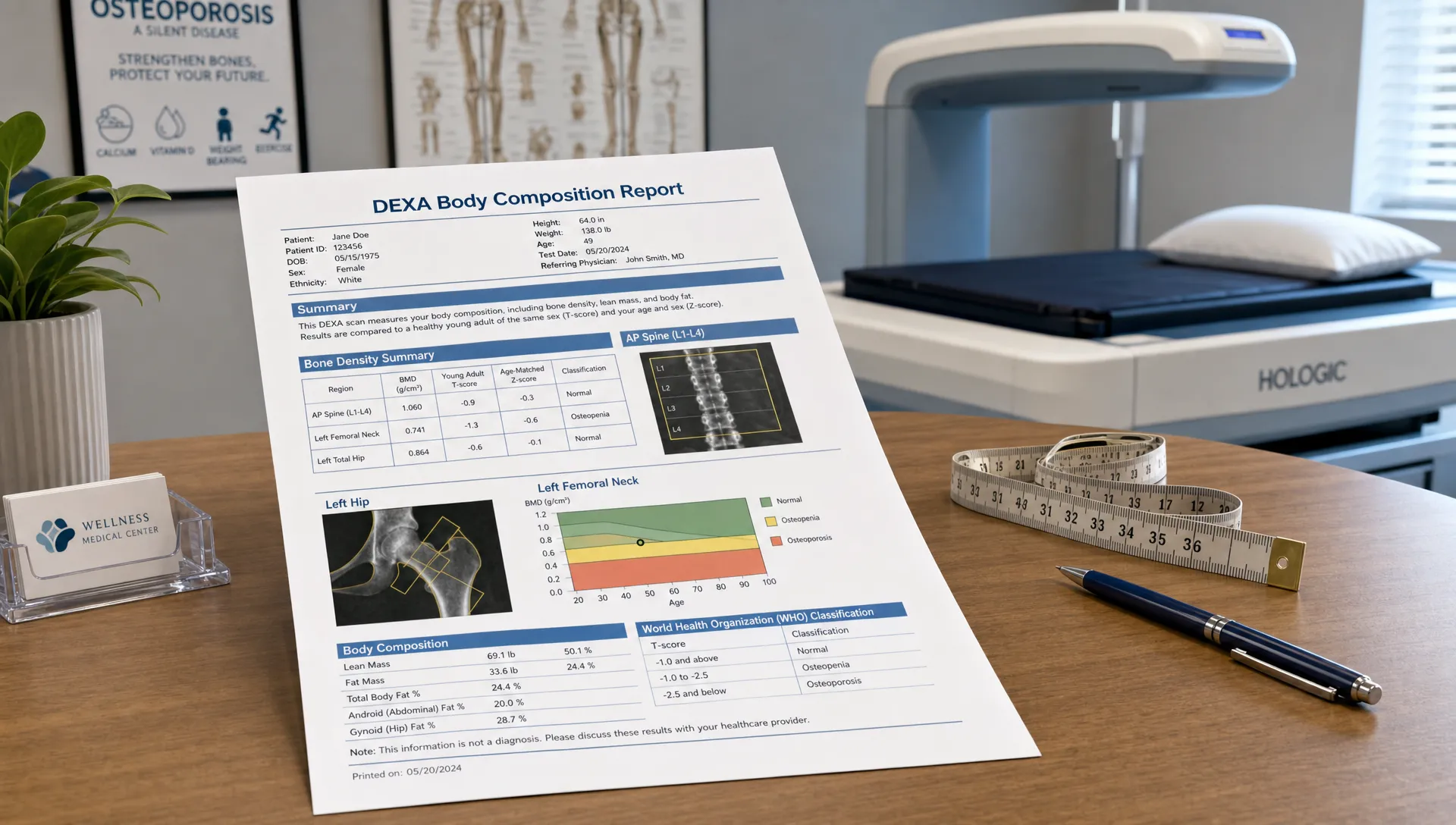
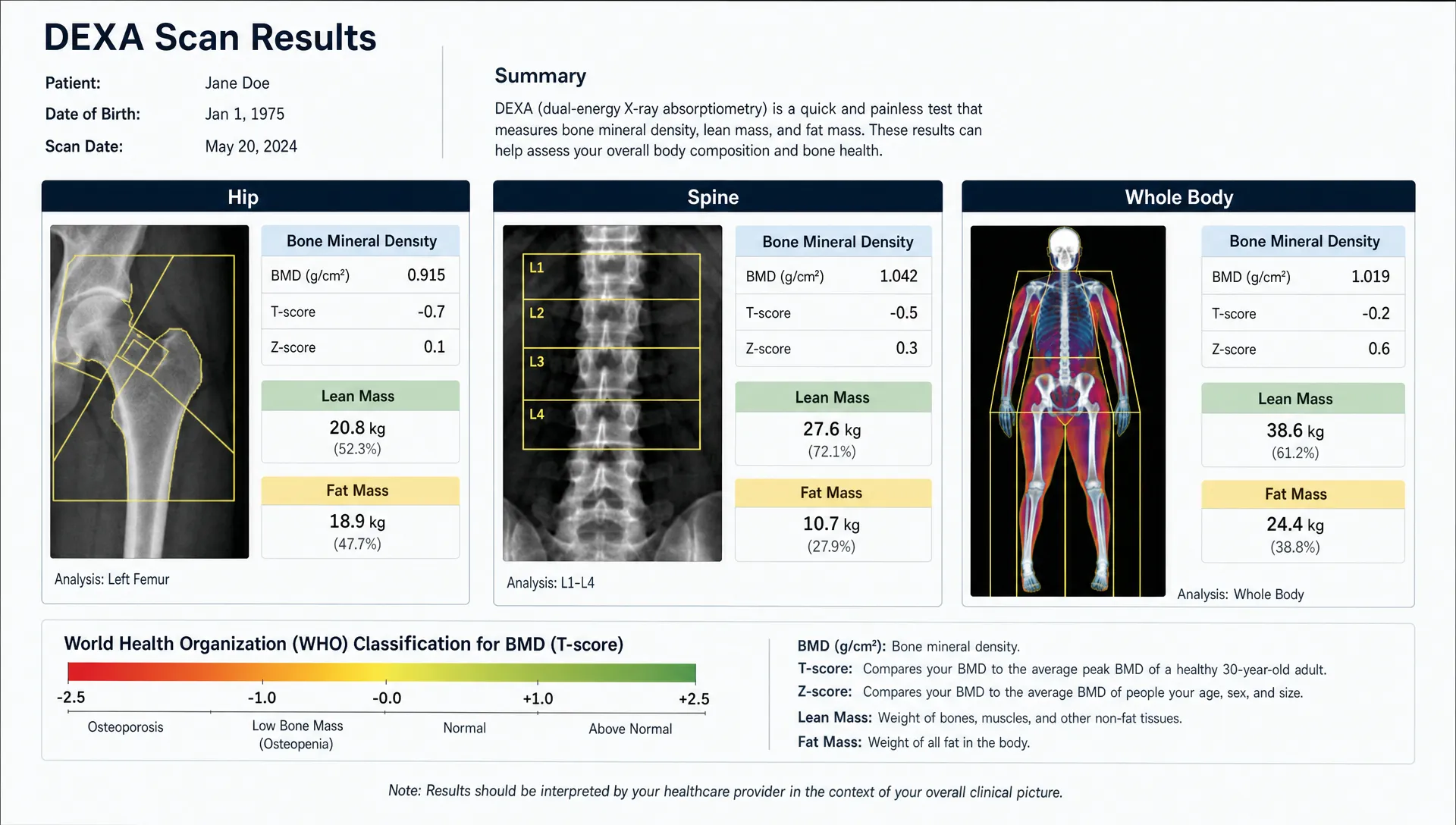
A DEXA report can include several bone-related metrics. The exact layout depends on the equipment and scan type, but these are the numbers most people should understand.
| Metric | What it means | Why it matters |
|---|---|---|
| Bone mineral content (BMC) | Estimated mineral content in a scanned bone region, often in grams | Gives a raw estimate of mineral amount, but is affected by bone size |
| Bone mineral density (BMD) | Mineral content divided by scanned area, usually g/cm² | A key measure used to assess bone strength and fracture risk |
| T-score | Your BMD compared with the average peak bone density of a healthy young adult | Used in adults, especially postmenopausal women and men over 50, to classify normal bone density, low bone mass, or osteoporosis |
| Z-score | Your BMD compared with what is expected for someone of your age, sex, and body size | Helps identify whether bone density is lower than expected for your demographic group |
| Region-specific results | Measurements from areas such as the hip, spine, or total body | Bone density can vary by body region, so location matters |
These numbers should not be interpreted in isolation. A single score is a starting point, not a full diagnosis.
T-score explained: normal, low bone mass, and osteoporosis
The T-score is one of the most recognized bone density numbers. It compares your BMD with the average peak BMD of a healthy young adult reference population. In general clinical use, the World Health Organization categories are commonly described as:
| T-score range | Common interpretation |
|---|---|
| -1.0 or higher | Normal bone density |
| Between -1.0 and -2.5 | Low bone mass, also called osteopenia |
| -2.5 or lower | Osteoporosis range |
The term low bone mass is important. It does not automatically mean you will fracture a bone, and it does not always mean medication is needed. It does mean your bone density is below the young adult reference range and should be evaluated alongside your overall fracture risk.
Organizations such as the Bone Health & Osteoporosis Foundation emphasize that bone density testing is one part of a broader risk assessment. Your clinician may also consider age, prior fractures, parental hip fracture history, smoking, alcohol intake, glucocorticoid use, rheumatoid arthritis, and other factors.
Z-score explained: “is this expected for me?”
A Z-score compares your bone density with what is typical for someone similar to you in age and sex. This is especially useful for premenopausal women, men under 50, children, and younger adults, where T-score categories may not tell the full story.
A very low Z-score can suggest that your bone density is below what would be expected for your age group. That does not automatically identify the cause, but it may prompt a healthcare provider to look for contributing factors such as nutrient deficiencies, endocrine issues, medication effects, digestive disorders, or excessive training without enough recovery and nutrition.
In simple terms, the T-score asks, “How do you compare with peak adult bone density?” The Z-score asks, “How do you compare with people like you?”
Why bone mass varies by body region
Bone is not uniform across your body. Your spine, hip, forearm, ribs, and legs all experience different loads and can respond differently to age, exercise, hormones, and injury history.
The hip and lumbar spine are especially important in clinical bone density testing because fractures in these areas can have serious consequences. The forearm may also be measured in certain cases, such as when hip or spine measurements are not usable or when specific medical conditions are being evaluated.
It is also normal for one region to look stronger or weaker than another. For example, someone who lifts weights may have relatively strong bone density in heavily loaded areas, while a person with arthritis in the spine may have an artificially elevated spine BMD reading because degenerative changes can affect the measurement. This is one reason expert interpretation matters.
What affects your bone mass numbers?
Bone mass changes over a lifetime. Most people build bone through childhood, adolescence, and early adulthood, then reach peak bone mass. After that, the goal becomes maintaining as much bone strength as possible and slowing age-related loss.
Several factors can influence your bone mass and density:
- Age and hormones: Estrogen and testosterone help maintain bone. Bone loss often accelerates after menopause, and low sex hormones can affect bone health in any sex.
- Strength and impact training: Resistance training and weight-bearing activity can help stimulate bone maintenance, especially when progressed safely.
- Nutrition: Calcium, vitamin D, protein, and overall energy intake all support bone remodeling and repair.
- Body composition: Very low body weight or chronic under-fueling can negatively affect bone, while adequate muscle mass can support balance, strength, and mechanical loading.
- Lifestyle and medications: Smoking, heavy alcohol use, long-term glucocorticoid use, and certain medical treatments can contribute to lower bone density.
- Medical history: Conditions affecting the thyroid, parathyroid, gut absorption, kidneys, inflammatory pathways, or menstrual function may affect bone health.
The National Institute of Arthritis and Musculoskeletal and Skin Diseases notes that lifestyle habits, nutrition, and medical risk factors all play a role in bone health. That is why a scan result is most useful when paired with a clear health history and a practical plan.
A “good” bone mass number depends on context
It is tempting to ask for one ideal bone mass number, but there is no universal target that applies to everyone. Your age, sex, height, ethnicity, training history, medical background, and scan region all affect what is expected.
A higher BMD is generally associated with stronger bones, but bigger is not always a simple “better.” Some readings can be influenced by artifacts, positioning, spinal degeneration, prior fractures, vascular calcifications, or hardware. On the other hand, a lower result may be explainable by body size or demographic factors, but still deserve attention if fracture risk is elevated.
The best interpretation looks at patterns:
- Is your BMD in a normal, low bone mass, or osteoporosis range?
- Is the Z-score unusually low for your age group?
- Are some regions much lower than others?
- Are results changing over time?
- Do the numbers match your injury history, training, nutrition, and medical risk factors?
This pattern-based approach is far more useful than reacting to a single number.
How bone mass connects with muscle and body composition
Bone does not exist in isolation. Muscle and bone interact mechanically and metabolically. Strong muscles apply force to bone during movement, and that loading is one reason resistance training can be beneficial for skeletal health.
A full-body DEXA scan can be especially helpful because it measures more than bone density. It can also estimate lean mass, fat mass, visceral fat, and left-right asymmetries. For people pursuing fitness, longevity, or performance goals, seeing bone mass alongside muscle and fat distribution can make the results more actionable.
For example, if someone has low lean mass and low bone density, their plan may emphasize progressive resistance training, adequate protein, and sufficient calories. If someone has strong muscle mass but unexpectedly low bone density, it may be worth investigating hormones, vitamin D status, medications, or training patterns. If you are curious about the broader health benefits of maintaining strong bones, DEXA SF’s article on reasons to maintain high bone density provides a helpful companion read.
What to do if your bone mass is low
If your results show low bone mass or a T-score in the osteoporosis range, do not panic, but do take it seriously. The right next step depends on your age, fracture history, risk factors, and the specific scan findings.
Start by reviewing the report with a qualified professional. A clinician may recommend additional lab work, a fracture risk assessment, medication review, or follow-up testing. If you have already had a fragility fracture, a very low T-score, or multiple risk factors, medical guidance is especially important.
From a lifestyle perspective, many bone-supportive habits are also good for general health. These include progressive strength training, balance work, adequate protein, calcium-rich foods, vitamin D assessment when appropriate, limiting smoking, moderating alcohol intake, and making sure weight loss goals do not create chronic under-fueling.
The goal is not just to increase a number on a report. The goal is to reduce fracture risk, preserve independence, support movement, and build a body composition profile that helps you age well.
How often should you track bone mass?
Bone changes slowly. Unlike hydration or daily scale weight, bone density usually does not shift meaningfully in a few weeks. For medical bone density monitoring, repeat testing is often spaced by one to two years or longer, depending on risk level, treatment status, and clinical guidance.
For body composition tracking, people may scan more frequently to monitor fat loss or muscle gain, but bone results should still be interpreted with patience. Small changes can reflect measurement variability, positioning differences, or normal noise rather than true bone gain or loss.
For the cleanest comparison, try to scan under similar conditions and, when possible, use the same facility and machine type. Consistency improves the usefulness of trend data.
When a DEXA scan is especially useful
A DEXA scan may be useful if you want objective insight into bone health, body composition, or both. It can be particularly valuable for people who are aging proactively, starting a training program, monitoring weight loss, rebuilding after injury, managing osteoporosis risk, or seeking a more precise baseline than a scale can provide.
It is also useful when you want to see the relationship between bone mass, muscle mass, fat mass, and metabolic indicators. That broader picture can support better fitness and nutrition decisions than body weight alone.
If you are in the Bay Area and want precise measurements with expert interpretation, DEXA SF provides professional DEXA scans in San Francisco that assess body fat, lean mass, bone density, visceral fat, asymmetries, and related metabolic insights. You can learn more or schedule through DEXA SF.
Frequently Asked Questions
Is bone mass the same as bone density? No. Bone mass often refers to the amount of bone mineral, while bone density measures mineral content relative to scanned area. DEXA reports commonly use BMD, T-scores, and Z-scores to assess bone health.
What does low bone mass mean? Low bone mass, often called osteopenia, means bone density is below the normal young adult reference range but not in the osteoporosis range. It may increase fracture risk, especially when combined with other risk factors.
Can you increase bone mass as an adult? Some adults can improve or maintain bone density through strength training, weight-bearing exercise, adequate nutrition, and medical treatment when appropriate. The amount of change depends on age, hormones, health status, and consistency.
What is a good T-score? A T-score of -1.0 or higher is generally considered normal. Between -1.0 and -2.5 is typically classified as low bone mass, while -2.5 or lower is in the osteoporosis range. A clinician should interpret your result in context.
Why would my spine and hip scores be different? Bone density varies by region because different bones experience different loads and age-related changes. Arthritis, prior injuries, positioning, and degenerative changes can also affect certain measurements.
Should athletes care about bone mass? Yes. Athletes can have excellent muscle mass but still experience low bone density, particularly with low energy availability, menstrual dysfunction, restrictive dieting, or repetitive stress injuries. A DEXA scan can help reveal what body weight alone misses.
Know your numbers, then build a smarter plan
Bone mass is more than a line on a report. It is one part of a larger picture that includes density, muscle, fat distribution, lifestyle, medical history, and long-term fracture risk.
A DEXA scan gives you objective data, but the real value comes from understanding what the numbers mean and how to act on them. If you want a clearer baseline for bone health and body composition, DEXA SF can help you measure what matters and interpret your results with practical fitness and nutrition guidance.