

How to Choose a DEXA Scan Provider in San Francisco
Searching for a DEXA scan in San Francisco can feel deceptively simple. Type “DEXA scan near me,” compare a few locations, and pick the closest appointment, right? Not quite.
A DEXA scan can give you highly detailed information about body fat, lean mass, bone density, visceral fat, and left-to-right muscle balance. But the value you get depends heavily on the provider: the equipment, the scan protocol, the report, and how well someone explains what the numbers mean for your goals.
Whether you are an athlete tracking performance, someone starting a fat loss plan, or a health-conscious San Franciscan who wants more precise data than a scale or smart watch can offer, this guide will help you choose a DEXA scan provider with confidence.
Start by clarifying why you want a DEXA scan
Before comparing providers, get clear on your primary reason for booking. DEXA, also called DXA, is used in different settings, and not every provider is optimized for the same goal.
If your main concern is osteoporosis risk, fracture risk, or a medical diagnosis, you may need a physician-ordered bone density scan through a medical imaging center. That type of appointment may involve insurance, medical records, and interpretation by a radiologist or clinician.
If your goal is body composition, such as measuring body fat percentage, lean mass, visceral fat, and regional muscle distribution, you will usually want a provider that specializes in full-body composition scans and can explain the data in a fitness and nutrition context.
If your goal is performance tracking, consistency matters even more. Athletes, strength trainees, endurance athletes, and body recomposition clients need repeatable scans under similar conditions, with enough detail to compare changes over time.
The best provider for you is the one whose service matches your use case, not simply the one with the nearest appointment.
Know what a quality DEXA scan should measure
A strong body composition DEXA experience should go beyond a single body fat percentage. That number is useful, but it is only one part of the story.
Look for a report that includes several key metrics:
- Total body fat percentage and total fat mass
- Lean mass, including regional lean mass by arms, legs, and trunk
- Bone-related measurements, such as bone mineral content or bone density metrics
- Visceral fat estimates, which can be more relevant to metabolic health than scale weight alone
- Left-versus-right asymmetry, especially if you train, play sports, or are returning from injury
- Clear comparisons over time if you plan to rescan
This is where DEXA differs from many consumer tools. Bathroom scales, handheld devices, and gym-based bioelectrical impedance devices can be useful for trends, but they are more affected by hydration, timing, and algorithmic estimates. If you are comparing scan methods, DEXA SF’s guide to how DEXA measures body fat, muscle, and visceral fat in San Francisco gives a deeper breakdown of the metrics people often care about most.
Check the provider’s equipment, protocol, and consistency
Accuracy is not just about having a DEXA machine. It also depends on how the scan is performed and whether the provider follows a consistent process.
DEXA uses low-dose X-rays to estimate tissue composition. According to RadiologyInfo.org, DXA bone densitometry uses a very small amount of ionizing radiation, and the exam is commonly used to assess bone density. For body composition scans, the same core technology can be used to estimate fat, lean tissue, and bone-related data across the body.
When evaluating a provider, ask whether they use a true DEXA scanner for body composition, not a different technology marketed as “similar to DEXA.” Also ask whether they provide consistent preparation guidance, positioning, and scan procedures.
Consistency matters if you plan to track change. A scan done after a hard workout, after a large meal, or under very different hydration conditions may not be perfectly comparable with a scan done under different circumstances. A good provider should help you understand how to prepare and how to make future scans as comparable as possible.
Look for expert interpretation, not just a PDF
A DEXA report can be dense. You may see terms like android fat, gynoid fat, lean mass index, bone mineral content, visceral adipose tissue, and regional mass distribution. Without context, those numbers can be interesting but hard to act on.
A high-quality provider should help you answer practical questions such as:
- Is my training plan increasing lean mass where I expect it to?
- Am I losing fat while preserving muscle?
- Is my visceral fat trending in the right direction?
- Do I have meaningful left-to-right asymmetries?
- What should I focus on before my next scan?
This is especially important because DEXA data should be interpreted in context. Age, sex, training history, diet phase, injury history, and health goals all affect what the numbers mean. The provider does not need to turn every scan into a long coaching session, but they should be able to explain the report clearly and help you identify the most useful next step.
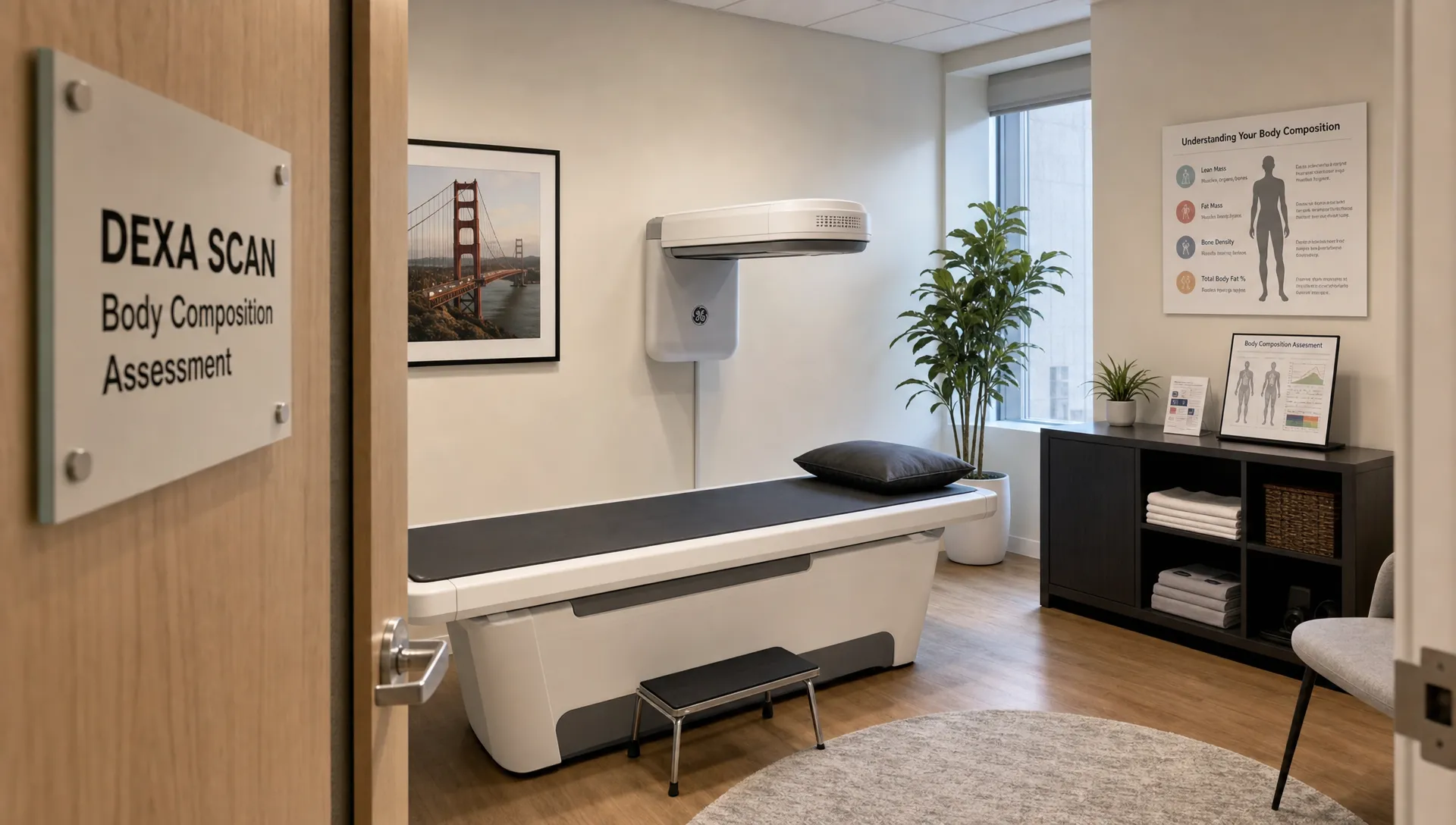
Compare provider types in San Francisco
San Francisco and the broader Bay Area offer several ways to access body composition or bone-related testing. The right choice depends on whether you want medical diagnostics, fitness-focused body composition data, or convenient progress tracking.
| Provider type | Best for | Strengths | What to check before booking |
|---|---|---|---|
| Body composition DEXA clinic | Fat, muscle, visceral fat, and progress tracking | Fitness-focused reports, practical interpretation, repeat scans | Confirm the scan includes the metrics you care about and expert review |
| Medical imaging center | Physician-ordered bone density testing | Medical workflow, insurance pathways, diagnostic reporting | Ask whether full body composition is included, since many medical scans focus on bone density |
| Gym or wellness center using non-DEXA devices | Quick informal estimates | Convenient and often inexpensive | Confirm whether it is true DEXA or another method such as bioelectrical impedance |
| Mobile or event-based testing | One-time convenience | Can be accessible for teams or groups | Ask about equipment, calibration, privacy, and how results are explained |
The biggest mistake is assuming all “body scans” are equivalent. They are not. If a provider does not clearly state what technology is being used and what measurements you will receive, ask before you book.
Consider convenience, but do not let it be the only factor
Location matters in San Francisco. A scan that requires complicated parking, a long Muni transfer, or an inconvenient appointment window may make it harder to retest consistently.
Still, the closest provider is not always the best provider. A slightly more convenient location may not be worth it if the report is limited, the staff cannot explain your results, or the process is not designed for repeatable tracking.
When comparing options, consider:
- Appointment availability and how far in advance you need to book
- Total appointment time, including check-in and result review
- Transit access, parking, and neighborhood convenience
- Whether the provider supports repeat scans over time
- How quickly you receive your results
- Whether pricing is transparent before you book
For many people, the best provider is the one they can return to every few months under similar conditions. That makes your trend data more useful than a one-off scan from whichever location was easiest that week.
Review pricing in context
DEXA scan pricing in San Francisco can vary depending on what is included. A basic scan may cost less than a scan with interpretation, metabolic insights, or nutrition guidance, but the cheaper option is not always the better value.
Before booking, ask what the price includes. Does it include a full body composition report? Does someone explain the results? Are visceral fat, lean mass, and asymmetry included? Are there packages for repeat scans if you are tracking a transformation or training cycle?
If cost is a major part of your decision, DEXA SF has a separate quick guide to DEXA scan cost in San Francisco that explains what can influence pricing and how to compare options more fairly.
Ask these questions before you schedule
A few minutes of research can save you from booking the wrong kind of scan. Use these questions when comparing DEXA providers in San Francisco:
- Do you offer a true DEXA body composition scan?
- What metrics are included in the report?
- Will I receive visceral fat and regional lean mass data?
- Do you provide left-versus-right asymmetry information?
- Who explains the results, and what qualifications or experience do they have?
- How should I prepare before the scan?
- How long does the appointment take?
- When will I receive my results?
- Can I compare future scans against my baseline?
- Is this scan intended for wellness and fitness tracking, medical diagnosis, or both?
The final question is important. A body composition scan can be extremely useful for fitness and wellness decisions, but if you have a medical concern, you should involve your healthcare provider.
Watch for red flags
Most providers are reputable, but some experiences are less useful than others. Be cautious if a provider is vague about the technology, cannot explain what is included, or makes dramatic promises about what one scan can do.
Red flags include:
- The provider uses “DEXA” loosely but does not clearly confirm a DEXA scanner
- Results are delivered without explanation or context
- Staff cannot answer basic questions about preparation or repeat testing
- The report only gives a body fat percentage with little additional detail
- There is no clear safety screening process
- The provider promises guaranteed fat loss, muscle gain, or medical outcomes from the scan itself
A DEXA scan is a measurement tool. It can guide better decisions, but it does not replace training, nutrition, medical care, or professional judgment.
Make sure the provider fits your next step
The best DEXA provider is not just accurate, it is actionable. After your scan, you should understand what to do next.
For example, if your goal is fat loss, you may want to know whether your weight change is coming mostly from fat mass or lean mass. If your goal is strength, you may care more about lean mass distribution and asymmetry. If your goal is metabolic health, visceral fat may be one of the most important numbers to track. If your goal is long-term health, bone-related metrics can help you know what to discuss with a qualified medical professional.
This is where a provider that combines precise measurement with expert interpretation can be more valuable than a provider that simply hands you a report.
Where DEXA SF fits into the decision
If you are looking for a DEXA scan provider in San Francisco focused on body composition, DEXA SF offers professional scans that measure body fat, lean mass, bone density, visceral fat, asymmetries, and metabolic data. Clients also receive interpretation and personalized fitness and nutrition guidance from qualified experts.
That combination is helpful for people who want more than a number. It is designed for people who want to understand what their results mean and how to use them for smarter training, nutrition, and health decisions.
If you are still comparing options, you can also review DEXA SF’s article on how its DEXA scan experience compares with other Bay Area options for a provider-focused perspective.
A simple decision framework
If you are choosing between several San Francisco DEXA scan options, use this framework.
Choose a medical imaging provider if your scan is physician-ordered, insurance-based, or primarily related to diagnosing or monitoring a medical condition.
Choose a body composition DEXA provider if your main goals are fat loss, muscle gain, visceral fat tracking, performance, or a more precise baseline than a scale can provide.
Choose the provider you can revisit consistently if you plan to track progress over time. Repeatability often matters more than saving a few minutes on the first appointment.
Choose the provider that explains your results clearly. The most accurate data is only useful if you know how to act on it.
Frequently Asked Questions
Is a DEXA scan provider the same as a bone density testing center? Not always. Some centers focus on medical bone density testing, while others specialize in full body composition scans for fat, muscle, visceral fat, and performance tracking. Ask what type of scan is offered before booking.
What should I look for in a DEXA scan report? Look for more than body fat percentage. A useful report should include lean mass, fat mass, regional distribution, visceral fat, bone-related measurements, and ideally left-versus-right asymmetry.
How often should I get a DEXA scan? It depends on your goal. Many people tracking fat loss, muscle gain, or athletic performance rescan every few months, while medical bone density testing follows a schedule determined by a clinician. Try to scan under similar conditions each time.
Is a DEXA scan safe? DEXA uses low-dose X-ray technology. It is commonly used for bone density testing, but you should always follow the provider’s safety screening instructions and tell them if you are pregnant or may be pregnant.
Should I choose the closest DEXA scan near me? Convenience matters, especially for repeat scans, but it should not be the only factor. Compare the technology, report quality, interpretation, pricing, and whether the provider is aligned with your goals.
Ready to choose a DEXA scan provider in San Francisco?
A good DEXA scan should give you accurate data, clear interpretation, and a practical path forward. If you want a precise body composition scan in San Francisco with expert guidance on what your results mean, schedule with DEXA SF and get a clearer baseline for your next health, fitness, or performance goal.